Thryomanes bewickii leucophrys
San Clemente Bewick's Wren
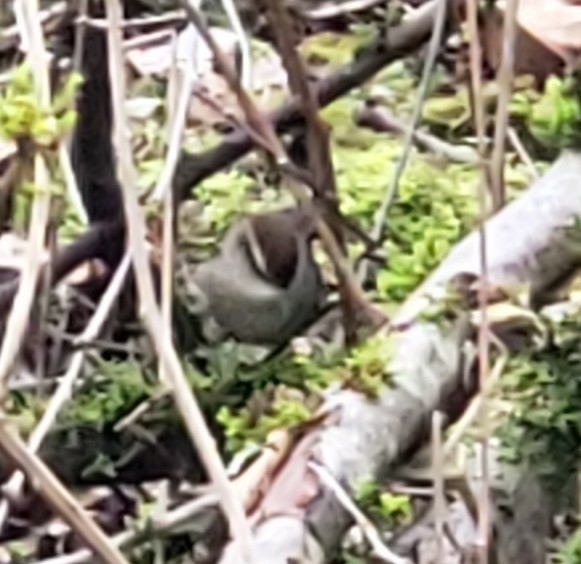
(c) Gavin Slater, some rights reserved (CC BY) · licence
Family: Troglodytidae · Class: Aves · Order: Passeriformes
Conservation status: G5TX SX
Thryomanes bewickii leucophrys (San Clemente Bewick's Wren) is a California animal in the Troglodytidae family.
The San Clemente Bewick's Wren (Thryomanes bewickii leucophrys) was a subspecies of Bewick's Wren endemic to San Clemente Island, California. This small passerine measured approximately 13 centimeters (5.1 inches) in length and weighed 8-12 grams (0.3-0.4 ounces). The subspecies exhibited the typical Bewick's Wren characteristics of grayish-brown upperparts and pale underparts, with a distinctive white eyebrow stripe and long, slightly curved bill adapted for gleaning insects from vegetation crevices. Historically, the San Clemente Bewick's Wren was restricted entirely to San Clemente Island, the southernmost of California's Channel Islands, located approximately 100 kilometers (62 miles) west of San Diego. The island encompasses roughly 145 square kilometers (56 square miles) and rises to 599 meters (1,965 feet) elevation. This subspecies represented one of several island-endemic Bewick's Wren populations that evolved in isolation on the Channel Islands. The subspecies inhabited the island's native shrubland communities, particularly areas dominated by coastal sage scrub vegetation. These habitats included stands of California sagebrush (Artemisia californica), island cherry (Prunus ilicifolia ssp. lyonii), and other endemic island shrubs. The birds preferred dense, low-growing vegetation that provided both nesting sites and foraging opportunities, typically occurring from sea level to the island's higher elevations. Like other Bewick's Wrens, this subspecies was primarily insectivorous, foraging actively through shrub layers for spiders, beetles, caterpillars, and other arthropods. The birds were known for their energetic foraging behavior, often cocking their tails upward while searching vegetation. Breeding likely occurred from March through July, with pairs constructing cup-shaped nests in shrub cavities or dense vegetation. Typical clutch size for the species ranges from 3-8 eggs, with incubation lasting approximately 14 days. The San Clemente Bewick's Wren is now extinct, with the last confirmed sighting occurring in 1941 (Birds of the World). The subspecies' decline and ultimate extinction resulted primarily from habitat destruction caused by introduced ungulates, particularly feral goats and pigs that severely degraded the island's native vegetation communities over many decades. The Global/State Rank of G5TX SX reflects this extinction status, indicating the subspecies is extinct (X) and was historically found in California (S), while the species as a whole (G5T) remains secure globally. Despite extensive habitat restoration efforts on San Clemente Island following the removal of introduced ungulates, the San Clemente Bewick's Wren population could not be recovered. This extinction represents one of several documented bird subspecies losses from California's Channel Islands, highlighting the vulnerability of isolated island populations to anthropogenic habitat modification and the introduction of non-native species.
Classification
Class: Aves · Order: Passeriformes · Family: Troglodytidae
Conservation status
G5TX SX
Frequently asked questions
How is Thryomanes bewickii leucophrys classified?
Thryomanes bewickii leucophrys belongs to class Aves, order Passeriformes, family Troglodytidae.
What family does Thryomanes bewickii leucophrys belong to?
Thryomanes bewickii leucophrys is in the Troglodytidae family.
Is Thryomanes bewickii leucophrys protected or of conservation concern?
Thryomanes bewickii leucophrys carries the following status: G5TX SX.
What is Thryomanes bewickii leucophrys?
The San Clemente Bewick's Wren (Thryomanes bewickii leucophrys) was a subspecies of Bewick's Wren endemic to San Clemente Island, California.
Is Thryomanes bewickii leucophrys found in California?
Yes. Thryomanes bewickii leucophrys is recorded in California in The California Species Project's catalogue.
Related species
Other California species in the same genus, family, or bioregion.
Data from The California Species Project — 14,000+ California species with verified data from CNPS, CDFW, USFWS, and more.