Thyanta pallidovirens
Red-shouldered Stink Bug
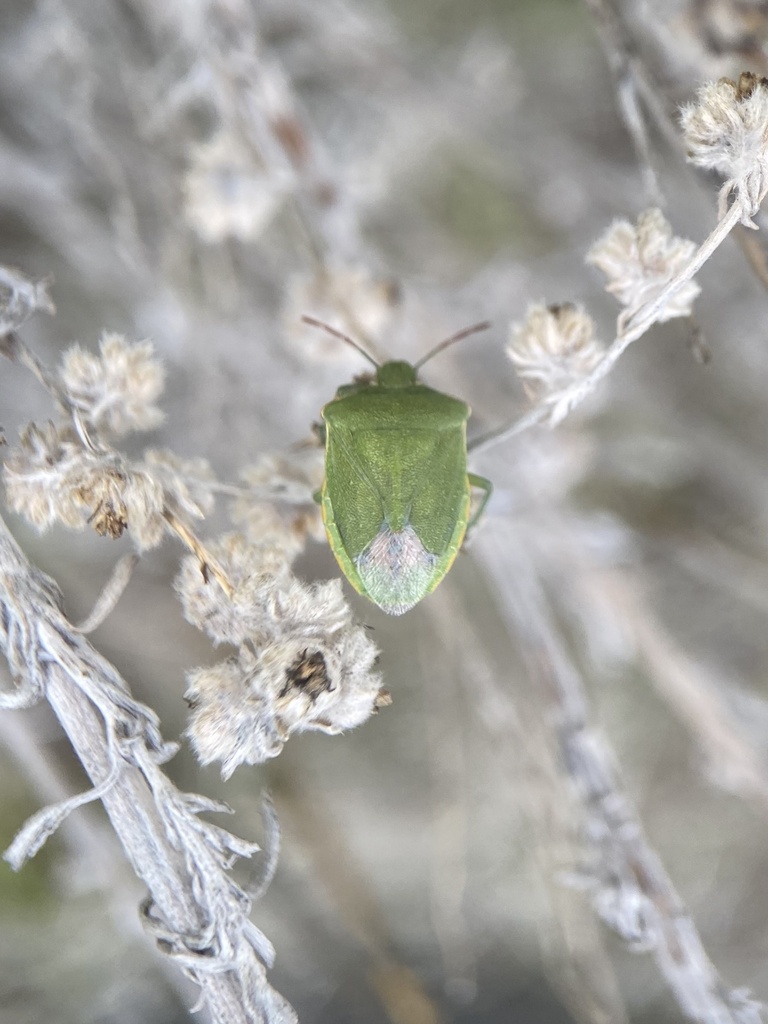
(c) Z, some rights reserved (CC BY) · licence
Family: Pentatomidae · Class: Insecta · Order: Hemiptera
Thyanta pallidovirens (Red-shouldered Stink Bug) is a California animal in the Pentatomidae family.
The red-shouldered stink bug is a medium-sized shield bug measuring 9 to 14 millimeters (0.35 to 0.55 inches) in length. The species displays considerable color variation, with green forms predominating during the active season and brown overwintering forms common in fall and winter. The distinctive feature that gives this species its common name is the reddish coloration on the lateral margins of the pronotum, though this marking can vary in intensity. The body is broadly oval with the characteristic pentagonal shape of stink bugs, and like other members of the family Pentatomidae, it possesses scent glands that produce defensive chemicals when disturbed. Thyanta pallidovirens occurs across western North America, with documented populations extending from British Columbia south to California and east to the Great Plains (BugGuide). In California, the species has been recorded from coastal areas to inland valleys, including documented populations in the Ballona Wetlands area of Los Angeles County (Nagano et al. 1981). The species' range overlaps with several closely related Thyanta species, making field identification challenging without close examination. This polyphagous species inhabits diverse plant communities, from salt marshes to agricultural areas and urban environments. The red-shouldered stink bug has been recorded feeding on dozens of plant species across 14 different plant families (BugGuide). It occurs in both natural vegetation and cultivated areas, where it may occasionally reach pest status on certain crops. The species shows adaptability to various elevation ranges and moisture conditions, from coastal wetlands to drier inland habitats. The red-shouldered stink bug is a true bug that feeds by piercing plant tissues with its needle-like mouthparts and consuming plant juices. Adults and nymphs feed on seeds, fruits, and tender plant tissues of their host plants. The species overwinters as adults, which accounts for the color dimorphism observed between seasons. Mating and egg-laying occur in spring and early summer, with females depositing clusters of barrel-shaped eggs on host plant foliage. The species completes multiple generations per year in favorable conditions, with peak adult activity occurring during warm months. Currently, Thyanta pallidovirens has no formal conservation status designation at federal or state levels. The species appears to maintain stable populations across its range and shows adaptability to human-modified landscapes. Its broad host plant range and tolerance for diverse habitats suggest resilience to environmental changes. However, like many native insects, populations may face localized pressures from habitat conversion, pesticide applications in agricultural areas, and competition from introduced species. The taxonomic complexity within the genus Thyanta, including subspecific variations, presents ongoing challenges for accurate population assessment and conservation planning.
Classification
Class: Insecta · Order: Hemiptera · Family: Pentatomidae
Frequently asked questions
How is Thyanta pallidovirens classified?
Thyanta pallidovirens belongs to class Insecta, order Hemiptera, family Pentatomidae.
What family does Thyanta pallidovirens belong to?
Thyanta pallidovirens is in the Pentatomidae family.
What is Thyanta pallidovirens?
The red-shouldered stink bug is a medium-sized shield bug measuring 9 to 14 millimeters (0.35 to 0.55 inches) in length.
Is Thyanta pallidovirens found in California?
Yes. Thyanta pallidovirens is recorded in California in The California Species Project's catalogue.
Related species
Other California species in the same genus, family, or bioregion.
Data from The California Species Project — 14,000+ California species with verified data from CNPS, CDFW, USFWS, and more.