Tiaroga cobitis
Loach minnow
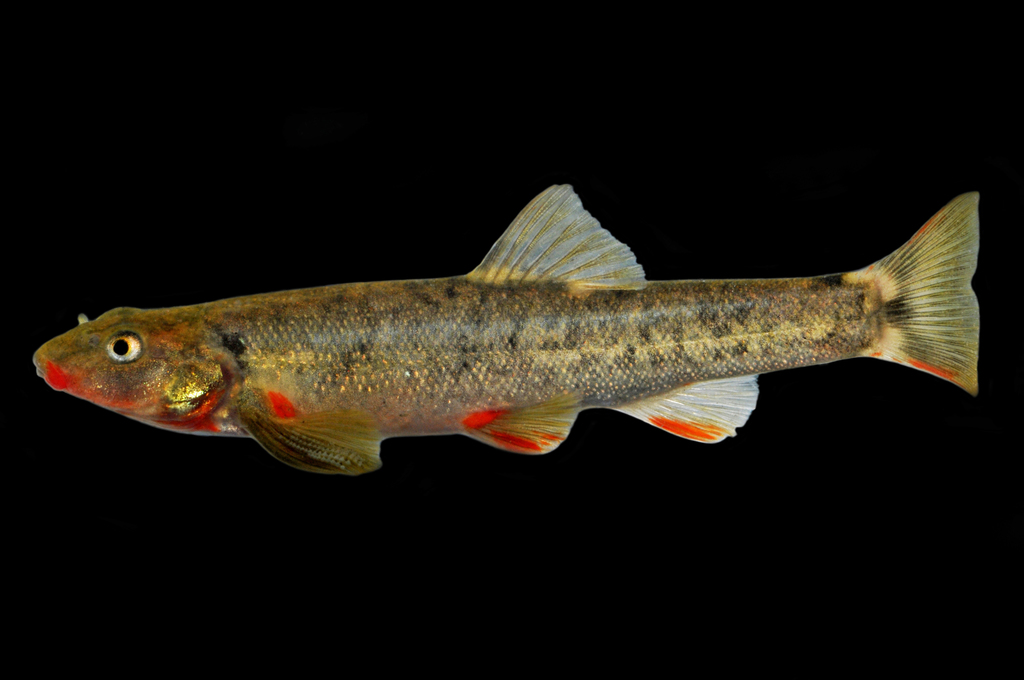
(c) Tom Kennedy, some rights reserved (CC BY) · licence
Family: Cyprinidae · Class: Unknown · Order: Unknown
Conservation status: Endangered
Tiaroga cobitis (Loach minnow) is a California animal in the Cyprinidae family.
The loach minnow is a small freshwater fish in the minnow family Cyprinidae with an elongated body that is flattened ventrally. Adults typically measure 60 to 90 millimeters (2.4 to 3.5 inches) in total length. The species has eight rays in the dorsal fin and seven in the anal fin, with approximately 65 scales along the lateral line. Coloration consists of an olivaceous background with numerous dark blotches and spots. Whitish spots occur at the origin and insertion of the dorsal fin and at the dorsal and ventral portions of the caudal fin base. A distinctive black basicaudal spot is usually present. Breeding males develop bright red-orange coloration. The species was originally classified as Rhinichthys cobitis by Charles Girard in 1856, but taxonomic revision in 2017 reclassified it as Tiaroga cobitis based on morphological and genetic data. Loach minnow are endemic to the Gila River basin in Arizona and New Mexico. Historically distributed throughout much of the Gila River system, the species now occupies approximately 15 to 20 percent of its original range. Current populations are restricted to portions of the Gila River and its tributaries including the West, Middle, and East Fork Gila River in Grant, Catron, and Hidalgo Counties, New Mexico, as well as segments of the Verde River, Salt River, San Pedro River, Bonita Creek, Eagle Creek, San Francisco River, and Blue River systems in Arizona. The species inhabits flowing streams and small rivers with rocky substrates, particularly areas with pools and runs containing gravel and cobble bottoms. Loach minnow prefer clear, well-oxygenated water with moderate current velocities. They are typically found in association with aquatic vegetation and may utilize areas where filamentous algae are present. The species requires streams with natural flow regimes that allow periodic flooding and adequate sediment transport to maintain spawning habitat in gravel interstices. Loach minnow feed exclusively on aquatic insects, making them specialized insectivores. Their flattened ventral body shape is adapted for bottom-feeding behavior in flowing water. Spawning occurs in gravel substrates where eggs are deposited in interstitial spaces between rocks. The species exhibits seasonal movement patterns related to spawning and feeding requirements. The U.S. Fish and Wildlife Service listed the loach minnow as endangered under the Endangered Species Act. Critical habitat was designated on February 23, 2012, encompassing eight units based on river subbasins throughout Arizona and New Mexico. Primary threats include habitat modification from water diversions and impoundments, competition and predation from nonnative fish species, water quality degradation, and habitat destruction from wildfire effects. Recent large wildfires have impacted several river systems containing loach minnow habitat, with ash and debris flows potentially suffocating fish and filling spawning gravels. Climate change poses additional threats through altered precipitation patterns and increased fire frequency. Conservation efforts focus on habitat restoration, nonnative species control, and maintaining adequate stream flows in occupied watersheds.
Classification
Class: Unknown · Order: Unknown · Family: Cyprinidae
Conservation status
Endangered
Frequently asked questions
How is Tiaroga cobitis classified?
Tiaroga cobitis belongs to class Unknown, order Unknown, family Cyprinidae.
What family does Tiaroga cobitis belong to?
Tiaroga cobitis is in the Cyprinidae family.
Is Tiaroga cobitis protected or of conservation concern?
Tiaroga cobitis carries the following status: Endangered.
What is Tiaroga cobitis?
The loach minnow is a small freshwater fish in the minnow family Cyprinidae with an elongated body that is flattened ventrally.
Is Tiaroga cobitis found in California?
Yes. Tiaroga cobitis is recorded in California in The California Species Project's catalogue.
Related species
Other California species in the same genus, family, or bioregion.
Data from The California Species Project — 14,000+ California species with verified data from CNPS, CDFW, USFWS, and more.