Tilapia zilli
Redbelly tilapia
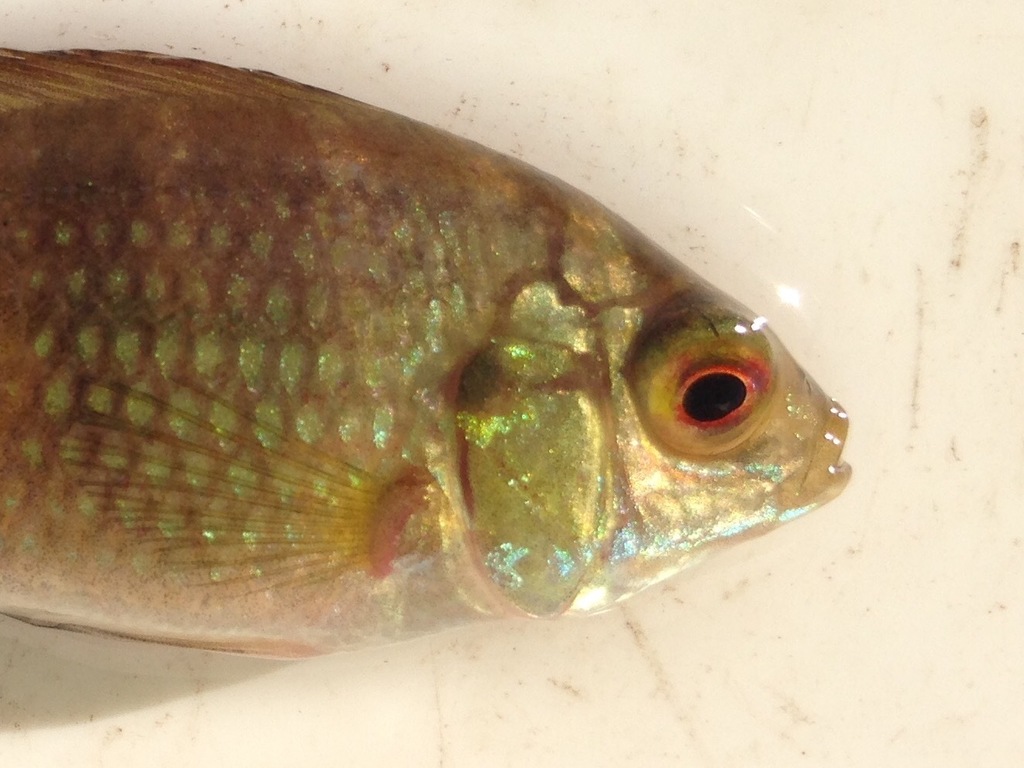
(c) Wilderness Safaris Botswana - Conservation Team, some rights reserved (CC BY) · licence
Family: Cichlidae · Class: Teleostei · Order: Perciformes
Tilapia zilli (Redbelly tilapia) is a California animal in the Cichlidae family.
The redbelly tilapia (Tilapia zilli) is a medium-sized freshwater cichlid native to Africa and the Middle East. Adult fish typically measure 20 to 30 centimeters (8 to 12 inches) in total length, though individuals can reach up to 40 centimeters (16 inches). The body is laterally compressed and deep, characteristic of the cichlid family. The species displays sexual dimorphism, with breeding males developing a distinctive reddish coloration on the belly and lower portions of the body, giving the species its common name. Females and non-breeding males are generally olive-green to gray with darker vertical bars along the sides. The dorsal fin is continuous with both spiny and soft-rayed portions, and the anal fin has three spines followed by soft rays. Naturally distributed across West and North Africa, including the Nile River system, and extending into the Middle East, redbelly tilapia has been widely introduced outside its native range for aquaculture purposes. In California, established populations occur in several water bodies, including the Salton Sea, various irrigation canals in the Imperial Valley, and warm-water habitats in Southern California. The species has also been reported from geothermal springs and artificially heated waters throughout the southwestern United States. Redbelly tilapia inhabits warm freshwater environments, preferring water temperatures above 20°C (68°F) and tolerating temperatures up to 42°C (108°F). The species demonstrates high tolerance for varying water quality conditions, including high salinity, low dissolved oxygen, and elevated ammonia levels. In California, populations are typically found in shallow, vegetated areas of lakes, ponds, canals, and slow-moving rivers. The species thrives in eutrophic waters with abundant organic matter and can survive in waters with salinity levels approaching those of seawater. Redbelly tilapia are omnivorous, feeding on algae, aquatic plants, detritus, small invertebrates, and organic debris. Their feeding behavior includes both grazing and filter-feeding activities. The species exhibits complex reproductive behavior typical of cichlids, with males establishing territories and constructing circular nests in sandy or muddy substrates. Females deposit 200 to 2,000 eggs, which are fertilized by the male and subsequently mouth-brooded by the female for 10 to 14 days. Juveniles remain near the female for several weeks after hatching, seeking refuge in her mouth when threatened. The species can reproduce year-round in suitable conditions, with multiple spawning events per year. As a non-native species in California, redbelly tilapia is not afforded conservation protection and is generally considered an introduced species that may compete with native fish communities. The species' high reproductive rate, broad environmental tolerance, and aggressive territorial behavior can impact native aquatic ecosystems. Management efforts typically focus on preventing further spread rather than conservation, as established populations can alter habitat structure and compete with native species for resources and spawning sites.
Classification
Class: Teleostei · Order: Perciformes · Family: Cichlidae
Frequently asked questions
How is Tilapia zilli classified?
Tilapia zilli belongs to class Teleostei, order Perciformes, family Cichlidae.
What family does Tilapia zilli belong to?
Tilapia zilli is in the Cichlidae family.
What is Tilapia zilli?
The redbelly tilapia (Tilapia zilli) is a medium-sized freshwater cichlid native to Africa and the Middle East.
Is Tilapia zilli found in California?
Yes. Tilapia zilli is recorded in California in The California Species Project's catalogue.
Related species
Other California species in the same genus, family, or bioregion.
Data from The California Species Project — 14,000+ California species with verified data from CNPS, CDFW, USFWS, and more.