Timema californicum
California Timema
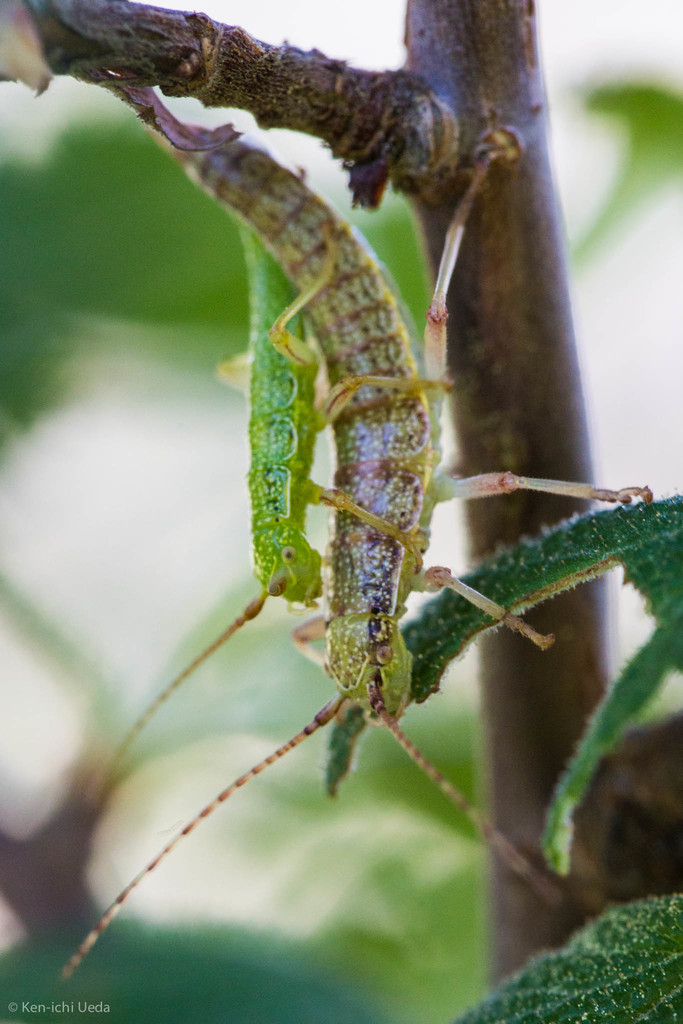
(c) Ken-ichi Ueda, some rights reserved (CC BY) · licence
Family: Timematidae · Class: Insecta · Order: Phasmida
Timema californicum (California Timema) is a California animal in the Timematidae family.
The California timema (Timema californicum) is a small walkingstick insect endemic to California's chaparral regions. Adults measure approximately 20 mm (0.8 inches) in length, with females typically larger than males. The body is cylindrical and elongated, lacking wings in both sexes. Coloration ranges from green to brown, providing effective camouflage among host vegetation. Unlike many walkingstick species, California timema lack distinct striping patterns and have relatively bulging eyes compared to other Timema species. This species occurs in the Coast Ranges and foothills of central and northern California. BugGuide records document populations from Mt. Diablo State Park in Contra Costa County and San Mateo County, with observations extending through the chaparral zones of the region. The distribution appears patchy, corresponding to suitable chaparral habitat throughout the coastal mountain ranges. California timema inhabit chaparral communities dominated by sclerophyllous shrubs. According to BugGuide observations, the species has been found specifically associated with manzanita (Arctostaphylos species) at elevations around 2,500 feet (762 meters). The thick, drought-adapted chaparral vegetation provides both food resources and protective cover. Individuals are typically found on their host plants during daylight hours, where their cryptic coloration renders them nearly invisible. As herbivorous insects, California timema feed primarily on the leaves and young growth of chaparral shrubs, particularly manzanita species. Like other members of the genus Timema, this species likely exhibits seasonal activity patterns aligned with host plant phenology. Reproduction occurs through sexual reproduction, distinguishing it from some parthenogenetic Timema species found elsewhere in California. Adults are most active during spring and early summer months when host plants produce new growth. The California timema currently holds no federal or state conservation listing status. However, like many chaparral-dependent species, it faces potential threats from habitat fragmentation due to urban development in coastal California. Wildfire management practices that alter natural fire cycles in chaparral communities may also impact population dynamics. Climate change poses additional concerns, as shifting precipitation patterns and increased temperatures could affect both the species and its host plants. The species' apparently patchy distribution suggests populations may be vulnerable to local extirpations from habitat disturbance. Detailed ecological studies of this species remain limited compared to other California insects. The specialized relationship with chaparral vegetation and specific host plant associations warrant further research to better understand population trends and habitat requirements. Conservation of intact chaparral ecosystems throughout the Coast Ranges will be essential for maintaining viable populations of this endemic walkingstick species.
Classification
Class: Insecta · Order: Phasmida · Family: Timematidae
Frequently asked questions
How is Timema californicum classified?
Timema californicum belongs to class Insecta, order Phasmida, family Timematidae.
What family does Timema californicum belong to?
Timema californicum is in the Timematidae family.
What is Timema californicum?
The California timema (Timema californicum) is a small walkingstick insect endemic to California's chaparral regions.
Is Timema californicum found in California?
Yes. Timema californicum is recorded in California in The California Species Project's catalogue.
More California species
This species has no close relatives in our California data — here are other species to explore.
Data from The California Species Project — 14,000+ California species with verified data from CNPS, CDFW, USFWS, and more.