Tivela stultorum
Pismo Clam
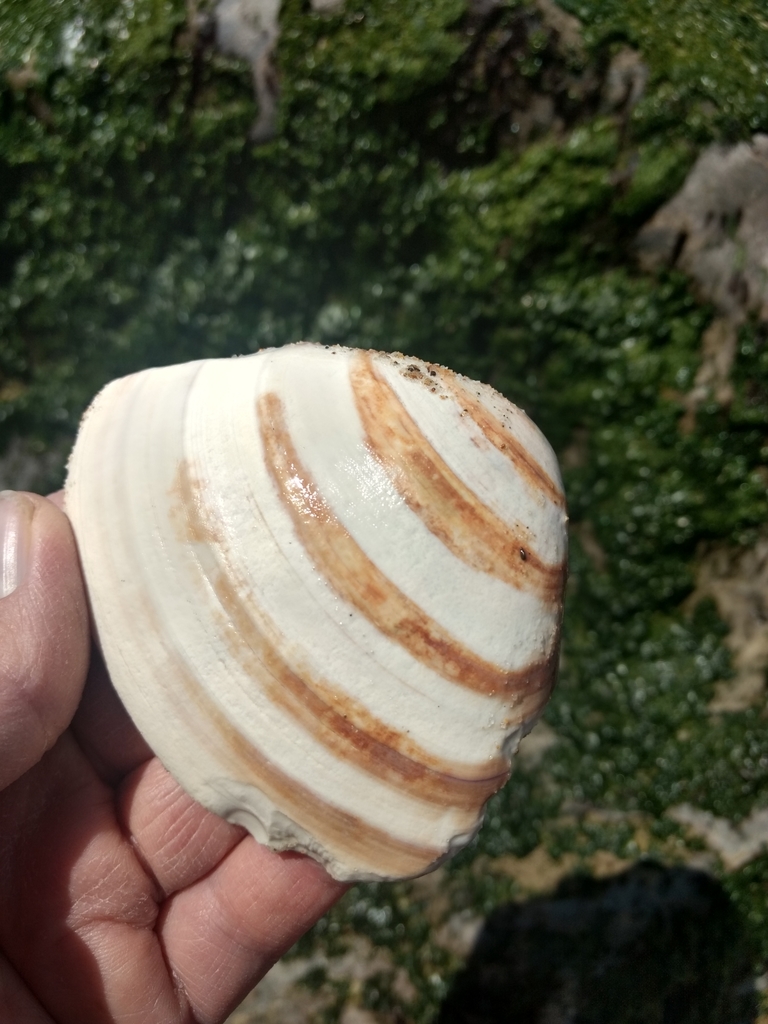
(c) Michele Jones, some rights reserved (CC BY) · licence
Family: Veneridae · Class: Bivalvia · Order: Veneroida
Tivela stultorum (Pismo Clam) is a California animal in the Veneridae family.
The Pismo clam is a large bivalve mollusk with a native range extending from Stinson Beach, California south to Bahía Magdalena, Baja California Sur, Mexico (Coan et al. 2000). Adults can exceed 180 mm (7.1 inches) in length and live for several decades (Fitch 1950). The shell is thick-walled and typically triangular to oval in shape, with a smooth exterior surface that ranges from tan to purple-brown coloration. Growth ring analysis indicates that Pismo clams reach the legal harvest size of 114 mm (4.5 inches) between 9 and 15 years of age, with growth rates influenced by water temperature, food availability, and environmental conditions. Currently in California, Pismo clam populations are documented from Monterey Bay south to San Diego, including the northern Channel Islands. Recent surveys indicate some of the highest clam densities in the state occur at San Diego beaches, which represent the southern extent of California populations. The species has experienced significant range contraction from its historical northern limit, no longer occurring in substantial numbers north of Monterey Bay. Pismo clams inhabit exposed, gently sloping intertidal and subtidal sandy beach habitats, as well as entrances to sandy bays and estuaries (Shaw and Hassler 1989). They typically burrow to depths of 5-15 cm in fine to medium-grained sand substrates (Armstrong 1965). The species shows preference for areas with moderate wave action that provides adequate water circulation and food delivery while avoiding excessive sediment disturbance. As filter feeders, Pismo clams consume phytoplankton and organic particles suspended in the water column. They are important prey species for sea otters, particularly along exposed coastlines with soft sediments where they represent a common food source (Stephenson 1977). The species serves as a significant component of sandy beach ecosystems and supports both recreational and subsistence fisheries. Pismo clam populations have declined substantially from historical levels throughout their California range. A 2022 study documented bed densities typically lower than those reported in the 1990s, though recruitment events can cause local population fluctuations (California Fish and Wildlife Scientific Journal). Current population densities range from 3 to 107 clams per meter of shoreline across study sites in Orange and San Diego counties. Length distributions show predominantly juvenile populations, with mean sizes of 16-17 mm in recent surveys, indicating ongoing recruitment but suggesting population stress. The California Department of Fish and Wildlife has established Pismo Clam Preserve areas, including sections of Morro Strand State Beach, to protect critical habitat. Ongoing research by California Polytechnic State University includes mark-recapture studies, habitat evaluation, predation impact assessment, and population monitoring to support conservation efforts. Primary threats include overharvesting, habitat degradation, climate change effects on ocean conditions, and predation pressure from recovering sea otter populations.
Classification
Class: Bivalvia · Order: Veneroida · Family: Veneridae
Frequently asked questions
How is Tivela stultorum classified?
Tivela stultorum belongs to class Bivalvia, order Veneroida, family Veneridae.
What family does Tivela stultorum belong to?
Tivela stultorum is in the Veneridae family.
What is Tivela stultorum?
The Pismo clam is a large bivalve mollusk with a native range extending from Stinson Beach, California south to Bahía Magdalena, Baja California Sur, Mexico (Coan et al.
Is Tivela stultorum found in California?
Yes. Tivela stultorum is recorded in California in The California Species Project's catalogue.
Related species
Other California species in the same genus, family, or bioregion.
Data from The California Species Project — 14,000+ California species with verified data from CNPS, CDFW, USFWS, and more.