Toxostoma bendirei
Bendire's Thrasher
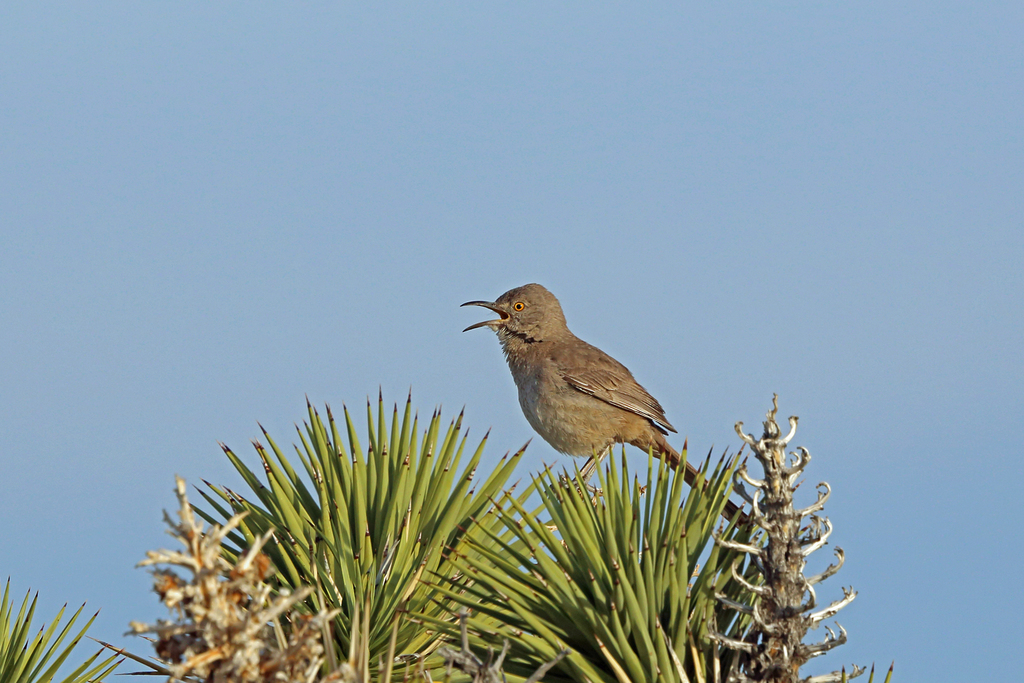
(c) Nigel Voaden, some rights reserved (CC BY) · licence
Family: Mimidae · Class: Aves · Order: Passeriformes
Conservation status: G4 S2
Toxostoma bendirei (Bendire's Thrasher) is a California animal in the Mimidae family.
Bendire's Thrasher is a medium-sized songbird measuring 23 to 28 centimeters (9 to 11 inches) in length with a wingspan of 33 to 36 centimeters (13 to 14 inches). The species displays grayish-brown upperparts with a pale buff to whitish breast marked by distinct triangular or arrowhead-shaped spots. The bill is relatively short and slightly curved compared to other thrasher species, with a dark upper mandible and pale lower mandible. The tail is long and rounded, and the legs are dark gray to black. Adults show pale yellow to orange eyes, distinguishing them from the similar Curve-billed Thrasher. Bendire's Thrasher has a limited range in California, occurring primarily in the southeastern desert regions including the Mojave and Sonoran deserts. The species is found in Inyo, Kern, San Bernardino, Riverside, and Imperial counties. Historically, the California population was more widespread, but current breeding range has contracted significantly. The species also occurs in Arizona, Nevada, New Mexico, and northwestern Mexico. The species inhabits arid desert scrubland and semi-desert areas at elevations from sea level to approximately 1,200 meters (4,000 feet). Preferred habitat includes areas dominated by cholla cactus, palo verde, ironwood, and desert broom. Bendire's Thrashers require dense shrub cover for nesting and foraging, typically selecting areas with 25 to 50 percent shrub canopy coverage. The species shows particular association with cholla cactus forests and mixed desert scrub communities. Bendire's Thrasher is primarily insectivorous, foraging on the ground by using its bill to dig through leaf litter and soil. The diet consists mainly of beetles, ants, grasshoppers, and other arthropods, supplemented with fruits and seeds, particularly cactus fruits during late summer. Breeding occurs from March through July, with peak nesting activity in April and May. Pairs construct cup-shaped nests in dense shrubs or cholla cacti, typically 1 to 3 meters above ground. Females lay 2 to 4 pale blue-green eggs with brown spotting. The species is generally monogamous and territorial during breeding season, with males performing elaborate song displays from prominent perches. Bendire's Thrasher is not federally listed but is considered a Species of Special Concern by the California Department of Fish and Wildlife due to declining populations and habitat loss. The species has experienced significant population declines in California, with breeding bird survey data indicating decreases of approximately 2.5 percent annually since 1968. Primary threats include habitat destruction from urban development, agricultural conversion, and renewable energy projects in desert areas. Invasive plant species, particularly non-native grasses, alter fire regimes and degrade suitable habitat. Climate change poses additional challenges through increased drought frequency and temperature extremes. Conservation efforts focus on habitat protection within existing protected areas and management of invasive species. The species' limited California range and specialized habitat requirements make it particularly vulnerable to continued population decline without active conservation measures.
Classification
Class: Aves · Order: Passeriformes · Family: Mimidae
Conservation status
G4 S2
Frequently asked questions
How is Toxostoma bendirei classified?
Toxostoma bendirei belongs to class Aves, order Passeriformes, family Mimidae.
What family does Toxostoma bendirei belong to?
Toxostoma bendirei is in the Mimidae family.
Is Toxostoma bendirei protected or of conservation concern?
Toxostoma bendirei carries the following status: G4 S2.
What is Toxostoma bendirei?
Bendire's Thrasher is a medium-sized songbird measuring 23 to 28 centimeters (9 to 11 inches) in length with a wingspan of 33 to 36 centimeters (13 to 14 inches).
Is Toxostoma bendirei found in California?
Yes. Toxostoma bendirei is recorded in California in The California Species Project's catalogue.
Related species
Other California species in the same genus, family, or bioregion.
Data from The California Species Project — 14,000+ California species with verified data from CNPS, CDFW, USFWS, and more.