Toxostoma crissale
Crissal Thrasher
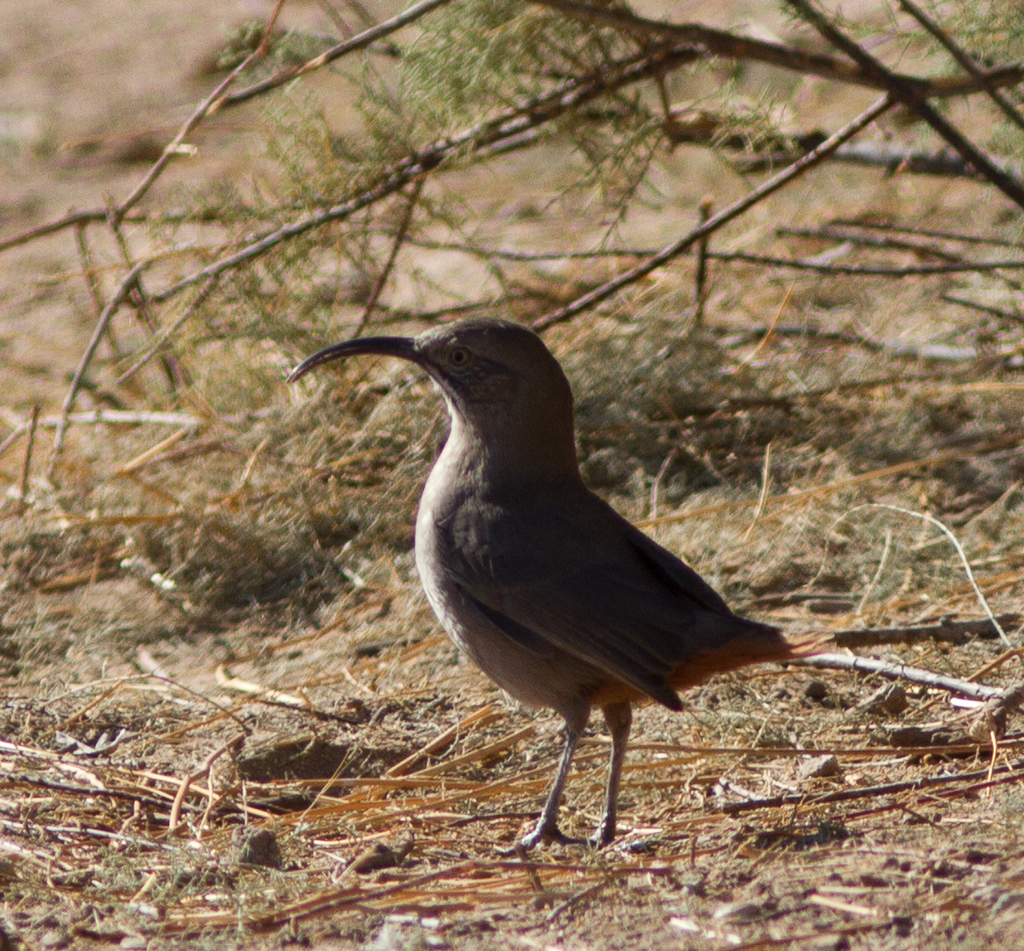
(c) Adam J. Searcy, some rights reserved (CC BY) · licence
Family: Mimidae · Class: Aves · Order: Passeriformes
Conservation status: G5 S2
Toxostoma crissale (Crissal Thrasher) is a California animal in the Mimidae family.
The Crissal Thrasher is a large, ground-dwelling songbird measuring 27 to 32 cm (10.6 to 12.6 inches) in length with a wingspan of 33 to 37 cm (13 to 14.6 inches). Adults weigh 63 to 85 grams (2.2 to 3.0 ounces). The species exhibits plain grayish-brown upperparts with a slight rufous tinge on the wings and tail. The underparts are grayish-white to pale buff, lacking the heavy spotting characteristic of many other thrasher species. The most distinctive feature is the deep rufous or chestnut-colored undertail coverts (crissum) that give the species its common name. The bill is long, dark, and slightly decurved, adapted for probing soil and leaf litter. The tail is notably long and graduated, and the legs are sturdy and well-developed for terrestrial foraging. The Crissal Thrasher ranges from southeastern California through southern Nevada, Arizona, southwestern New Mexico, and northwestern Mexico in Sonora and Baja California. In California, the species occurs primarily in the southeastern desert regions, including the Sonoran and Mojave Desert transition zones. Populations are found in Riverside, Imperial, and San Bernardino counties, with scattered records from Kern and Inyo counties. The California range represents the northwestern extent of the species' distribution. This species inhabits dense riparian thickets, desert washes, and scrubland areas dominated by mesquite, catclaw acacia, palo verde, and desert willow. Crissal Thrashers show strong preference for areas with dense understory vegetation and occur from sea level to approximately 1,220 meters (4,000 feet) elevation. They require territories with both dense cover for nesting and adjacent open areas for foraging. The species is closely associated with desert riparian corridors and relies on permanent or intermittent water sources. Crissal Thrashers are secretive, ground-foraging birds that use their curved bills to probe soil and turn over leaf litter in search of insects, spiders, small reptiles, and occasionally seeds and berries. They are typically solitary or found in pairs during breeding season. The species is largely non-migratory, maintaining year-round territories. Breeding occurs from February through May, with pairs constructing bulky, cup-shaped nests 1 to 3 meters above ground in dense shrubs or small trees. Females lay 2 to 4 pale blue-green eggs with brown spotting. Incubation lasts 14 to 15 days, and nestlings fledge after 12 to 14 days. Males are known for their varied, melodious song delivered from prominent perches, particularly during dawn and dusk. The Crissal Thrasher is not federally listed but receives a Global rank of G5 (secure) and California State rank of S2 (imperiled), reflecting its limited distribution and declining populations within the state. Primary threats include habitat loss from urban development, agriculture, water diversions, and invasive plant species that alter native vegetation structure. Climate change may affect water availability in desert riparian systems essential to the species. Grazing by livestock can degrade understory vegetation critical for nesting and foraging.
Classification
Class: Aves · Order: Passeriformes · Family: Mimidae
Conservation status
G5 S2
Frequently asked questions
How is Toxostoma crissale classified?
Toxostoma crissale belongs to class Aves, order Passeriformes, family Mimidae.
What family does Toxostoma crissale belong to?
Toxostoma crissale is in the Mimidae family.
Is Toxostoma crissale protected or of conservation concern?
Toxostoma crissale carries the following status: G5 S2.
What is Toxostoma crissale?
The Crissal Thrasher is a large, ground-dwelling songbird measuring 27 to 32 cm (10.6 to 12.6 inches) in length with a wingspan of 33 to 37 cm (13 to 14.6 inches).
Is Toxostoma crissale found in California?
Yes. Toxostoma crissale is recorded in California in The California Species Project's catalogue.
Related species
Other California species in the same genus, family, or bioregion.
Data from The California Species Project — 14,000+ California species with verified data from CNPS, CDFW, USFWS, and more.