Toxostoma curvirostre
Curve-billed Thrasher
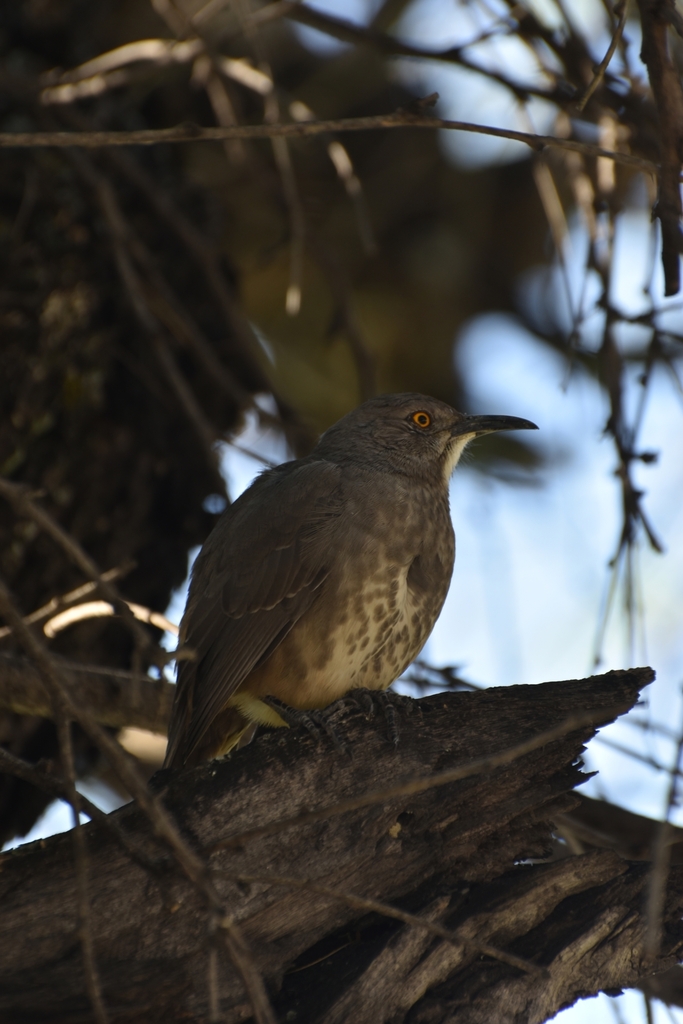
(c) Yael Ruiz, some rights reserved (CC BY-SA) · licence
Family: Mimidae · Class: Aves · Order: Passeriformes
Toxostoma curvirostre (Curve-billed Thrasher) is a California animal in the Mimidae family.
The Curve-billed Thrasher is a medium-sized songbird measuring 25 to 28 centimeters (9.8 to 11 inches) in length with a wingspan of approximately 33 centimeters (13 inches). Adults weigh between 65 and 85 grams (2.3 to 3.0 ounces). The species is characterized by its distinctive curved, black bill that measures 25 to 35 millimeters in length. The upperparts are grayish-brown with a slight rufous tinge, while the underparts are pale gray to whitish with dark spots on the breast and flanks. The tail is long and rounded, and the legs are dark gray to black. Adults show bright orange to red-orange eyes, which distinguish them from similar species. The Curve-billed Thrasher occurs primarily in the southwestern United States and northwestern Mexico. In California, the species is found in the southeastern desert regions, including portions of Imperial, Riverside, and San Bernardino counties. The range extends into the Sonoran and Mojave deserts, with populations documented in areas near the Colorado River and in desert valleys below 1,200 meters (4,000 feet) elevation. The species reaches the northern limit of its range in southern Nevada and extreme southwestern Utah. This thrasher inhabits arid desert scrublands dominated by cholla cacti, palo verde, creosote bush, and ocotillo. The species shows a strong association with cholla cactus forests, particularly areas with dense stands of jumping cholla and teddy bear cholla. Curve-billed Thrashers also occupy desert washes, bajadas, and rocky hillsides with scattered shrubs and cacti. They occur from sea level to approximately 1,200 meters elevation, though most populations are found below 600 meters. Curve-billed Thrashers are omnivorous, feeding on insects, spiders, small reptiles, fruits, and seeds. Their curved bill is adapted for probing into crevices and turning over debris to locate prey. During breeding season, pairs are territorial and construct cup-shaped nests in cholla cacti or thorny shrubs, typically 1 to 3 meters above ground. Breeding occurs from March through August, with peak activity from April to June. Females lay 2 to 4 pale blue to blue-green eggs with brown spotting. Incubation lasts 12 to 15 days, and young fledge after 14 to 18 days in the nest. The species exhibits year-round residency throughout most of its range, though some seasonal movement occurs in response to food availability and weather patterns. Curve-billed Thrashers are known for their complex vocalizations, producing varied songs that include mimicry of other bird species and mechanical sounds. As of December 2025, the Curve-billed Thrasher is not federally or state listed as threatened or endangered. The species maintains stable populations throughout most of its range, though habitat loss due to urban development and agriculture poses localized threats in some areas. Climate change and increased aridity may affect habitat suitability in marginal areas, but the species' adaptation to desert environments provides some resilience to environmental changes.
Classification
Class: Aves · Order: Passeriformes · Family: Mimidae
Frequently asked questions
How is Toxostoma curvirostre classified?
Toxostoma curvirostre belongs to class Aves, order Passeriformes, family Mimidae.
What family does Toxostoma curvirostre belong to?
Toxostoma curvirostre is in the Mimidae family.
What is Toxostoma curvirostre?
The Curve-billed Thrasher is a medium-sized songbird measuring 25 to 28 centimeters (9.8 to 11 inches) in length with a wingspan of approximately 33 centimeters (13 inches).
Is Toxostoma curvirostre found in California?
Yes. Toxostoma curvirostre is recorded in California in The California Species Project's catalogue.
Related species
Other California species in the same genus, family, or bioregion.
Data from The California Species Project — 14,000+ California species with verified data from CNPS, CDFW, USFWS, and more.