Toxostoma curvirostre palmeri
Curve-billed Thrasher (Palmer's)
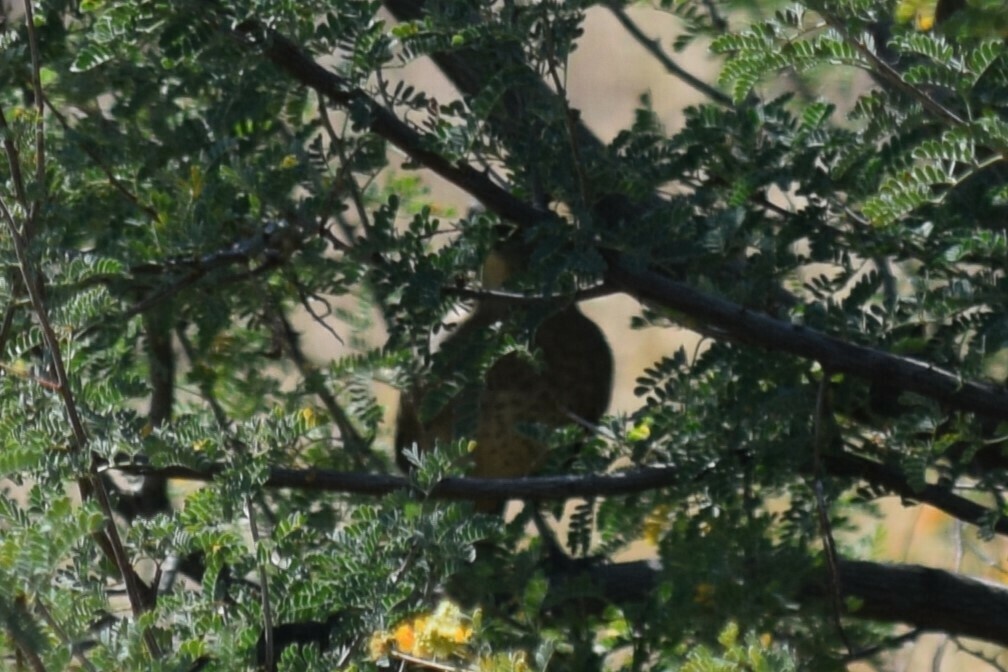
(c) William Harmon, some rights reserved (CC BY) · licence
Family: Mimidae · Class: Aves · Order: Passeriformes
Toxostoma curvirostre palmeri (Curve-billed Thrasher (Palmer's)) is a California animal in the Mimidae family.
The Palmer's Curve-billed Thrasher (Toxostoma curvirostre palmeri) is a subspecies of the Curve-billed Thrasher, a medium-sized songbird in the mockingbird family (Mimidae). Adults measure 25-30 cm (10-12 inches) in length with a distinctive curved black bill that gives the species its name. The plumage is grayish-brown above with a lighter gray-brown below, featuring faint spotting on the breast and throat. The tail is long and slightly rounded, and the bird displays two white wing bars that are visible in flight. The orange-yellow eyes are particularly striking against the subdued plumage. Palmer's Curve-billed Thrasher occurs primarily in the southwestern United States and northwestern Mexico. In the United States, this subspecies is found in Arizona and extreme southeastern California, extending into Baja California and Sonora, Mexico. According to the U.S. Fish and Wildlife Service, the subspecies palmeri is distinguished from other Curve-billed Thrasher subspecies by subtle differences in size and plumage characteristics (USFWS Taxonomic Database 2025). The species inhabits desert scrublands and thorny brushlands, particularly areas dominated by cholla cactus, palo verde, mesquite, and ocotillo. Palmer's subspecies shows a strong association with Sonoran Desert vegetation communities, typically occurring from sea level to approximately 1,200 meters (4,000 feet) elevation. The birds prefer areas with dense shrub cover interspersed with open ground for foraging. Curve-billed Thrashers are omnivorous, feeding on insects, spiders, small reptiles, berries, and cactus fruits. They forage primarily on the ground, using their curved bills to probe soil and leaf litter, and to extract insects from bark crevices. The species is known for its complex vocalizations, including elaborate song sequences and mimicry of other bird species. Breeding occurs from February through July, with peak activity in March and April. Pairs construct cup-shaped nests in thorny shrubs or cacti, typically 1-3 meters above ground. Females lay 2-4 pale blue eggs with brown spotting, and both parents participate in incubation and chick rearing. The Palmer's Curve-billed Thrasher is included on the U.S. Fish and Wildlife Service Birds of Conservation Concern list for specific subspecies, including palmeri (USFWS Birds of Conservation Concern 2021). While not federally listed under the Endangered Species Act, habitat loss due to urban development poses the primary conservation threat. According to Birds of the World, both preferred U.S. habitats for Curve-billed Thrashers - south Texas brushland and the Sonoran Desert in Arizona - are being transformed by development (Cornell Lab of Ornithology 2025). Climate change may also affect the species through altered precipitation patterns and increased temperatures in desert regions. Conservation efforts focus on habitat protection within existing protected areas and maintaining connectivity between fragmented desert habitats.
Classification
Class: Aves · Order: Passeriformes · Family: Mimidae
Frequently asked questions
How is Toxostoma curvirostre palmeri classified?
Toxostoma curvirostre palmeri belongs to class Aves, order Passeriformes, family Mimidae.
What family does Toxostoma curvirostre palmeri belong to?
Toxostoma curvirostre palmeri is in the Mimidae family.
What is Toxostoma curvirostre palmeri?
The Palmer's Curve-billed Thrasher (Toxostoma curvirostre palmeri) is a subspecies of the Curve-billed Thrasher, a medium-sized songbird in the mockingbird family (Mimidae).
Is Toxostoma curvirostre palmeri found in California?
Yes. Toxostoma curvirostre palmeri is recorded in California in The California Species Project's catalogue.
Related species
Other California species in the same genus, family, or bioregion.
Data from The California Species Project — 14,000+ California species with verified data from CNPS, CDFW, USFWS, and more.