Toxostoma lecontei
Le Conte's Thrasher
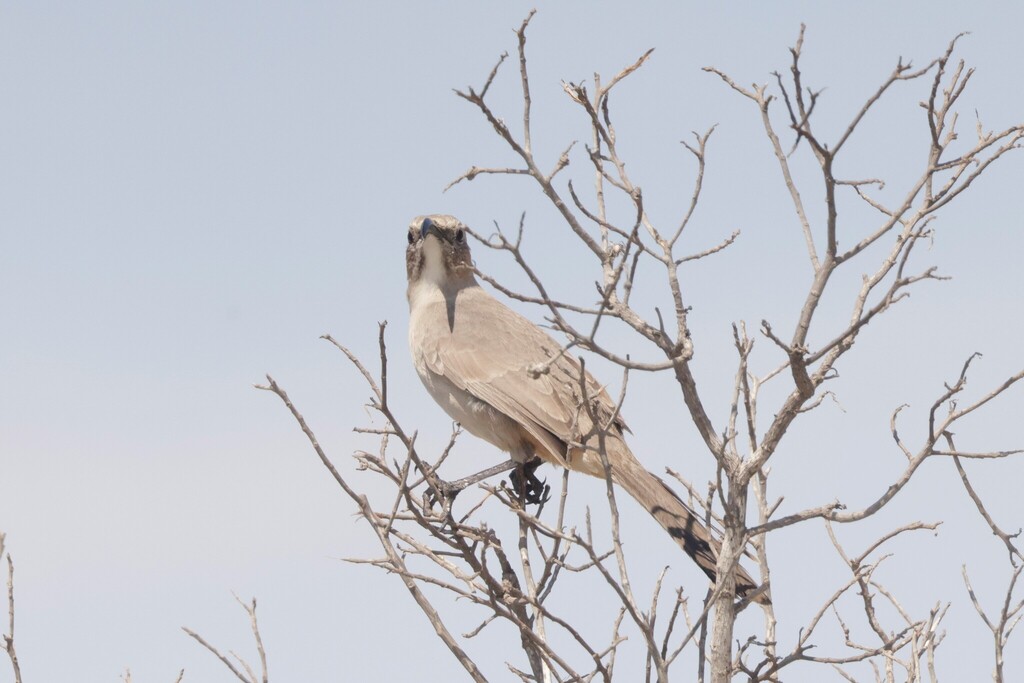
no rights reserved · CC0
Family: Mimidae · Class: Aves · Order: Passeriformes
Conservation status: G4 S3
Toxostoma lecontei (Le Conte's Thrasher) is a California animal in the Mimidae family.
Le Conte's Thrasher is a large, pale songbird endemic to the southwestern United States and northwestern Mexico. Adults measure 25 to 28 centimeters (10 to 11 inches) in length with a wingspan of approximately 33 centimeters (13 inches). The species displays uniform sandy-buff to pale gray-brown plumage that provides effective camouflage against desert substrates. The underparts are slightly paler than the upperparts, with faint darker streaking on the throat and upper breast. A distinctive long, slightly curved black bill and long, graduated tail distinguish this species from other thrashers. The legs are dark gray to black, and the eyes are pale yellow to orange. Le Conte's Thrasher inhabits the Mojave and Sonoran deserts of California, Nevada, Arizona, and Baja California. In California, the species occurs primarily in the southeastern desert regions, including the Mojave Desert from Kern County south through Imperial County. The range extends into the Colorado Desert and includes areas around the Salton Sea. Populations are also documented in Death Valley and the eastern slopes of the Sierra Nevada. This species requires mature desert scrub habitats dominated by saltbush, creosote bush, and desert sage communities. Le Conte's Thrasher shows strong preference for areas with scattered shrubs 1 to 2 meters in height, particularly where cholla cactus is present for nesting. The species typically occurs at elevations from below sea level to 800 meters (2,600 feet), though some populations extend to 1,200 meters (3,900 feet). Open washes and flats with sparse vegetation density between 10 to 30 percent shrub cover provide optimal foraging habitat. Le Conte's Thrasher is primarily insectivorous, foraging on the ground by using its bill to probe soil and leaf litter for beetles, ants, caterpillars, and other arthropods. The species also consumes fruits and seeds, particularly from desert mistletoe and various cacti during fall and winter months. Breeding occurs from February through June, with peak activity in March and April. Pairs construct cup-shaped nests in dense shrubs, typically cholla cactus, 1 to 2.5 meters above ground. Females lay 2 to 4 pale blue-green eggs with brown spotting. Incubation lasts 14 to 16 days, and nestlings fledge after 14 to 18 days. The species is largely sedentary but may make local movements in response to resource availability. Le Conte's Thrasher is not federally listed but is considered a California Species of Special Concern due to habitat loss and fragmentation. The species has a Global Rank of G4 (apparently secure) and State Rank of S3 (vulnerable) in California. Primary threats include urban and agricultural development, off-road vehicle use, livestock grazing, and invasive plant species that alter native shrub communities. Solar energy development in desert regions poses an emerging threat to remaining habitat. Climate change may shift suitable habitat ranges and affect prey availability. Conservation efforts focus on habitat protection and restoration within existing protected areas.
Classification
Class: Aves · Order: Passeriformes · Family: Mimidae
Conservation status
G4 S3
Frequently asked questions
How is Toxostoma lecontei classified?
Toxostoma lecontei belongs to class Aves, order Passeriformes, family Mimidae.
What family does Toxostoma lecontei belong to?
Toxostoma lecontei is in the Mimidae family.
Is Toxostoma lecontei protected or of conservation concern?
Toxostoma lecontei carries the following status: G4 S3.
What is Toxostoma lecontei?
Le Conte's Thrasher is a large, pale songbird endemic to the southwestern United States and northwestern Mexico.
Is Toxostoma lecontei found in California?
Yes. Toxostoma lecontei is recorded in California in The California Species Project's catalogue.
Related species
Other California species in the same genus, family, or bioregion.
Data from The California Species Project — 14,000+ California species with verified data from CNPS, CDFW, USFWS, and more.