Toxostoma rufum
Brown Thrasher
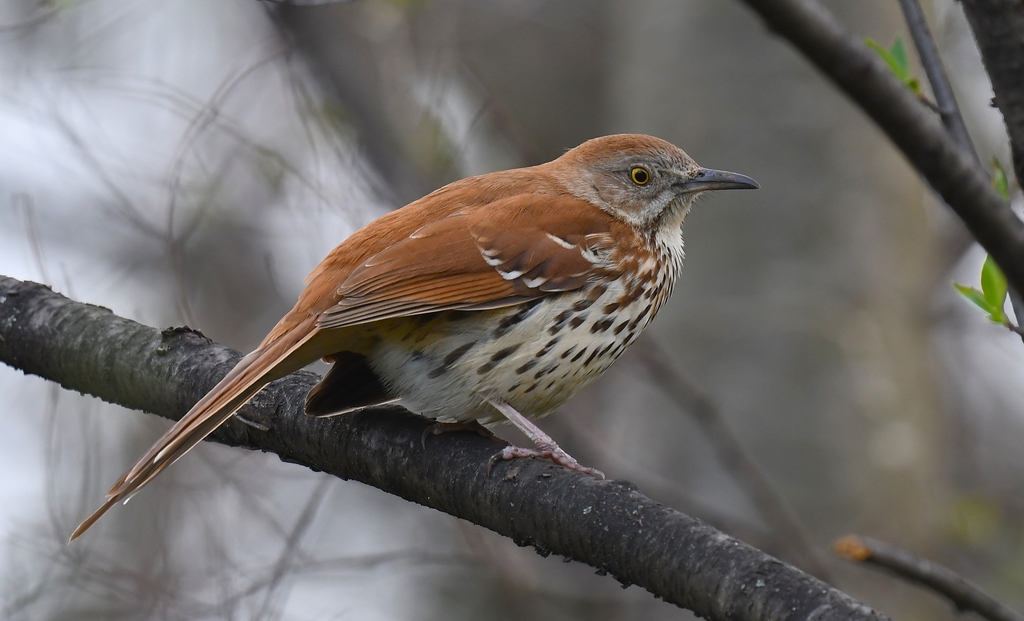
no rights reserved · CC0
Family: Mimidae · Class: Aves · Order: Passeriformes
Toxostoma rufum (Brown Thrasher) is a California animal in the Mimidae family.
The Brown Thrasher is a large, robust songbird measuring 23-30 cm (9.1-11.8 inches) in length with a wingspan of 29-33 cm (11.4-13.0 inches). Adults weigh 61-89 grams (2.2-3.1 ounces). The upperparts are bright rufous-brown, while the underparts are white to pale buff with prominent dark brown streaking. The species displays a long, slightly curved bill adapted for ground foraging, bright yellow to orange eyes, and a notably long tail that is often held cocked upward. Males and females appear similar, though males average slightly larger. Historically, Brown Thrashers bred across much of eastern North America from southern Canada to the Gulf Coast. In California, the species is considered a vagrant, with very few documented records. Most California sightings occur during fall and winter months along the coast and in desert regions, likely representing birds that have wandered far from their normal migration routes. The species' core range extends from Maine west to Alberta and south to Florida and central Texas. Brown Thrashers inhabit dense shrublands, forest edges, brushy areas, and suburban landscapes with adequate cover. They prefer areas with thick understory vegetation, including brambles, multiflora rose, and other thorny shrubs that provide nesting sites and protection from predators. During migration and winter, they utilize similar habitats plus riparian corridors and desert scrub. The species typically forages on the ground beneath dense cover. Brown Thrashers are primarily insectivorous during the breeding season, consuming beetles, caterpillars, moths, ants, and other arthropods. They employ a distinctive double-scratch foraging technique, using both feet simultaneously to move leaf litter. The diet shifts to include fruits and seeds during fall and winter, particularly berries from elderberry, dogwood, and sumac. Males are accomplished singers with repertoires exceeding 1,000 song types, often singing from exposed perches during breeding season. Nesting occurs from April through July, with pairs constructing cup nests 0.9-4.3 meters (3-14 feet) above ground in dense shrubs. Females lay 2-5 pale blue eggs with fine brown spots, which are incubated for 11-14 days. Young fledge after 9-13 days but remain dependent on parents for several additional weeks. The Brown Thrasher is not federally listed and maintains stable populations across most of its range. However, the species has experienced regional declines, particularly in agricultural areas where intensive farming practices have reduced suitable habitat. According to the North American Breeding Bird Survey, populations declined by approximately 1.1% annually between 1966 and 2019. Primary threats include habitat loss from agricultural intensification, urban development, and the removal of hedgerows and brushy borders. Climate change may affect the species through altered precipitation patterns and shifts in insect prey availability.
Classification
Class: Aves · Order: Passeriformes · Family: Mimidae
Frequently asked questions
How is Toxostoma rufum classified?
Toxostoma rufum belongs to class Aves, order Passeriformes, family Mimidae.
What family does Toxostoma rufum belong to?
Toxostoma rufum is in the Mimidae family.
What is Toxostoma rufum?
The Brown Thrasher is a large, robust songbird measuring 23-30 cm (9.1-11.8 inches) in length with a wingspan of 29-33 cm (11.4-13.0 inches).
Is Toxostoma rufum found in California?
Yes. Toxostoma rufum is recorded in California in The California Species Project's catalogue.
Related species
Other California species in the same genus, family, or bioregion.
Data from The California Species Project — 14,000+ California species with verified data from CNPS, CDFW, USFWS, and more.