Trachymela sloanei
Australian Tortoise Beetle
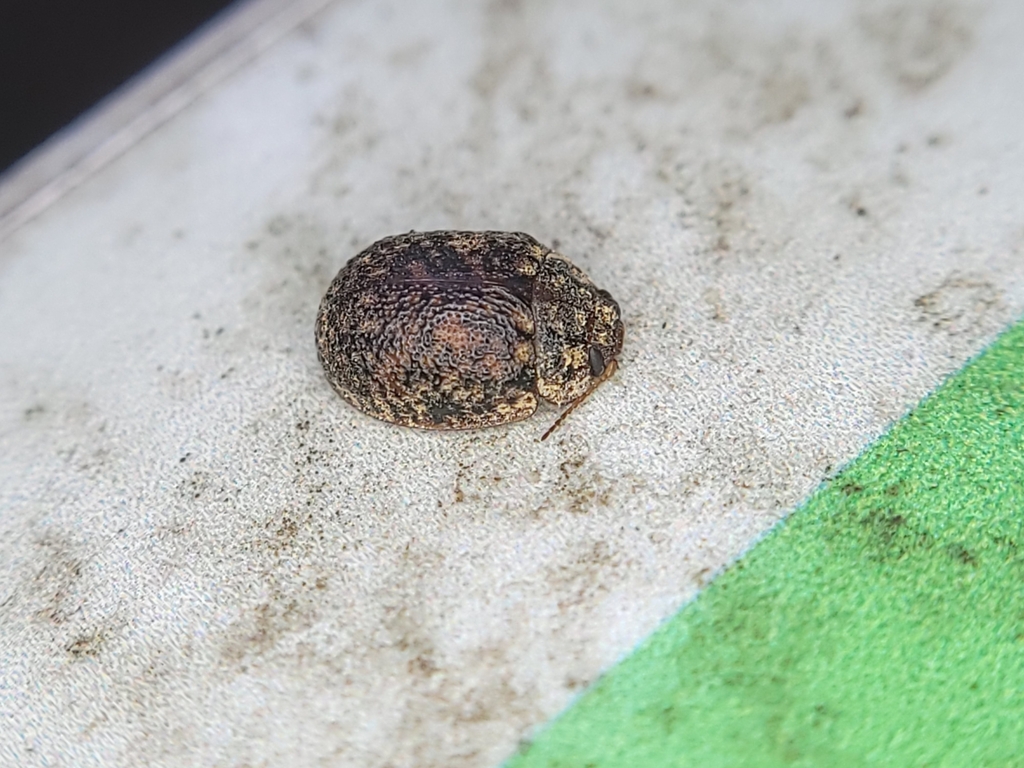
no rights reserved · CC0
Family: Chrysomelidae · Class: Insecta · Order: Coleoptera
Trachymela sloanei (Australian Tortoise Beetle) is a California animal in the Chrysomelidae family.
The Australian Tortoise Beetle is a leaf beetle in the family Chrysomelidae, subfamily Chrysomelinae, tribe Chrysomelini. This species belongs to the subtribe Paropsina and genus Trachymela, which includes several tortoise beetles native to Australia. Adult beetles are typically small to medium-sized members of the Chrysomelidae, though specific morphological measurements for this species have not been well documented in available literature. Trachymela sloanei is native to Australia but has been introduced to North America as a non-native species. According to BugGuide, this species was first detected in North America around 1998. The beetle has established populations in several regions of the United States, though its current distribution in California specifically requires further documentation. As an introduced species, it represents one of many non-native arthropods that have colonized North American ecosystems over the past several decades. The species is closely associated with eucalyptus trees (Eucalyptus spp.), which serve as its primary host plants. This host plant relationship reflects the beetle's Australian origins, where eucalyptus species are native and abundant. In North American populations, the beetles are typically found on large eucalyptus specimens, particularly on limbs and branches where they feed and reproduce. The species appears to prefer mature eucalyptus trees rather than saplings or smaller specimens. As a member of the leaf beetle family, T. sloanei likely exhibits typical chrysomelid feeding behavior, consuming leaf tissue of its eucalyptus hosts. Adult beetles presumably feed on foliage, while larvae may develop within or on the plant tissues. Like other tortoise beetles in the Chrysomelini, this species may exhibit protective behaviors such as covering itself with fecal shields or seeking shelter under leaf surfaces. Reproductive biology and seasonal activity patterns for North American populations have not been thoroughly studied, though the species appears to maintain established populations in areas with suitable eucalyptus plantings. The Australian Tortoise Beetle currently has no federal or state conservation listing status in the United States. As an introduced species, it is not considered a conservation priority, though its ecological impacts on native ecosystems remain largely unstudied. The species does not appear on endangered species lists or species of special concern inventories. However, some states have included it in their species inventories as part of comprehensive biodiversity assessments, including New York's Species of Greatest Conservation Need list, though this inclusion likely reflects inventory completeness rather than conservation concern. The long-term establishment success and ecological role of T. sloanei in North American ecosystems requires further research. While the species appears to maintain stable populations where eucalyptus trees are present, its interactions with native species, potential for range expansion, and overall ecosystem impacts have not been comprehensively evaluated. Continued monitoring of this introduced species may provide insights into the colonization patterns of Australian arthropods in North American environments.
Classification
Class: Insecta · Order: Coleoptera · Family: Chrysomelidae
Frequently asked questions
How is Trachymela sloanei classified?
Trachymela sloanei belongs to class Insecta, order Coleoptera, family Chrysomelidae.
What family does Trachymela sloanei belong to?
Trachymela sloanei is in the Chrysomelidae family.
What is Trachymela sloanei?
The Australian Tortoise Beetle is a leaf beetle in the family Chrysomelidae, subfamily Chrysomelinae, tribe Chrysomelini.
Is Trachymela sloanei found in California?
Yes. Trachymela sloanei is recorded in California in The California Species Project's catalogue.
Related species
Other California species in the same genus, family, or bioregion.
Data from The California Species Project — 14,000+ California species with verified data from CNPS, CDFW, USFWS, and more.