Tragosoma harrisii
Hairy Pine Borer
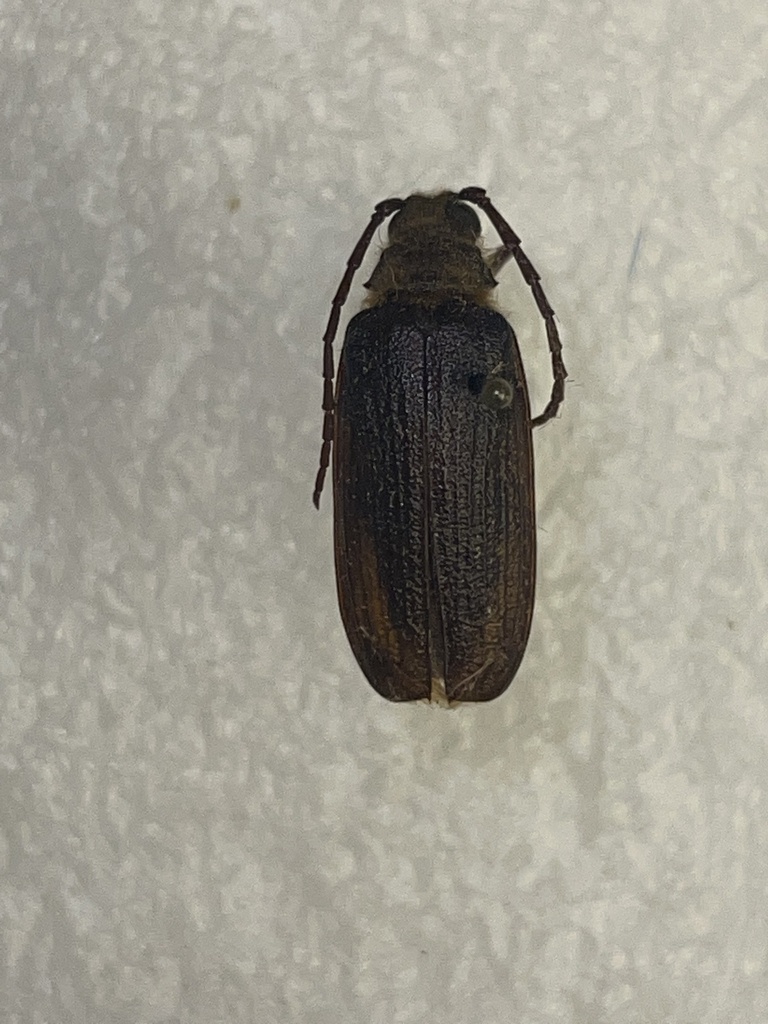
(c) Teá Montagna, some rights reserved (CC BY) · licence
Family: Cerambycidae · Class: Insecta · Order: Coleoptera
Tragosoma harrisii (Hairy Pine Borer) is a California animal in the Cerambycidae family.
The hairy pine borer (Tragosoma harrisii) is a large, robust longhorn beetle in the family Cerambycidae. Adults typically measure 25-40 mm (1.0-1.6 inches) in length, making them among the larger beetles in their family. The body is dark brown to black with a cylindrical form characteristic of wood-boring beetles. The species is distinguished by its notably hairy appearance, with dense setae covering much of the body surface, particularly the thorax and elytra. The antennae are moderately long, extending about half the body length in both sexes, with males having slightly longer antennae than females. Tragosoma harrisii occurs across much of North America, with populations distributed from southern Canada through the United States. In California, the species is found primarily in mountainous and forested regions where suitable host trees occur. The distribution includes the Sierra Nevada, Coast Ranges, and other montane areas where coniferous forests are present. Populations also extend into the Pacific Northwest and eastward across the continent to the Atlantic states. This beetle inhabits coniferous forest ecosystems, showing a strong association with pine species. Adults are typically found in mature forest stands where dead, dying, or weakened pine trees provide suitable breeding habitat. The species occurs at various elevations but is most commonly encountered in montane coniferous forests. Habitat quality depends on the presence of appropriate host material, including fire-damaged trees, trees stressed by drought, or those affected by other disturbances that compromise tree health. The hairy pine borer exhibits a wood-boring lifestyle typical of cerambycid beetles. Larvae develop within the sapwood and heartwood of dead or dying coniferous trees, primarily pines. The larval stage can extend over multiple years, with development time varying based on environmental conditions and host tree characteristics. Adult beetles emerge through round exit holes in the bark, typically during warmer months when conditions favor dispersal and mating. Adults are primarily active during daylight hours and may be attracted to recently dead or dying trees for oviposition. Females deposit eggs in bark crevices or directly into wood, where larvae subsequently tunnel and feed. Currently, Tragosoma harrisii does not appear on federal or state endangered species lists, suggesting stable population status across its range. However, like many forest-associated insects, the species may face challenges from forest management practices, wildfire suppression policies that alter natural disturbance regimes, and climate change impacts on forest ecosystems. The beetle's dependence on dead and dying coniferous trees means that forest health and natural disturbance patterns significantly influence population dynamics. Conservation of this species benefits from maintaining diverse forest age structures and allowing natural processes that create the dead wood habitat essential for larval development.
Classification
Class: Insecta · Order: Coleoptera · Family: Cerambycidae
Frequently asked questions
How is Tragosoma harrisii classified?
Tragosoma harrisii belongs to class Insecta, order Coleoptera, family Cerambycidae.
What family does Tragosoma harrisii belong to?
Tragosoma harrisii is in the Cerambycidae family.
What is Tragosoma harrisii?
The hairy pine borer (Tragosoma harrisii) is a large, robust longhorn beetle in the family Cerambycidae.
Is Tragosoma harrisii found in California?
Yes. Tragosoma harrisii is recorded in California in The California Species Project's catalogue.
Related species
Other California species in the same genus, family, or bioregion.
Data from The California Species Project — 14,000+ California species with verified data from CNPS, CDFW, USFWS, and more.