Tramea lacerata
Black Saddlebags
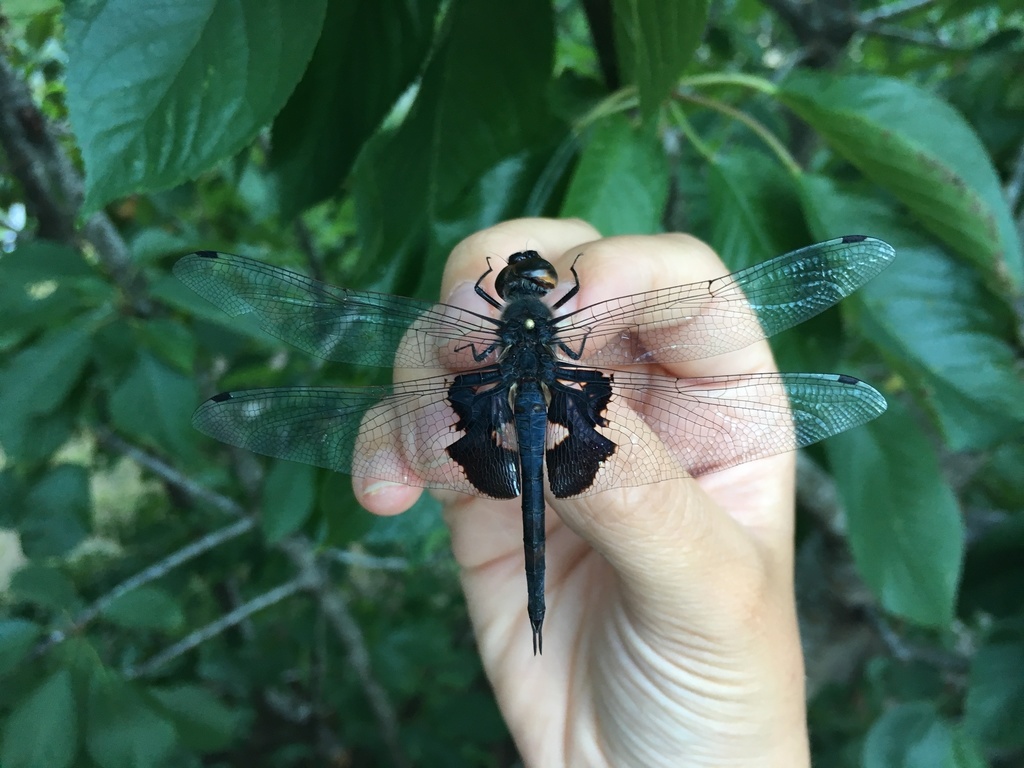
(c) Samuelle Simard-Provençal, some rights reserved (CC BY) · licence
Family: Libellulidae · Class: Insecta · Order: Odonata
Tramea lacerata (Black Saddlebags) is a California animal in the Libellulidae family.
The Black Saddlebags is a large dragonfly in the skimmer family Libellulidae, easily recognized by the distinctive dark patches on its hindwings that resemble saddlebags. Males are dark metallic green with a bronze or reddish sheen, while females display similar coloration but are typically less vibrant. Both sexes possess the characteristic broad, dark brown to black markings on the basal half of each hindwing, which distinguishes them from most other North American dragonflies. Adults measure 50-58 mm (2.0-2.3 inches) in body length with a wingspan reaching 86 mm (3.4 inches). Black Saddlebags occur across much of North America, from southern Canada to Central America. In California, the species is found primarily in the Central Valley, coastal regions, and scattered locations throughout the state where suitable wetland habitat exists. Their distribution extends from sea level to moderate elevations, though they are most common in lowland areas with abundant water sources. This species inhabits a variety of freshwater environments including ponds, lakes, marshes, slow-moving streams, and constructed wetlands. Black Saddlebags prefer open water with emergent vegetation along the margins, which provides habitat for their aquatic larvae and perching sites for adults. The larvae, known as nymphs, are aquatic predators that develop in still or slow-moving waters with muddy or sandy bottoms and abundant aquatic vegetation. Development from egg to adult typically requires one to two years, with nymphs overwintering in the aquatic environment. Adult Black Saddlebags are active aerial predators, capturing flying insects including mosquitoes, gnats, flying ants, and other small prey. Males establish territories over suitable breeding habitat, often perching on tall vegetation or structures near water. During reproduction, males grasp females in tandem flight, and mated pairs fly together over water while the female deposits eggs by dipping her abdomen at the water's surface. Flight season in California typically extends from late spring through early fall, with peak activity during summer months. Black Saddlebags are notable as one of North America's five primary migratory dragonfly species, according to the Migratory Dragonfly Partnership (Xerces Society 2013). These extensive migrations can involve thousands of individuals moving in directional flights, often triggered by weather patterns and seasonal changes. The species demonstrates exceptional navigational abilities, with populations moving considerable distances between breeding and overwintering areas. Currently, Black Saddlebags hold no federal or state conservation listing in California. However, like many wetland-dependent species, they face challenges from habitat loss due to wetland drainage, water diversions, and urban development. Climate change may affect their distribution and migration patterns. The Migratory Dragonfly Partnership has established a network of citizen scientists to monitor migration patterns and population trends for this species and other migratory dragonflies, contributing valuable data for conservation planning and habitat management efforts.
Classification
Class: Insecta · Order: Odonata · Family: Libellulidae
Frequently asked questions
How is Tramea lacerata classified?
Tramea lacerata belongs to class Insecta, order Odonata, family Libellulidae.
What family does Tramea lacerata belong to?
Tramea lacerata is in the Libellulidae family.
What is Tramea lacerata?
The Black Saddlebags is a large dragonfly in the skimmer family Libellulidae, easily recognized by the distinctive dark patches on its hindwings that resemble saddlebags.
Is Tramea lacerata found in California?
Yes. Tramea lacerata is recorded in California in The California Species Project's catalogue.
Related species
Other California species in the same genus, family, or bioregion.
Data from The California Species Project — 14,000+ California species with verified data from CNPS, CDFW, USFWS, and more.