Tramea onusta
Red Saddlebags
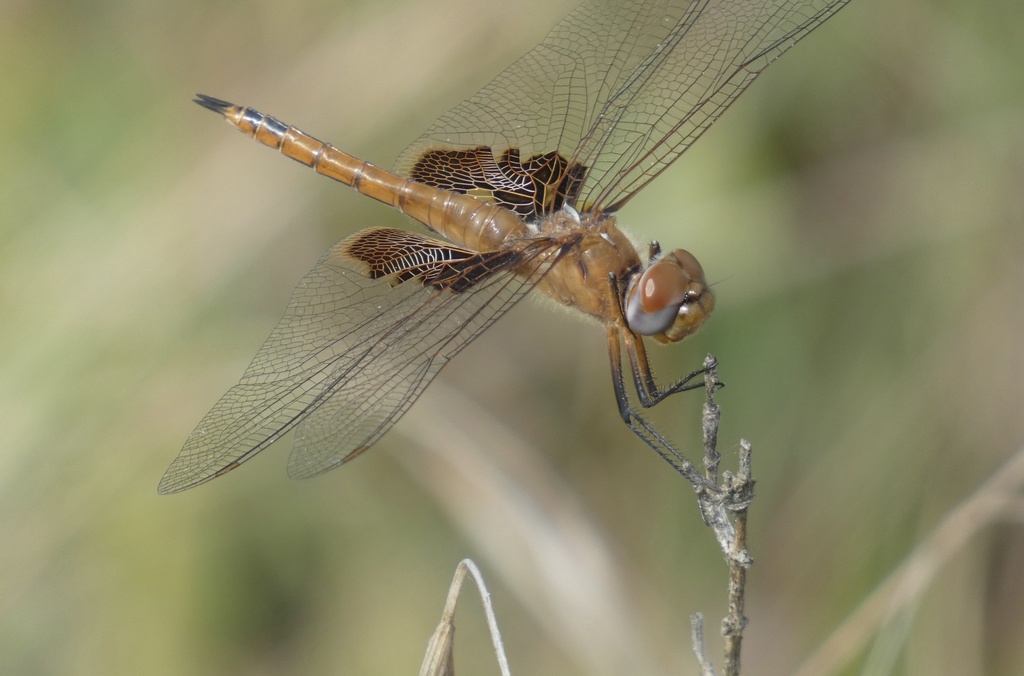
(c) Laura Liedtke, some rights reserved (CC BY) · licence
Family: Libellulidae · Class: Insecta · Order: Odonata
Tramea onusta (Red Saddlebags) is a California animal in the Libellulidae family.
The red saddlebags is a medium-sized dragonfly in the skimmer family Libellulidae, characterized by distinctive reddish patches at the base of the hindwings that resemble saddlebags. Adults typically measure 40-45 mm (1.6-1.8 inches) in body length with a wingspan of approximately 70-80 mm (2.8-3.1 inches). Males display bright red coloration at the wing bases, while females show more subdued orange-red patches. The thorax is brownish-red, and the abdomen appears reddish-brown with darker markings. The species can be distinguished from the similar black saddlebags (Tramea lacerata) by the red rather than dark coloration of the wing patches. Red saddlebags occur across much of North America, from southern Canada to Central America. In California, the species is found throughout most of the state at elevations from sea level to approximately 2,000 meters (6,600 feet). Historical records from the Ballona Wetlands area indicate the species' presence in coastal Southern California habitats (Mattoni 1991). The species maintains stable populations across its range and is considered secure globally with a NatureServe ranking of G5 (NatureServe 2016). This species inhabits a variety of freshwater wetland habitats including ponds, lakes, slow-moving streams, marshes, and temporary pools. Adults are often observed over open water areas and adjacent upland habitats. The species shows preference for areas with emergent vegetation that provide perching sites and oviposition substrates. Nymphs develop in shallow, vegetated waters where they can find adequate prey and shelter among aquatic plants. Red saddlebags are strong fliers that exhibit both territorial and migratory behaviors. Males establish territories over suitable breeding sites, perching on emergent vegetation or flying patrol routes over open water. Mating occurs in flight, with pairs remaining in tandem during egg-laying. Females deposit eggs by dipping the tip of their abdomen into the water surface, often while still attached to the male. The species is considered one of North America's regular migrants, with individuals capable of long-distance movements (Xerces Society 2011). Peak flight periods typically occur from late spring through early fall, with timing varying by latitude and local climate conditions. Nymphs are aquatic predators that feed on mosquito larvae, midges, and other small invertebrates. Adult dragonflies are aerial predators, capturing flying insects including mosquitoes, flies, gnats, and smaller dragonflies. Development from egg to adult typically requires one to two years, with nymphs overwintering in aquatic habitats. The species serves an important ecological role as both predator and prey in freshwater ecosystems. The red saddlebags currently holds no special conservation status and is not federally or state-listed. Populations appear stable across the species' range, though local declines may occur due to habitat loss from wetland drainage, water pollution, and climate change impacts on aquatic systems. The species benefits from wetland conservation efforts and habitat restoration projects that maintain or create suitable breeding sites.
Classification
Class: Insecta · Order: Odonata · Family: Libellulidae
Frequently asked questions
How is Tramea onusta classified?
Tramea onusta belongs to class Insecta, order Odonata, family Libellulidae.
What family does Tramea onusta belong to?
Tramea onusta is in the Libellulidae family.
What is Tramea onusta?
The red saddlebags is a medium-sized dragonfly in the skimmer family Libellulidae, characterized by distinctive reddish patches at the base of the hindwings that resemble saddlebags.
Is Tramea onusta found in California?
Yes. Tramea onusta is recorded in California in The California Species Project's catalogue.
Related species
Other California species in the same genus, family, or bioregion.
Data from The California Species Project — 14,000+ California species with verified data from CNPS, CDFW, USFWS, and more.