Trichodes ornatus
Ornate Checkered Beetle
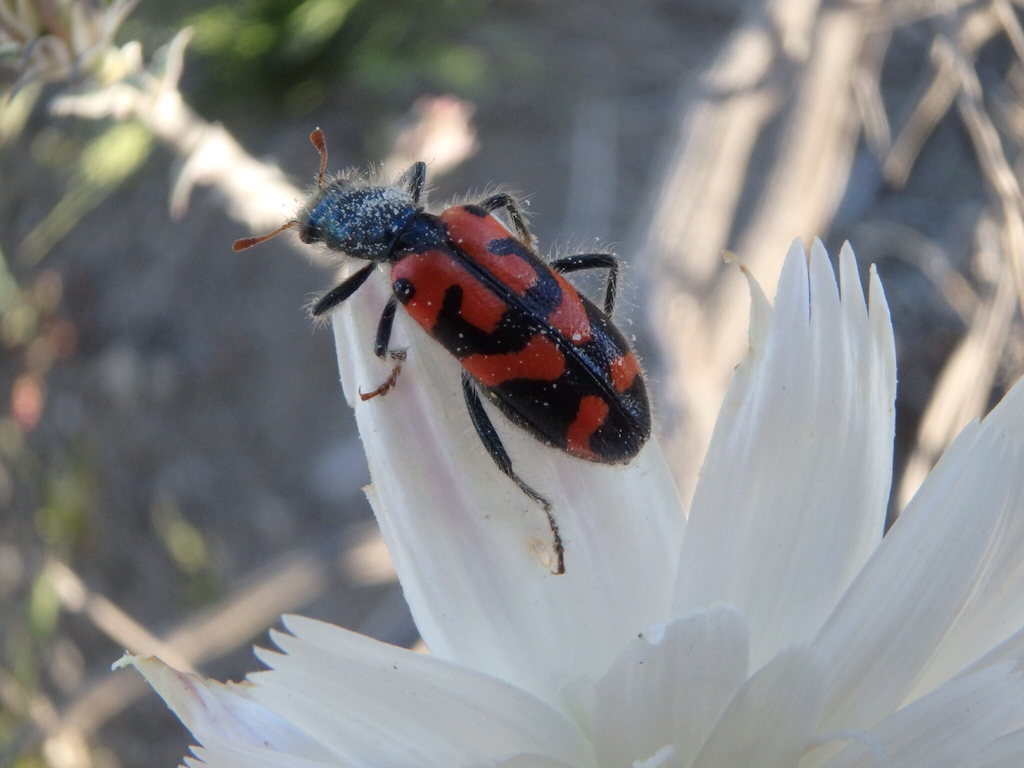
(c) W. Terry Hunefeld, some rights reserved (CC BY) · licence
Family: Cleridae · Class: Insecta · Order: Coleoptera
Trichodes ornatus (Ornate Checkered Beetle) is a California animal in the Cleridae family.
The ornate checkered beetle (Trichodes ornatus) is a medium-sized clerid beetle belonging to the family Cleridae, subfamily Clerinae. Adults typically measure 8-15 mm in length and display distinctive coloration patterns that give the species its common name. The body is elongated with a metallic blue-green base color marked by bright orange or reddish bands across the elytra, creating a checkered appearance. The head and pronotum are typically blue-green with dense punctation, while the legs and antennae are dark. Trichodes ornatus occurs across western North America, with populations documented from British Columbia south through California and east to Colorado and New Mexico. In California, the species is found throughout much of the state, from coastal regions to inland valleys and mountainous areas. According to NatureServe, the species has a global conservation rank of G5, indicating it is secure globally (NatureServe 2019). This beetle inhabits diverse environments including chaparral, oak woodlands, mixed coniferous forests, and grasslands. Adults are commonly found on flowers of various plant species, particularly those in the families Apiaceae, Asteraceae, and Rosaceae. Elevation ranges vary considerably across the species' distribution, from near sea level in coastal areas to moderate elevations in montane regions. The species shows particular association with areas having abundant flowering plants during the active season. Ornate checkered beetles are active predators both as adults and larvae. Adults feed on pollen and nectar from flowers but also prey on small insects found on blooms. The larvae are parasitoid, developing within the nests of solitary bees, particularly species in the genera Anthophora, Megachile, and Osmia. Female beetles locate bee nesting sites and deposit eggs near or within the nest chambers. The beetle larvae then consume the bee larvae and their provisions. This parasitoid relationship makes T. ornatus an important component of native bee community dynamics. Adults are most active during spring and summer months, coinciding with peak flowering periods of their host plants and the nesting activities of their bee hosts. Mating occurs on flowers, and females seek out appropriate bee nesting sites for oviposition. The species exhibits one generation per year in most locations, overwintering in the pupal stage within bee nest chambers. Currently, Trichodes ornatus does not hold any special conservation status at federal or state levels. The species appears stable across most of its range, benefiting from its generalist feeding habits and diverse habitat associations. However, like many insects dependent on native bee communities, potential threats include habitat loss, pesticide use, and disruption of native plant-pollinator relationships. The species serves as both predator and flower visitor, playing dual ecological roles in maintaining ecosystem balance. Conservation efforts focused on preserving native flowering plant communities and supporting solitary bee populations indirectly benefit ornate checkered beetle populations throughout California.
Classification
Class: Insecta · Order: Coleoptera · Family: Cleridae
Frequently asked questions
How is Trichodes ornatus classified?
Trichodes ornatus belongs to class Insecta, order Coleoptera, family Cleridae.
What family does Trichodes ornatus belong to?
Trichodes ornatus is in the Cleridae family.
What is Trichodes ornatus?
The ornate checkered beetle (Trichodes ornatus) is a medium-sized clerid beetle belonging to the family Cleridae, subfamily Clerinae.
Is Trichodes ornatus found in California?
Yes. Trichodes ornatus is recorded in California in The California Species Project's catalogue.
Related species
Other California species in the same genus, family, or bioregion.
Data from The California Species Project — 14,000+ California species with verified data from CNPS, CDFW, USFWS, and more.