Trigonoscuta rothi punctata
Punctate Dune Weevil
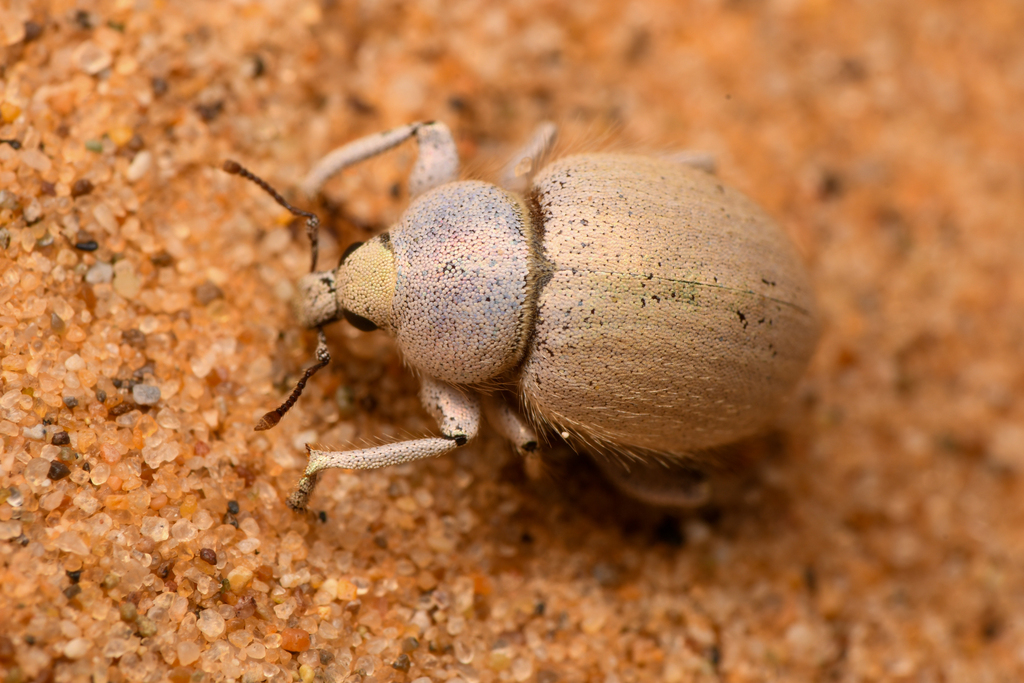
(c) Trevor Van Loon, some rights reserved (CC BY) · licence
Family: Curculionidae · Class: Insecta · Order: Coleoptera
Conservation status: G1G2T1 S1
Trigonoscuta rothi punctata (Punctate Dune Weevil) is a California animal in the Curculionidae family.
Trigonoscuta rothi punctata is a small weevil subspecies endemic to California's coastal dune systems. This beetle belongs to the family Curculionidae and represents one of four described subspecies within the Trigonoscuta rothi complex. The punctate dune weevil exhibits typical weevil morphology with an elongated rostrum (snout) used for feeding and egg-laying, though detailed morphological descriptions distinguishing it from other T. rothi subspecies remain limited in published literature. The subspecies is restricted to coastal dune habitats along California's coastline, though its precise historical and current range boundaries have not been comprehensively documented. The species' extremely limited distribution contributes to its Global/State Rank of G1G2T1 S1, indicating it is critically imperiled both globally and within California. This ranking reflects either very few occurrences or very steep population declines. Punctate dune weevils inhabit specialized coastal dune ecosystems characterized by shifting sand substrates and salt-tolerant vegetation communities. These dynamic environments support unique plant assemblages adapted to salt spray, wind exposure, and unstable soils. The species likely depends on specific dune-adapted plant species for both larval development and adult feeding, though documented host plant relationships have not been established in available scientific literature. Like other weevils, this subspecies presumably undergoes complete metamorphosis with egg, larval, pupal, and adult stages. Adults likely use their specialized mouthparts to feed on plant tissues and create oviposition sites in host plants. Larvae probably develop within plant tissues or root systems before pupating in the soil or plant material. Specific details regarding breeding biology, seasonal activity patterns, and life cycle duration remain undocumented. The conservation status of Trigonoscuta rothi punctata reflects significant taxonomic and biological uncertainties. In 2006, the U.S. Fish and Wildlife Service determined that a petition to list this subspecies under the Endangered Species Act did not provide substantial scientific information establishing it as a scientifically accepted taxon (Federal Register 2006). The Service noted that while Pierce (1975) published descriptions of T. r. punctata and related subspecies, Anderson (2002) questioned the validity of most Trigonoscuta taxa and recommended taxonomic reassessment. This taxonomic uncertainty complicates conservation planning efforts. Coastal dune ecosystems face numerous conservation challenges including urban development, recreational activities, invasive plant species, and climate change impacts such as sea level rise and altered storm patterns. NatureServe indicates the long-term trend for this species is unknown but likely reflects decline due to habitat loss affecting dune invertebrates. The species' apparent restriction to a highly threatened habitat type, combined with its extremely limited distribution, suggests significant conservation concern regardless of taxonomic status. Future research priorities include taxonomic clarification of the T. rothi complex using modern systematic methods, comprehensive surveys to determine current distribution and population status, and ecological studies to identify critical habitat requirements and threats. Resolution of taxonomic questions will be essential for developing appropriate conservation strategies for this potentially imperiled dune specialist.
Classification
Class: Insecta · Order: Coleoptera · Family: Curculionidae
Conservation status
G1G2T1 S1
Frequently asked questions
How is Trigonoscuta rothi punctata classified?
Trigonoscuta rothi punctata belongs to class Insecta, order Coleoptera, family Curculionidae.
What family does Trigonoscuta rothi punctata belong to?
Trigonoscuta rothi punctata is in the Curculionidae family.
Is Trigonoscuta rothi punctata protected or of conservation concern?
Trigonoscuta rothi punctata carries the following status: G1G2T1 S1.
What is Trigonoscuta rothi punctata?
Trigonoscuta rothi punctata is a small weevil subspecies endemic to California's coastal dune systems.
Is Trigonoscuta rothi punctata found in California?
Yes. Trigonoscuta rothi punctata is recorded in California in The California Species Project's catalogue.
Related species
Other California species in the same genus, family, or bioregion.
Data from The California Species Project — 14,000+ California species with verified data from CNPS, CDFW, USFWS, and more.