Trimerotropis infantilis
Zayante band- winged grasshopper
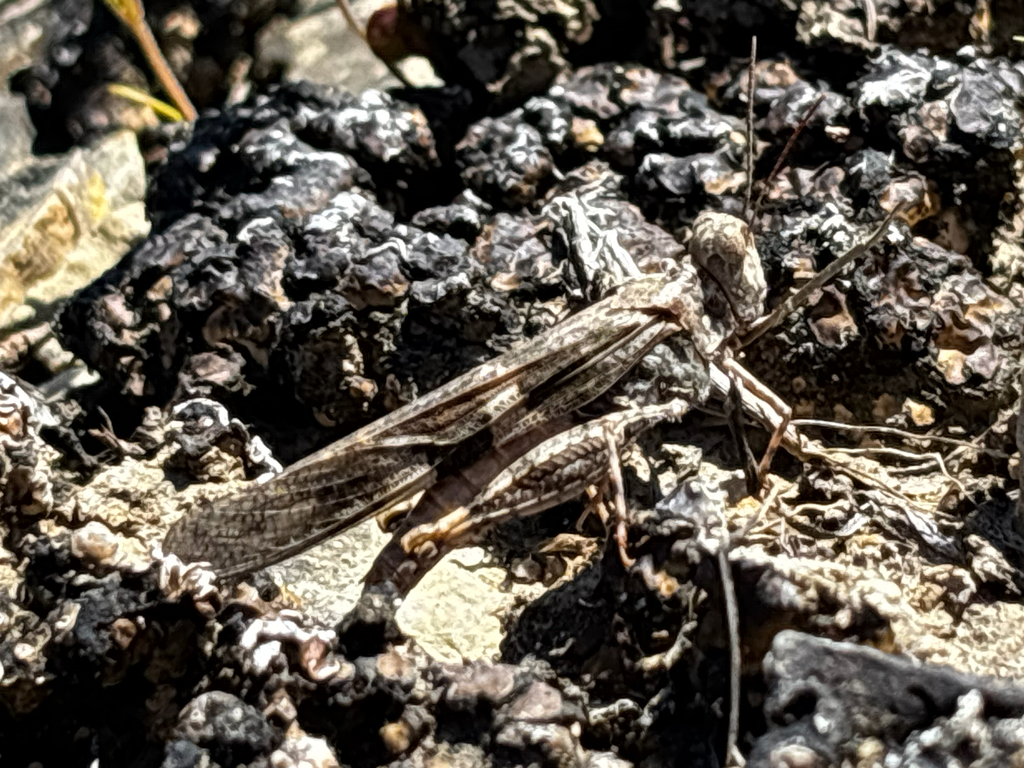
(c) Chris Stahl, some rights reserved (CC BY) · licence
Family: Acrididae · Class: Insecta · Order: Orthoptera
Conservation status: Endangered · G1 S1
Trimerotropis infantilis (Zayante band- winged grasshopper) is a California animal in the Acrididae family.
The Zayante band-winged grasshopper is a small, endemic grasshopper species found exclusively in the Zayante sand hills ecosystem of Santa Cruz County, California. This species exhibits the characteristic band-winged grasshopper morphology with distinctive wing patterns, though specific morphometric data remain limited in the scientific literature. The species was first described from specimens collected in 1977 on sparsely vegetated sandy soil above the Olympia sand quarry (Rentz and Weissman 1984). The Zayante band-winged grasshopper has an extremely restricted range, occurring only within the Zayante sand hills of Santa Cruz County, California. Historical specimens were collected from locations including Alma (1928), Santa Cruz (1941), Felton (1959), and the Santa Cruz Mountains, though many early collection records lack precise locality data (Rentz and Weissman 1984). The species is distributed over an area of less than 10 square kilometers within this unique ecosystem. This grasshopper is narrowly restricted to sand parkland habitat found on ridges and hills within the Zayante sand hills ecosystem. The habitat consists of sparsely vegetated sandy soils derived from isolated sandstone deposits in the Santa Cruz Mountains. The species requires open areas with minimal vegetation cover, distinguishing it from surrounding habitats such as redwood forest, chaparral, and grasslands where the grasshopper does not occur. The sand parkland habitat provides the specific substrate conditions essential for the species' survival and reproduction. Limited information exists regarding the specific behavioral ecology and life history of the Zayante band-winged grasshopper. Like other band-winged grasshoppers in the genus Trimerotropis, this species likely exhibits ground-dwelling habits and relies on cryptic coloration for predator avoidance. The species presumably feeds on available vegetation within its sand parkland habitat, though specific dietary preferences and reproductive biology have not been well documented in the scientific literature. The U.S. Fish and Wildlife Service listed the Zayante band-winged grasshopper as endangered in 1997 due to severe habitat loss and its extremely limited distribution. Historically, approximately 2,533 hectares (6,265 acres) of Zayante sand hills habitat occurred in Santa Cruz County, but significant portions have been lost to development and other human activities. Critical habitat was designated in 2001, encompassing approximately 4,224 hectares (10,560 acres) in Santa Cruz County, including all areas known to be occupied by the species. The primary threat continues to be habitat loss and degradation. Recovery efforts focus on habitat protection and management within the designated critical habitat areas. Federal expenditures for the species' conservation totaled $66,000 in fiscal year 2000, reflecting ongoing conservation efforts. The species' G1 S1 ranking indicates it is critically imperiled both globally and within California, with fewer than five occurrences documented.
Classification
Class: Insecta · Order: Orthoptera · Family: Acrididae
Conservation status
Endangered · G1 S1
Frequently asked questions
How is Trimerotropis infantilis classified?
Trimerotropis infantilis belongs to class Insecta, order Orthoptera, family Acrididae.
What family does Trimerotropis infantilis belong to?
Trimerotropis infantilis is in the Acrididae family.
Is Trimerotropis infantilis protected or of conservation concern?
Trimerotropis infantilis carries the following status: Endangered · G1 S1.
What is Trimerotropis infantilis?
The Zayante band-winged grasshopper is a small, endemic grasshopper species found exclusively in the Zayante sand hills ecosystem of Santa Cruz County, California.
Is Trimerotropis infantilis found in California?
Yes. Trimerotropis infantilis is recorded in California in The California Species Project's catalogue.
Related species
Other California species in the same genus, family, or bioregion.
Data from The California Species Project — 14,000+ California species with verified data from CNPS, CDFW, USFWS, and more.