Trimerotropis occidentiloides
Santa Monica Grasshopper
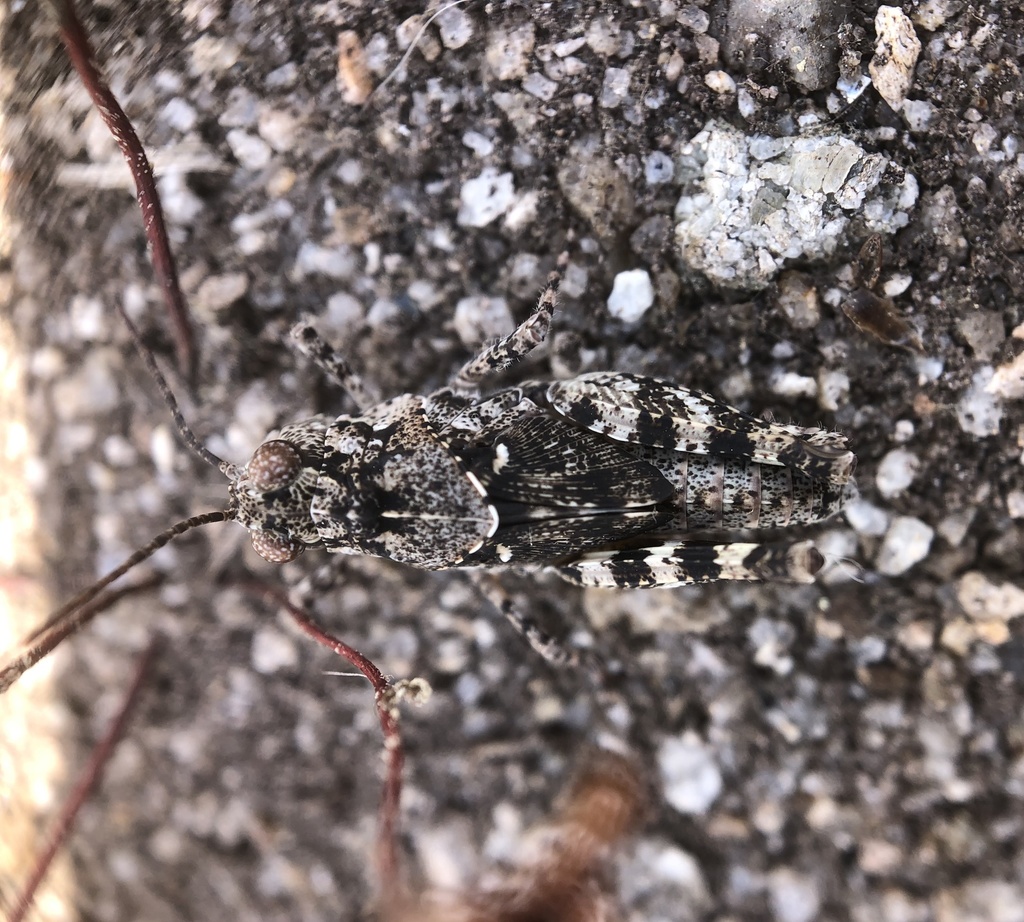
(c) James Kindt, some rights reserved (CC BY) · licence
Family: Acrididae · Class: Insecta · Order: Orthoptera
Conservation status: G2 S2
Trimerotropis occidentiloides (Santa Monica Grasshopper) is a California animal in the Acrididae family.
The Santa Monica Grasshopper is a band-winged grasshopper endemic to the Santa Monica Mountains of Los Angeles County, California. This species belongs to the subfamily Oedipodinae and is distinguished from the closely related Trimerotropis fontana by narrower tegminal bands that are often represented as spots or speckles rather than continuous bands, and by the median ridge characteristics of the prozona (BugGuide.Net). The species exhibits the typical band-winged grasshopper morphology with cryptic coloration that provides camouflage against rocky and sandy substrates. The Santa Monica Grasshopper has an extremely restricted range, occurring only in the Santa Monica Mountains south of Thousand Oaks in Los Angeles County, California (BugGuide.Net). This represents one of the most geographically limited distributions of any North American grasshopper species. The type locality was established in the Santa Monica Mountains during the species' original description by Rentz & Weissman in 1981. This species inhabits the distinctive Mediterranean climate ecosystems of the Santa Monica Mountains, including chaparral, coastal sage scrub, and oak woodland communities. The grasshopper is typically found on exposed rocky outcrops, sandy slopes, and areas with sparse vegetation cover that characterize much of the Santa Monica Mountains landscape. These habitats experience hot, dry summers and mild, wet winters typical of Southern California's Mediterranean climate zone. As a member of the band-winged grasshopper subfamily, the Santa Monica Grasshopper likely exhibits similar behavioral patterns to related species, including cryptic behavior when at rest and conspicuous flight displays when disturbed. Band-winged grasshoppers typically produce sounds through crepitation - the snapping or crackling sounds made by their wings during flight. Like other Trimerotropis species, this grasshopper is presumed to be primarily herbivorous, feeding on various grasses and forbs within its habitat. Specific details regarding breeding biology, seasonal activity patterns, and dietary preferences have not been well documented for this species. The Santa Monica Grasshopper's conservation status reflects its extremely limited range and the ongoing pressures facing the Santa Monica Mountains ecosystem. With a Global/State Rank of G2 S2, the species is considered imperiled both globally and within California. This ranking indicates a high risk of extinction due to very restricted range, few populations, steep declines, or other factors. The Santa Monica Mountains face continuous development pressure from the expanding Los Angeles metropolitan area, habitat fragmentation from roads and urban infrastructure, and altered fire regimes that may affect the grasshopper's specialized habitat requirements. Climate change poses additional threats through potential shifts in precipitation patterns and temperature regimes that could alter the Mediterranean ecosystem conditions upon which this species depends. The species' occurrence within some protected areas of the Santa Monica Mountains National Recreation Area may provide some conservation benefit, though comprehensive population monitoring and habitat management strategies have not been well established. Given the extremely restricted range and ongoing habitat pressures, the Santa Monica Grasshopper represents a priority species for conservation attention within California's unique Mediterranean climate ecosystems.
Classification
Class: Insecta · Order: Orthoptera · Family: Acrididae
Conservation status
G2 S2
Frequently asked questions
How is Trimerotropis occidentiloides classified?
Trimerotropis occidentiloides belongs to class Insecta, order Orthoptera, family Acrididae.
What family does Trimerotropis occidentiloides belong to?
Trimerotropis occidentiloides is in the Acrididae family.
Is Trimerotropis occidentiloides protected or of conservation concern?
Trimerotropis occidentiloides carries the following status: G2 S2.
What is Trimerotropis occidentiloides?
The Santa Monica Grasshopper is a band-winged grasshopper endemic to the Santa Monica Mountains of Los Angeles County, California.
Is Trimerotropis occidentiloides found in California?
Yes. Trimerotropis occidentiloides is recorded in California in The California Species Project's catalogue.
Related species
Other California species in the same genus, family, or bioregion.
Data from The California Species Project — 14,000+ California species with verified data from CNPS, CDFW, USFWS, and more.