Trimerotropis verruculata
Crackling Forest Grasshopper
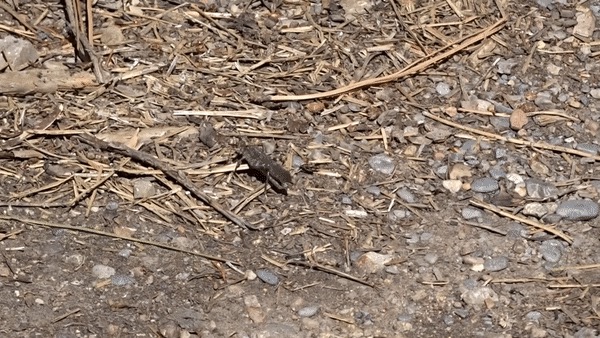
(c) Thomas Koffel, some rights reserved (CC BY) · licence
Family: Acrididae · Class: Insecta · Order: Orthoptera
Trimerotropis verruculata (Crackling Forest Grasshopper) is a California animal in the Acrididae family.
The Crackling Forest Grasshopper is a medium-sized band-winged grasshopper belonging to the subfamily Oedipodinae. Adults display pale gray to light brown coloration on the body and forewings, with distinctive dark crossbands marking the forewings. Like other band-winged grasshoppers, this species exhibits conspicuous hind wings that become visible during flight, contributing to their characteristic appearance when airborne. Trimerotropis verruculata occurs across western North America, with documented populations extending from Canada south through the western United States. In California, the species has been recorded in the Sierra Nevada Mountains, with observations documented at Carson Pass at elevations around 2,700 meters (9,000 feet) (BugGuide 2008). The species includes multiple subspecies, including T. v. suffusa and the nominotypical T. v. verruculata, which may have distinct distributional patterns within the broader range. This grasshopper inhabits forested and mountainous terrain, showing a preference for higher elevation environments. Observations from the Sierra Nevada indicate the species occurs in montane forest habitats at substantial elevations, suggesting adaptation to cooler, mountainous conditions. The specific microhabitat requirements and substrate preferences have not been extensively documented in the scientific literature. The Crackling Forest Grasshopper derives its common name from the distinctive stridulating behavior exhibited during flight. When disturbed, individuals typically fly short distances of 1 to 2 meters (3 to 7 feet), producing a characteristic buzzing or crackling sound with their wings during flight (BugGuide 2008). This crepitation serves as both an escape mechanism and likely plays a role in intraspecific communication. Band-winged grasshoppers characteristically alight on bare ground after flight, making them relatively conspicuous in their habitat. Adult activity has been documented into late autumn, with specimens collected as late as November in some regions. Detailed information regarding the species' life cycle, reproductive behavior, and dietary preferences remains limited in published literature. Like other members of the Acrididae family, this species likely follows a typical grasshopper development pattern with egg, multiple nymphal instars, and adult stages. Specific host plants, breeding timing, and overwintering strategies have not been well documented for this species. Trimerotropis verruculata does not appear on federal or state endangered species lists and lacks formal conservation status designations. Population trends and conservation threats have not been systematically assessed. The species' apparent adaptation to higher elevation forest habitats may make it potentially vulnerable to climate change impacts, particularly warming temperatures that could shift suitable habitat to higher elevations. However, without comprehensive population surveys or trend data, the conservation status remains uncertain. The relatively limited scientific documentation for this species highlights the need for additional research into its distribution, ecology, and population dynamics across its range.
Classification
Class: Insecta · Order: Orthoptera · Family: Acrididae
Frequently asked questions
How is Trimerotropis verruculata classified?
Trimerotropis verruculata belongs to class Insecta, order Orthoptera, family Acrididae.
What family does Trimerotropis verruculata belong to?
Trimerotropis verruculata is in the Acrididae family.
What is Trimerotropis verruculata?
The Crackling Forest Grasshopper is a medium-sized band-winged grasshopper belonging to the subfamily Oedipodinae.
Is Trimerotropis verruculata found in California?
Yes. Trimerotropis verruculata is recorded in California in The California Species Project's catalogue.
Related species
Other California species in the same genus, family, or bioregion.
Data from The California Species Project — 14,000+ California species with verified data from CNPS, CDFW, USFWS, and more.