Trimorphodon lambda
Sonoran Lyresnake
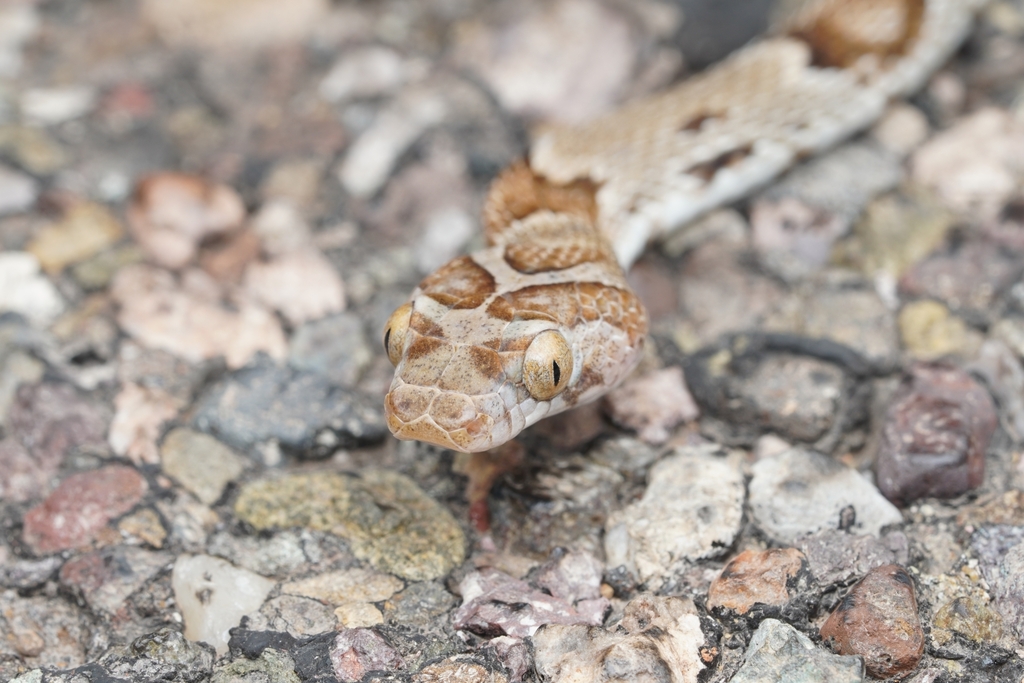
(c) Jonghyun Park, some rights reserved (CC BY) · licence
Family: Colubridae · Class: Reptilia · Order: Squamata
Trimorphodon lambda (Sonoran Lyresnake) is a California animal in the Colubridae family.
The Sonoran lyresnake is a medium-sized colubrid snake native to southwestern North America, with a limited distribution in southeastern California. Adults typically reach 610 to 915 mm (24 to 36 inches) in total length, with a slender body, distinctively broad head, and narrow neck. The large eyes with vertical pupils reflect this species' nocturnal hunting behavior. Dorsal coloration ranges from pale gray to light brown, marked with 17 to 24 dark brown or black crossbands that may appear hexagonal or lyre-shaped, giving the species its common name. The ventral surface is cream to pale yellow, and the scales are smooth, giving the snake a somewhat glossy appearance. The Sonoran lyresnake occurs in extreme southeastern California, primarily in the Colorado and Sonoran desert regions. In California, the species is documented from Imperial County and the southeastern portion of Riverside County, representing the northwestern edge of its range. The broader distribution extends through Arizona, southern Nevada, northwestern Mexico, and Baja California. Within California, populations are restricted to desert mountain ranges and adjacent bajadas below 1,220 meters (4,000 feet) elevation. This species inhabits rocky desert terrain, favoring areas with granite outcrops, boulder piles, and rocky hillsides with scattered desert vegetation. Typical habitat includes creosote bush scrub, desert washes, and lower elevations of desert mountain slopes. Sonoran lyresnakes seek shelter in rock crevices, beneath large boulders, and in rodent burrows during daylight hours. The species shows strong preference for areas with adequate rock cover that provides both thermal regulation and protection from predators. Sonoran lyresnakes are primarily nocturnal and semi-arboreal, actively foraging during warm nights from spring through fall. The species is mildly venomous, possessing enlarged rear fangs and Duvernoy's glands that produce toxins effective against their prey but pose minimal risk to humans. Diet consists primarily of lizards, particularly geckos and small diurnal species that they locate in rock crevices and vegetation. Small mammals, bird eggs, and nestling birds supplement their diet. Mating occurs in spring, with females depositing 2 to 6 elongated eggs in summer under rocks or in soil crevices. Eggs incubate for approximately 60 to 75 days, with hatchlings emerging in late summer measuring 200 to 250 mm in length. The Sonoran lyresnake is not listed under federal or state endangered species legislation. However, California populations face threats from habitat loss due to renewable energy development, urban expansion, and recreational activities in desert regions. Climate change may affect the species through altered precipitation patterns and increased temperatures. Collection for the pet trade historically impacted some populations, though current regulations limit this pressure. The species' secretive nature and limited California range make population monitoring challenging, but established populations appear stable within protected desert areas such as Joshua Tree National Park and Anza-Borrego Desert State Park.
Classification
Class: Reptilia · Order: Squamata · Family: Colubridae
Frequently asked questions
How is Trimorphodon lambda classified?
Trimorphodon lambda belongs to class Reptilia, order Squamata, family Colubridae.
What family does Trimorphodon lambda belong to?
Trimorphodon lambda is in the Colubridae family.
What is Trimorphodon lambda?
The Sonoran lyresnake is a medium-sized colubrid snake native to southwestern North America, with a limited distribution in southeastern California.
Is Trimorphodon lambda found in California?
Yes. Trimorphodon lambda is recorded in California in The California Species Project's catalogue.
Related species
Other California species in the same genus, family, or bioregion.
Data from The California Species Project — 14,000+ California species with verified data from CNPS, CDFW, USFWS, and more.