Trimorphodon lyrophanes
California Lyresnake
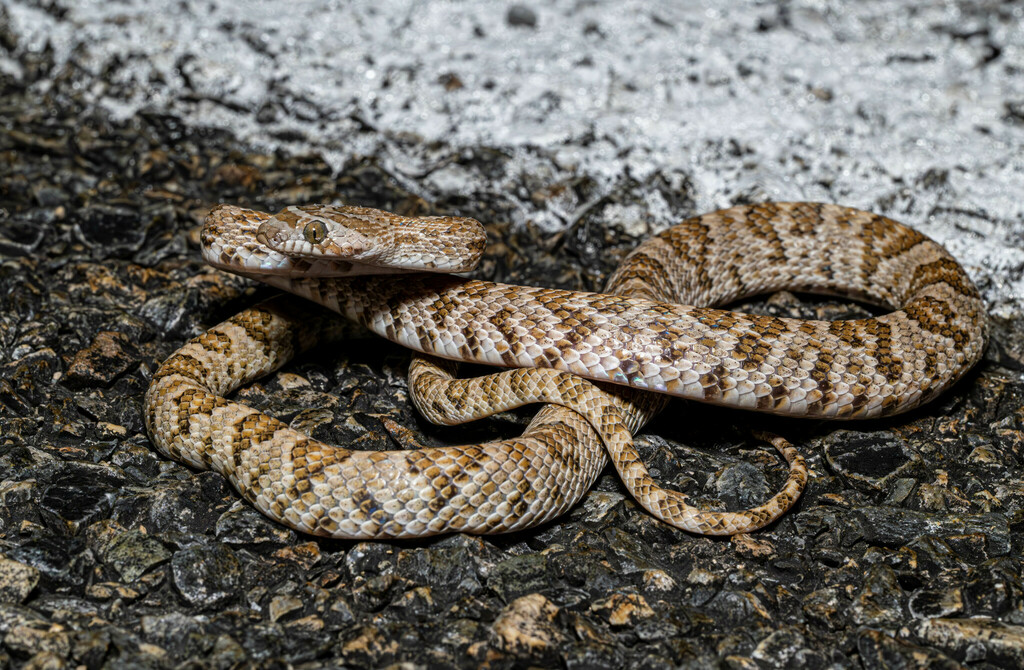
(c) Jeremiah Degenhardt, some rights reserved (CC BY) · licence
Family: Colubridae · Class: Reptilia · Order: Squamata
Trimorphodon lyrophanes (California Lyresnake) is a California animal in the Colubridae family.
The California lyresnake is a medium-sized, nocturnal colubrid snake endemic to the southwestern United States and northwestern Mexico. Adults typically measure 610 to 1,070 mm (24 to 42 inches) in total length, with a slender build and distinctively broad head that contrasts sharply with a narrow neck. The large eyes reflect the species' nocturnal lifestyle. Dorsal coloration ranges from light gray to brown with 17 to 24 dark brown or black crossbands across the body that may appear hexagonal or lyre-shaped, giving the species its common name. The ventral surface is cream to white with dark markings extending onto the belly scales. In California, the California lyresnake occurs in the southern and eastern portions of the state, including the Mojave and Sonoran desert regions. The species is found in Riverside, San Bernardino, Imperial, Kern, Los Angeles, and Inyo counties. The range extends from sea level to approximately 1,830 meters (6,000 feet) elevation in mountainous areas. Outside California, the species occurs in Arizona, Nevada, Utah, Colorado, New Mexico, Texas, and Baja California, Mexico. This species inhabits rocky desert terrain, including boulder-strewn hillsides, rocky outcrops, canyon walls, and mountainous areas with substantial rock cover. California lyresnakes are closely associated with granite, limestone, and volcanic rock formations that provide crevices for shelter and ambush sites for hunting. They also occur in desert scrub communities, pinyon-juniper woodlands, and chaparral habitats where rocky substrates are present. The species shows strong fidelity to areas with complex rock structure and vertical relief. California lyresnakes are strictly nocturnal and crepuscular, emerging after sunset to hunt. They are semi-arboreal, climbing rocks and low vegetation with considerable agility. The diet consists primarily of lizards, particularly sleeping geckos, whiptails, and spiny lizards, though they also consume small mammals, birds, eggs, and occasionally other snakes. As rear-fanged colubrids, they possess mild venom delivered through enlarged rear teeth to subdue prey, though they pose no significant danger to humans. Reproduction occurs through oviparity, with females laying clutches of 3 to 20 eggs in summer. Eggs are typically deposited in rock crevices or under large stones, hatching in late summer or early fall after approximately 60 to 75 days of incubation. The California lyresnake is not federally listed and has no special conservation status in California as of December 2025. Populations appear stable throughout most of the species' range, though localized threats include habitat fragmentation from urban development, road mortality, and collection for the pet trade. The species' secretive nature and specific habitat requirements make population monitoring challenging. Climate change may affect the species through altered precipitation patterns and increased temperatures in desert environments, though the full extent of these impacts remains unclear.
Classification
Class: Reptilia · Order: Squamata · Family: Colubridae
Frequently asked questions
How is Trimorphodon lyrophanes classified?
Trimorphodon lyrophanes belongs to class Reptilia, order Squamata, family Colubridae.
What family does Trimorphodon lyrophanes belong to?
Trimorphodon lyrophanes is in the Colubridae family.
What is Trimorphodon lyrophanes?
The California lyresnake is a medium-sized, nocturnal colubrid snake endemic to the southwestern United States and northwestern Mexico.
Is Trimorphodon lyrophanes found in California?
Yes. Trimorphodon lyrophanes is recorded in California in The California Species Project's catalogue.
Related species
Other California species in the same genus, family, or bioregion.
Data from The California Species Project — 14,000+ California species with verified data from CNPS, CDFW, USFWS, and more.