Tringa brevipes
Gray-tailed Tattler
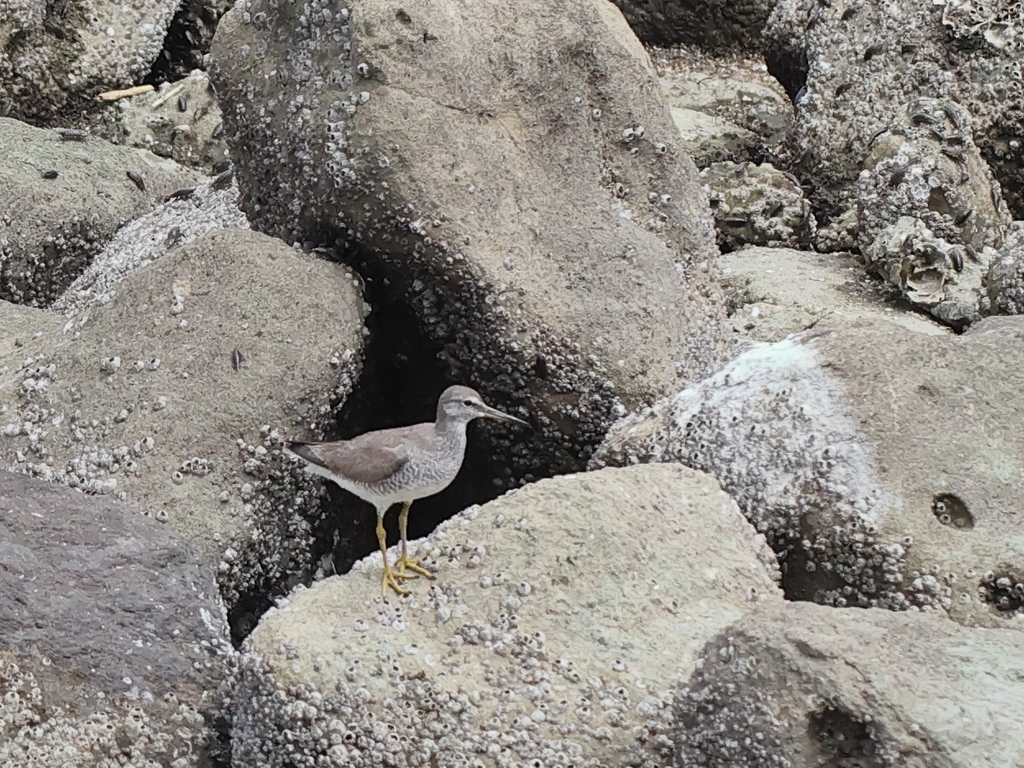
(c) Rainer Breitling, some rights reserved (CC BY) · licence
Family: Scolopacidae · Class: Aves · Order: Charadriiformes
Tringa brevipes (Gray-tailed Tattler) is a California animal in the Scolopacidae family.
The Gray-tailed Tattler is a medium-sized shorebird with a streamlined body adapted for probing mudflats and rocky shores. Adults measure 24 to 27 centimeters (9.4 to 10.6 inches) in length with a wingspan of 55 to 60 centimeters (21.7 to 23.6 inches). The species weighs between 95 and 165 grams (3.4 to 5.8 ounces). In breeding plumage, adults display dark gray upperparts with white underparts heavily barred with dark gray across the breast, flanks, and undertail coverts. The bill is straight, dark, and measures 35 to 40 millimeters in length. Legs are bright yellow to orange-yellow. Non-breeding adults show plain gray upperparts and white underparts with minimal barring. The tail appears uniformly gray from above, lacking the white outer tail feathers of the closely related Wandering Tattler. The Gray-tailed Tattler breeds across boreal and subarctic regions of Siberia, from the Ural Mountains east to Chukotka and Kamchatka. During migration and winter, the species occurs along coastlines from Southeast Asia to Australia and New Zealand. In California, Gray-tailed Tattlers are rare but regular migrants, primarily observed along the coast from April through May and August through October. The species has been recorded at various coastal locations including Monterey Bay, San Francisco Bay, and southern California beaches, though sightings remain uncommon with fewer than five individuals typically reported annually statewide. During the non-breeding season in California, Gray-tailed Tattlers inhabit rocky shores, mudflats, sandy beaches, and tidal pools. The species shows a preference for areas with mixed substrate types, including both sandy and rocky sections. Unlike many shorebirds that favor extensive mudflats, this species often forages along wave-washed rocks and in shallow tide pools. Elevation ranges from sea level to occasionally low coastal bluffs up to 10 meters above high tide. Gray-tailed Tattlers are primarily solitary or occur in small groups of two to five individuals during migration. The species feeds by probing soft substrates and picking prey from rock surfaces and crevices. Diet consists mainly of marine worms, crustaceans, mollusks, and small fish. Foraging behavior includes deliberate walking with periodic probing and gleaning from surfaces. The species is known for its bobbing motion when alert or disturbed. Breeding occurs on the tundra, where females lay three to four eggs in ground scrapes lined with lichens and leaves. Incubation lasts 23 to 24 days. The Gray-tailed Tattler is not federally listed and faces no immediate conservation concerns globally. The International Union for Conservation of Nature classifies the species as Least Concern. Population trends appear stable across the breeding range, though comprehensive surveys are limited due to remote nesting areas. In California, the species remains a rare but expected component of migrant shorebird communities. Climate change impacts on Arctic breeding grounds represent a potential long-term threat, as warming temperatures may alter tundra habitat and affect insect prey availability during the critical breeding season.
Classification
Class: Aves · Order: Charadriiformes · Family: Scolopacidae
Frequently asked questions
How is Tringa brevipes classified?
Tringa brevipes belongs to class Aves, order Charadriiformes, family Scolopacidae.
What family does Tringa brevipes belong to?
Tringa brevipes is in the Scolopacidae family.
What is Tringa brevipes?
The Gray-tailed Tattler is a medium-sized shorebird with a streamlined body adapted for probing mudflats and rocky shores.
Is Tringa brevipes found in California?
Yes. Tringa brevipes is recorded in California in The California Species Project's catalogue.
Related species
Other California species in the same genus, family, or bioregion.
Data from The California Species Project — 14,000+ California species with verified data from CNPS, CDFW, USFWS, and more.