Tringa erythropus
Spotted Redshank
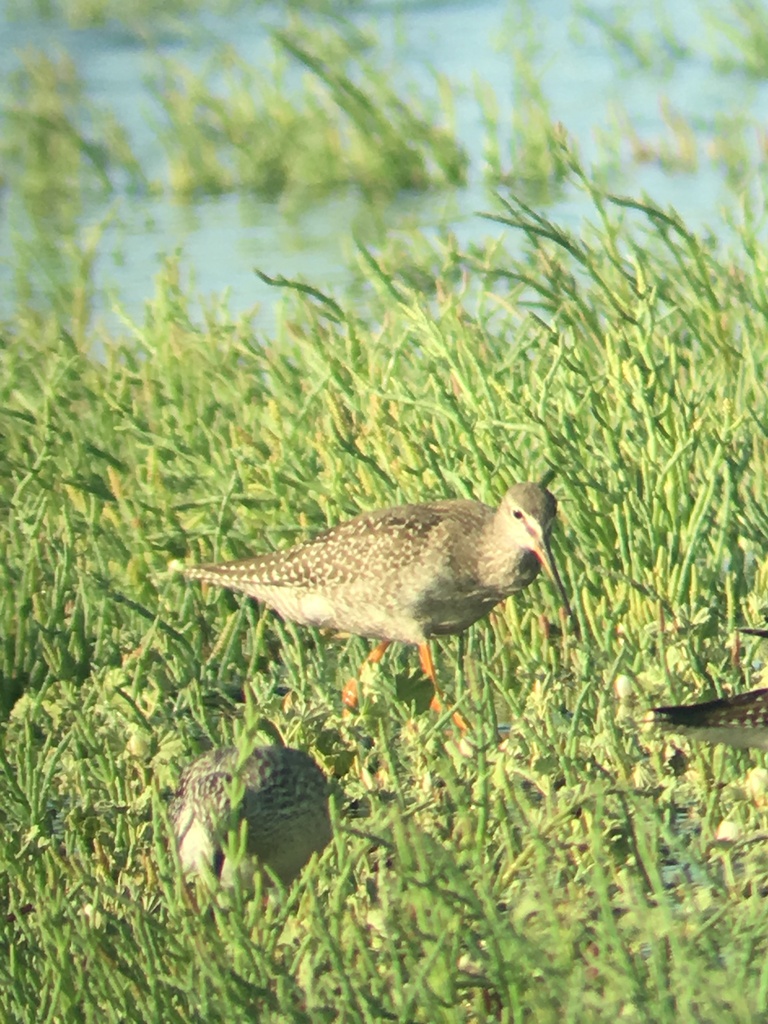
(c) Adam J. Searcy, some rights reserved (CC BY) · licence
Family: Scolopacidae · Class: Aves · Order: Charadriiformes
Tringa erythropus (Spotted Redshank) is a California animal in the Scolopacidae family.
The Spotted Redshank is a medium-sized shorebird measuring 29-31 cm (11.4-12.2 inches) in length with a wingspan of 61-67 cm (24-26 inches). During breeding season, adults display striking sooty black plumage with white spots on the back and wings, contrasting sharply with their bright red-orange legs and bill base. The bill is long, straight, and black-tipped. Non-breeding adults show pale gray upperparts and white underparts with fine barring on the flanks. In flight, the species exhibits a distinctive white wedge extending up the back and lacks wing bars, distinguishing it from similar species. The Spotted Redshank breeds across the subarctic regions of Eurasia, from Scandinavia east through Siberia. In North America, this species occurs as a rare vagrant, with California recording occasional sightings primarily along the coast and at inland wetlands. Most California records occur during fall migration from August through October, with scattered winter and spring observations. The species has been documented at locations including Bolsa Chica, Morro Bay, and various sites in the Central Valley. This species inhabits shallow freshwater and brackish wetlands, including mudflats, shallow ponds, flooded fields, and coastal lagoons. During breeding, Spotted Redshanks prefer open tundra with scattered pools and boggy areas. On wintering grounds and during migration, they utilize estuaries, fish ponds, and sewage treatment facilities where water depths allow for their preferred feeding behavior. Spotted Redshanks are active feeders, employing a distinctive swimming and up-ending technique while foraging, unlike most other sandpipers. They probe in soft substrates and pick prey from the surface, consuming aquatic invertebrates including worms, crustaceans, mollusks, and insect larvae. The species also takes small fish and occasionally plant material. Breeding occurs from May through July, with females laying 3-4 olive-brown eggs with dark markings in a ground scrape lined with vegetation. Males perform most incubation duties over a 22-24 day period. The Spotted Redshank is not federally or state-listed in California, as it occurs only as a rare vagrant rather than a breeding or regular wintering species. The global population is considered stable by BirdLife International, with an estimated 150,000-500,000 breeding pairs across its Eurasian range. Climate change may affect breeding habitat in Arctic regions, potentially influencing migration patterns and vagrant occurrence in California. The species faces typical shorebird threats including habitat loss at stopover sites and wintering areas, though these primarily affect populations outside North America. In California, the rarity of this species makes it of particular interest to birders and researchers studying vagrant patterns along the Pacific Flyway.
Classification
Class: Aves · Order: Charadriiformes · Family: Scolopacidae
Frequently asked questions
How is Tringa erythropus classified?
Tringa erythropus belongs to class Aves, order Charadriiformes, family Scolopacidae.
What family does Tringa erythropus belong to?
Tringa erythropus is in the Scolopacidae family.
What is Tringa erythropus?
The Spotted Redshank is a medium-sized shorebird measuring 29-31 cm (11.4-12.2 inches) in length with a wingspan of 61-67 cm (24-26 inches).
Is Tringa erythropus found in California?
Yes. Tringa erythropus is recorded in California in The California Species Project's catalogue.
Related species
Other California species in the same genus, family, or bioregion.
Data from The California Species Project — 14,000+ California species with verified data from CNPS, CDFW, USFWS, and more.