Tringa flavipes
Lesser Yellowlegs
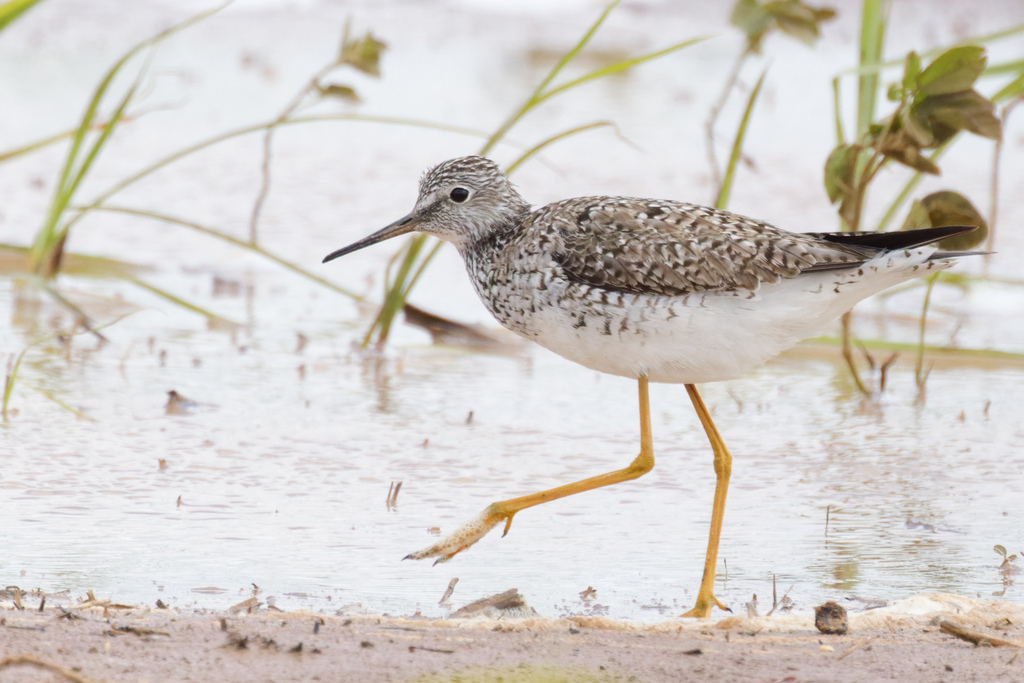
(c) Brent Cox, some rights reserved (CC BY) · licence
Family: Scolopacidae · Class: Aves · Order: Charadriiformes
Tringa flavipes (Lesser Yellowlegs) is a California animal in the Scolopacidae family.
The Lesser Yellowlegs is a medium-sized shorebird measuring 23 to 25 cm (9 to 10 inches) in length with a wingspan of 59 to 64 cm (23 to 25 inches). Adults weigh between 67 to 94 grams (2.4 to 3.3 ounces). The species displays a slender build with long, bright yellow legs that extend beyond the tail in flight. The bill is straight, thin, and dark, measuring approximately one-third the length of the head. Breeding adults exhibit dark brown upperparts with white spotting, while the underparts are white with dark streaking on the breast and flanks. Non-breeding plumage is grayer above with reduced streaking below. The species is distinguished from the Greater Yellowlegs by its smaller size, thinner bill, and different call structure. Lesser Yellowlegs breed across the boreal forests of Alaska and Canada, from central Alaska east to Labrador and south to northern Minnesota and Wisconsin. In California, the species occurs as a regular migrant and winter resident throughout the state. Migration occurs along all major flyways, with birds arriving in California from late June through September during fall migration, and departing from March through May during spring migration. Some individuals overwinter along the coast and in the Central Valley. During migration and winter, Lesser Yellowlegs inhabit shallow freshwater and brackish wetlands, including marshes, ponds, flooded fields, mudflats, and lagoons. The species prefers water depths of 5 to 23 cm (2 to 9 inches) and areas with soft substrates for foraging. In California, they utilize managed wetlands, seasonal pools, agricultural fields, sewage treatment ponds, and coastal estuaries. Breeding habitat consists of open areas within boreal forest, including bogs, muskegs, and the edges of small ponds and streams. Lesser Yellowlegs are active foragers, walking deliberately through shallow water while picking prey from the surface or probing into soft substrates. Their diet consists primarily of aquatic invertebrates including larvae of flies, beetles, and midges, as well as small crustaceans, worms, and occasionally small fish. The species exhibits both solitary and gregarious behavior, often forming mixed flocks with other shorebird species during migration. Breeding occurs from May through July, with females laying 3 to 4 eggs in a shallow scrape lined with grass and leaves. Incubation lasts 22 to 23 days, and young fledge approximately 18 to 20 days after hatching. The Lesser Yellowlegs is not federally or state listed in California and maintains stable population trends across most of its range according to the North American Breeding Bird Survey. However, the species faces ongoing threats from wetland habitat loss and degradation, particularly in staging and wintering areas. Climate change may alter breeding habitat in the boreal forest and affect the timing of insect emergence. Conservation efforts focus on wetland protection and restoration, including programs that maintain seasonal flooding cycles in agricultural areas that provide important foraging habitat during migration and winter periods.
Classification
Class: Aves · Order: Charadriiformes · Family: Scolopacidae
Frequently asked questions
How is Tringa flavipes classified?
Tringa flavipes belongs to class Aves, order Charadriiformes, family Scolopacidae.
What family does Tringa flavipes belong to?
Tringa flavipes is in the Scolopacidae family.
What is Tringa flavipes?
The Lesser Yellowlegs is a medium-sized shorebird measuring 23 to 25 cm (9 to 10 inches) in length with a wingspan of 59 to 64 cm (23 to 25 inches).
Is Tringa flavipes found in California?
Yes. Tringa flavipes is recorded in California in The California Species Project's catalogue.
Related species
Other California species in the same genus, family, or bioregion.
Data from The California Species Project — 14,000+ California species with verified data from CNPS, CDFW, USFWS, and more.