Tringa incana
Wandering Tattler
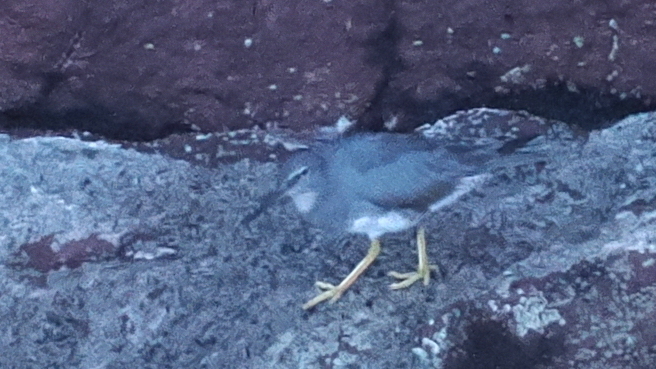
no rights reserved · CC0
Family: Scolopacidae · Class: Aves · Order: Charadriiformes
Tringa incana (Wandering Tattler) is a California animal in the Scolopacidae family.
The Wandering Tattler is a medium-sized shorebird measuring 25 to 29 centimeters (10 to 11.5 inches) in length with a wingspan of 50 to 55 centimeters (20 to 22 inches). Adults weigh 55 to 120 grams (1.9 to 4.2 ounces). During breeding season, the species displays uniform dark gray upperparts and heavily barred underparts with dark and white bands extending from the throat to the undertail coverts. The bill is straight, dark, and approximately equal in length to the head. Legs are bright yellow to orange-yellow. In non-breeding plumage, the underparts become uniformly pale gray without barring, creating a more subdued appearance. Juveniles resemble non-breeding adults but show subtle pale edges on the wing coverts. The Wandering Tattler breeds in mountainous regions of Alaska and northwestern Canada, nesting along gravel bars and rocky shores of swift-flowing streams above 300 meters (1,000 feet) elevation. During migration and winter, the species occurs along rocky coastlines from southeastern Alaska to Ecuador, including the Galápagos Islands and various Pacific islands. In California, Wandering Tattlers are present year-round along the coast, with peak numbers occurring during spring and fall migration periods from April to May and August to September. Some individuals remain through winter, particularly along the central and southern California coast. The species inhabits rocky intertidal zones, jetties, breakwaters, and occasionally sandy beaches during non-breeding periods. Wandering Tattlers show strong fidelity to specific coastal sites, often returning to the same rock formations annually. They prefer areas with exposed rock surfaces and tide pools where prey is accessible during low tide. The species typically avoids mudflats and soft sediment habitats preferred by other sandpipers. Wandering Tattlers are solitary foragers that use a deliberate picking and probing feeding strategy. Their diet consists primarily of marine invertebrates including amphipods, isopods, small crabs, marine worms, and mollusks gleaned from rock surfaces and crevices. The species exhibits a distinctive teetering behavior, constantly bobbing its tail while foraging. Breeding occurs from May through July, with pairs establishing territories along mountain streams. Nests are simple scrapes lined with pebbles and plant material, typically containing four eggs. Incubation lasts 23 to 25 days, with both parents sharing responsibilities. The Wandering Tattler is not federally or state-listed and maintains stable population trends according to the North American Breeding Bird Survey. However, the species faces localized threats from coastal development, human disturbance at roosting and foraging sites, oil spills, and climate change impacts on coastal habitats. Sea level rise may reduce available rocky intertidal habitat, while increased storm intensity could affect breeding success in mountain habitats. The species' reliance on specific rocky coastal environments makes it vulnerable to habitat degradation, though its wide distribution provides some population resilience.
Classification
Class: Aves · Order: Charadriiformes · Family: Scolopacidae
Frequently asked questions
How is Tringa incana classified?
Tringa incana belongs to class Aves, order Charadriiformes, family Scolopacidae.
What family does Tringa incana belong to?
Tringa incana is in the Scolopacidae family.
What is Tringa incana?
The Wandering Tattler is a medium-sized shorebird measuring 25 to 29 centimeters (10 to 11.5 inches) in length with a wingspan of 50 to 55 centimeters (20 to 22 inches).
Is Tringa incana found in California?
Yes. Tringa incana is recorded in California in The California Species Project's catalogue.
Related species
Other California species in the same genus, family, or bioregion.
Data from The California Species Project — 14,000+ California species with verified data from CNPS, CDFW, USFWS, and more.