Tringa melanoleuca
Greater Yellowlegs
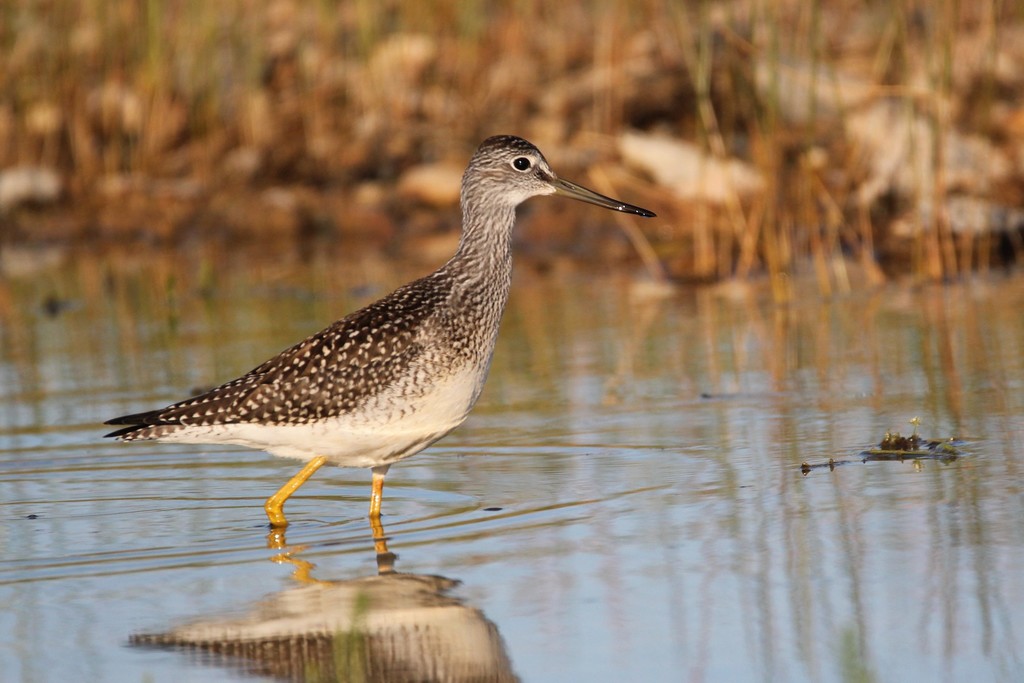
(c) Quinten Wiegersma, some rights reserved (CC BY) · licence
Family: Scolopacidae · Class: Aves · Order: Charadriiformes
Tringa melanoleuca (Greater Yellowlegs) is a California animal in the Scolopacidae family.
The Greater Yellowlegs is a large, long-legged shorebird measuring 29 to 40 cm (11.4 to 15.7 inches) in length with a wingspan of 70 to 74 cm (27.6 to 29.1 inches). Adults weigh between 111 to 250 grams (3.9 to 8.8 ounces). The species displays a distinctive long, slightly upturned bill that is dark at the tip and pale at the base, measuring 5.5 to 6.5 cm (2.2 to 2.6 inches). The bright yellow-orange legs extend well beyond the tail in flight, providing the species' common name. During breeding season, adults exhibit heavily barred underparts with dark streaking on the neck and breast. Non-breeding plumage is grayer above with less distinct markings below. The white rump and barred tail are visible in flight. Greater Yellowlegs breed across the boreal forests of Canada and Alaska, with nesting grounds extending from Newfoundland west to central Alaska. The species winters along both North American coasts from British Columbia to northern South America on the Pacific side, and from Nova Scotia to Argentina on the Atlantic coast. In California, Greater Yellowlegs are common migrants and winter residents from August through May, with peak migration occurring in September and April. They are found throughout the state's coastal areas, Central Valley wetlands, and mountain lakes up to 2,135 meters (7,000 feet) elevation. The species inhabits diverse wetland environments including saltwater marshes, mudflats, shallow ponds, flooded agricultural fields, sewage treatment ponds, and freshwater marshes. During migration and winter, they prefer areas with water depths of 10 to 25 cm (4 to 10 inches) where they can wade effectively. Breeding habitat consists of muskeg, bogs, and wet meadows near treeline in boreal and subarctic regions. Greater Yellowlegs are active foragers, using their sensitive bills to probe soft substrates and pick prey from water surfaces. Their diet includes small fish, aquatic invertebrates, marine worms, crustaceans, and insects. The species exhibits both visual and tactile feeding behaviors, often moving rapidly through shallow water while sweeping their bills side to side. Breeding occurs from May through July, with females laying 3 to 4 heavily spotted eggs in a shallow ground scrape lined with grass and leaves. Incubation lasts 22 to 23 days, performed primarily by females. Young are precocial and leave the nest within 24 hours of hatching. The Greater Yellowlegs is not federally listed and maintains stable population trends across most of its range. The North American Breeding Bird Survey indicates relatively stable populations from 1966 to 2019, though some regional declines have been documented in eastern breeding areas. Primary conservation concerns include wetland habitat loss, particularly in wintering and migration areas, and disturbance at roosting sites. Climate change may affect breeding habitat availability in northern regions and alter migration timing. The species benefits from wetland conservation programs and protected area networks throughout its range.
Classification
Class: Aves · Order: Charadriiformes · Family: Scolopacidae
Frequently asked questions
How is Tringa melanoleuca classified?
Tringa melanoleuca belongs to class Aves, order Charadriiformes, family Scolopacidae.
What family does Tringa melanoleuca belong to?
Tringa melanoleuca is in the Scolopacidae family.
What is Tringa melanoleuca?
The Greater Yellowlegs is a large, long-legged shorebird measuring 29 to 40 cm (11.4 to 15.7 inches) in length with a wingspan of 70 to 74 cm (27.6 to 29.1 inches).
Is Tringa melanoleuca found in California?
Yes. Tringa melanoleuca is recorded in California in The California Species Project's catalogue.
Related species
Other California species in the same genus, family, or bioregion.
Data from The California Species Project — 14,000+ California species with verified data from CNPS, CDFW, USFWS, and more.