Tringa nebularia
Common Greenshank
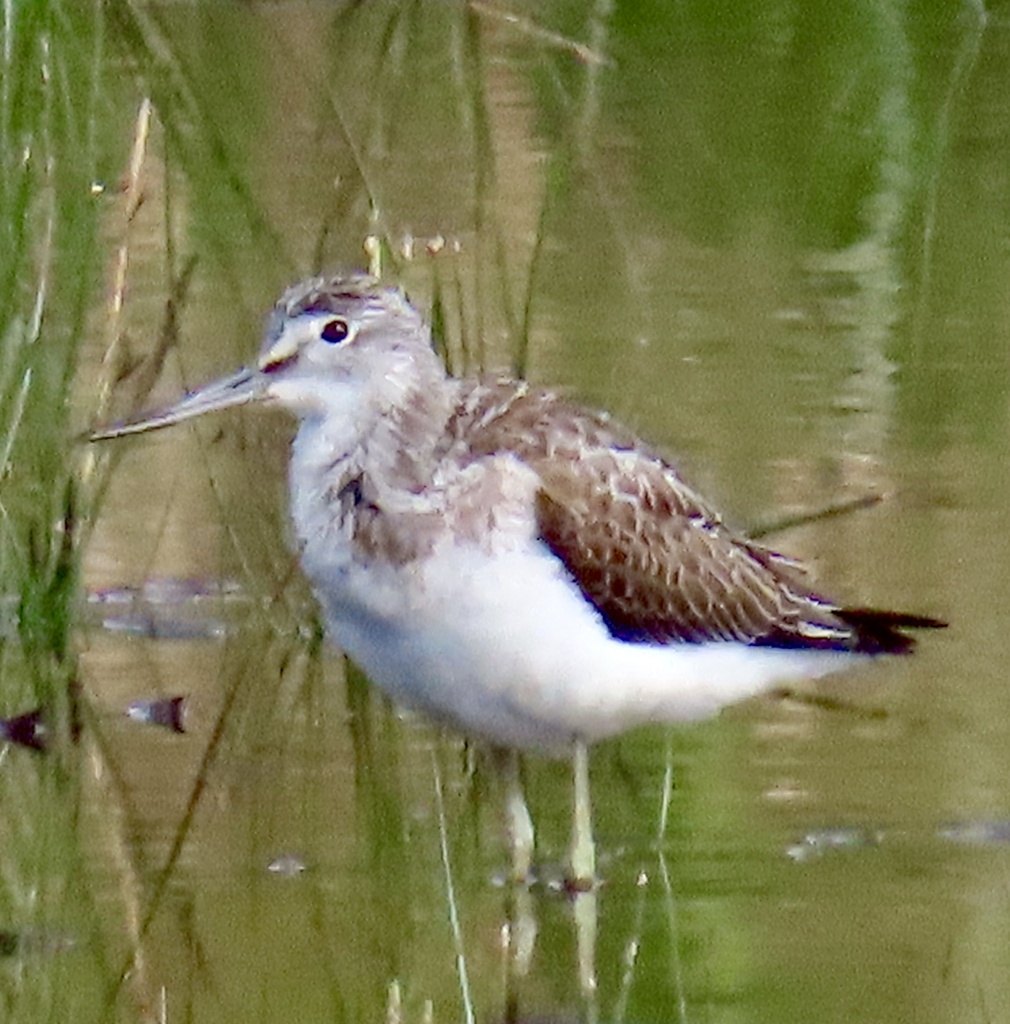
no rights reserved · CC0
Family: Scolopacidae · Class: Aves · Order: Charadriiformes
Tringa nebularia (Common Greenshank) is a California animal in the Scolopacidae family.
The Common Greenshank is a large wading bird in the sandpiper family, measuring 30 to 35 cm (12 to 14 inches) in length with a wingspan of 68 to 70 cm (27 to 28 inches). Adults weigh between 140 to 270 grams (4.9 to 9.5 ounces). The species displays a long, slightly upturned bill that is dark at the tip and greenish-yellow at the base. During breeding season, adults show dark streaking on the head, neck, and upperparts with white underparts. Non-breeding plumage is paler gray-brown above with less distinct markings. The legs are distinctively long and greenish-yellow, giving the species its common name. In flight, the white rump and back form a prominent wedge-shaped patch, and no wing stripe is visible. The Common Greenshank breeds across northern Eurasia from Scotland through Scandinavia, Russia, and central Asia to the Pacific coast. In North America, this species occurs as a rare vagrant, with most records from Alaska's western and northern coasts. In California, the Common Greenshank is an extremely rare vagrant with fewer than ten documented records. Most California sightings have occurred along the coast, particularly in the San Francisco Bay area, with occasional records from inland locations such as the Salton Sea. This species inhabits a variety of wetland environments including coastal mudflats, estuaries, salt marshes, freshwater marshes, shallow lakes, and flooded fields. During breeding season, Common Greenshanks prefer boreal forest clearings near wetlands, particularly areas with scattered trees and open ground. On wintering grounds and during migration, they utilize intertidal zones, fish ponds, and sewage treatment facilities. The species forages in water depths ranging from a few centimeters to knee-deep. Common Greenshanks are active foragers, wading through shallow water and probing mud and sand for invertebrates. Their diet consists primarily of marine worms, mollusks, crustaceans, and small fish, supplemented with insects during breeding season. They employ various feeding techniques including picking, probing, and occasionally swimming to capture prey. Breeding occurs from May to July, with nests constructed on the ground in scrapes lined with vegetation. Females typically lay four eggs, which are incubated for 24 to 25 days. Chicks are precocial and fledge after 25 to 31 days. Globally, the Common Greenshank maintains stable populations and is classified as Least Concern by the International Union for Conservation of Nature. The worldwide population is estimated between 440,000 to 1,300,000 individuals. In California, the species has no conservation status due to its extremely rare occurrence as a vagrant. Climate change and habitat loss in breeding areas pose potential long-term threats to the species' northern range, while coastal development and pollution affect wintering grounds throughout the species' range.
Classification
Class: Aves · Order: Charadriiformes · Family: Scolopacidae
Frequently asked questions
How is Tringa nebularia classified?
Tringa nebularia belongs to class Aves, order Charadriiformes, family Scolopacidae.
What family does Tringa nebularia belong to?
Tringa nebularia is in the Scolopacidae family.
What is Tringa nebularia?
The Common Greenshank is a large wading bird in the sandpiper family, measuring 30 to 35 cm (12 to 14 inches) in length with a wingspan of 68 to 70 cm (27 to 28 inches).
Is Tringa nebularia found in California?
Yes. Tringa nebularia is recorded in California in The California Species Project's catalogue.
Related species
Other California species in the same genus, family, or bioregion.
Data from The California Species Project — 14,000+ California species with verified data from CNPS, CDFW, USFWS, and more.