Tringa semipalmata
Willet
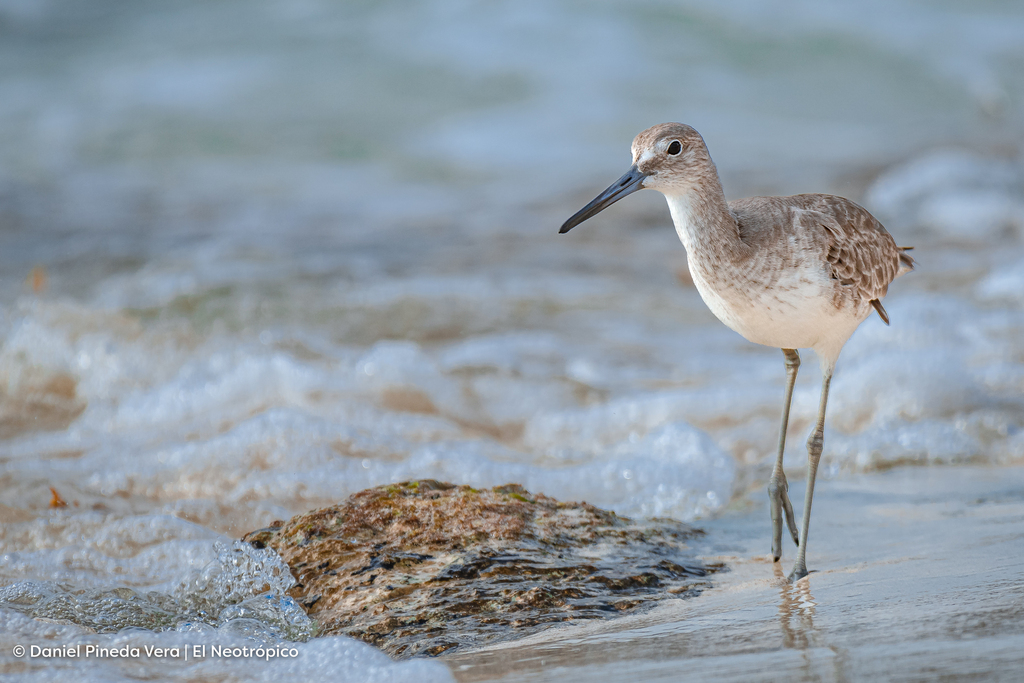
(c) Daniel Pineda Vera, some rights reserved (CC BY) · licence
Family: Scolopacidae · Class: Aves · Order: Charadriiformes
Tringa semipalmata (Willet) is a California animal in the Scolopacidae family.
The Willet is a large, stocky shorebird measuring 33 to 41 cm (13 to 16 inches) in length with a wingspan of 62 to 69 cm (24 to 27 inches). Adults weigh between 200 to 330 grams (7 to 12 ounces). The species exhibits subtle sexual dimorphism, with females typically larger than males. In breeding plumage, Willets display heavily barred underparts and mottled brown upperparts with darker streaks. Non-breeding adults appear more uniform grayish-brown above with pale underparts. The most distinctive feature is revealed in flight: bold black and white wing stripes create a striking pattern against otherwise cryptic plumage. The bill is straight and dark, measuring 5 to 7 cm (2 to 2.8 inches), while the legs are bluish-gray to dark gray. Willets breed across two distinct populations in North America. The western subspecies (T. s. inornata) breeds in the Great Plains and western interior, while the eastern subspecies (T. s. semipalmata) breeds along Atlantic and Gulf coasts. In California, Willets are primarily migrants and winter residents along the entire coastline, from Humboldt County south to San Diego County. They are particularly abundant in San Francisco Bay, Monterey Bay, and the Salton Sea. During migration, they utilize both coastal and interior wetlands, including seasonal flooding in the Central Valley. The species inhabits diverse wetland environments including salt marshes, mudflats, beaches, shallow lagoons, and tidal pools. During breeding season, western populations prefer prairie potholes, wet meadows, and shallow alkaline lakes at elevations ranging from 300 to 1,800 meters (1,000 to 6,000 feet). In California, wintering birds concentrate in estuarine environments with extensive mudflats and eelgrass beds that support abundant invertebrate prey. They readily use both natural and constructed wetlands, including sewage treatment ponds and managed wetlands. Willets are opportunistic foragers, probing soft substrates for polychaete worms, mollusks, crustaceans, and small fish. Their diet varies seasonally and geographically, with marine invertebrates dominating coastal areas and insects, small fish, and aquatic invertebrates important in freshwater habitats. Breeding occurs from April through July, with peak activity in May and June. Females typically lay four olive-buff eggs with dark brown spotting in a shallow scrape lined with grass. Incubation lasts 22 to 29 days, shared by both sexes. Chicks are precocial and fledge at approximately 28 days. The Willet is not federally listed and maintains stable continental populations, though regional variations exist. According to the North American Breeding Bird Survey, populations have remained relatively stable since 1970, with some fluctuations in different regions. Climate change poses potential long-term threats through sea level rise affecting coastal habitats and altered precipitation patterns impacting breeding areas. Habitat loss from coastal development and wetland conversion represents the primary conservation concern, particularly for wintering populations in California's heavily developed coastal zone.
Classification
Class: Aves · Order: Charadriiformes · Family: Scolopacidae
Frequently asked questions
How is Tringa semipalmata classified?
Tringa semipalmata belongs to class Aves, order Charadriiformes, family Scolopacidae.
What family does Tringa semipalmata belong to?
Tringa semipalmata is in the Scolopacidae family.
What is Tringa semipalmata?
The Willet is a large, stocky shorebird measuring 33 to 41 cm (13 to 16 inches) in length with a wingspan of 62 to 69 cm (24 to 27 inches).
Is Tringa semipalmata found in California?
Yes. Tringa semipalmata is recorded in California in The California Species Project's catalogue.
Related species
Other California species in the same genus, family, or bioregion.
Data from The California Species Project — 14,000+ California species with verified data from CNPS, CDFW, USFWS, and more.