Tringa solitaria
Solitary Sandpiper
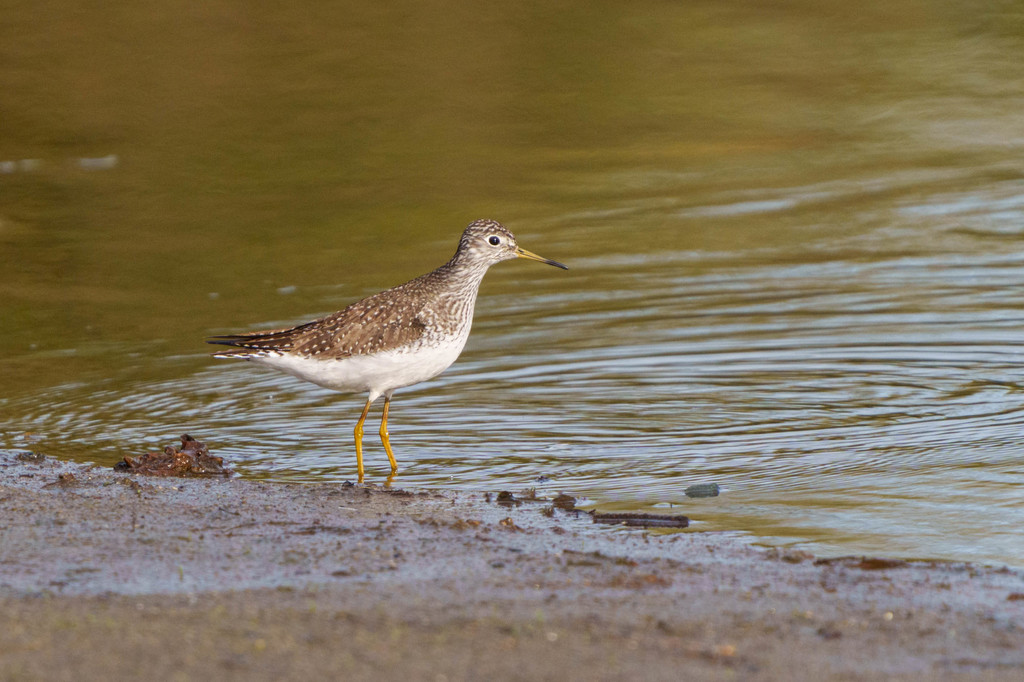
(c) Pete Lypkie, some rights reserved (CC BY) · licence
Family: Scolopacidae · Class: Aves · Order: Charadriiformes
Tringa solitaria (Solitary Sandpiper) is a California animal in the Scolopacidae family.
The Solitary Sandpiper is a medium-sized shorebird measuring 18-23 cm (7-9 inches) in length with a wingspan of 50-59 cm (20-23 inches). Adults weigh 31-65 grams. The species displays olive-brown to blackish upperparts heavily spotted with white, creating a distinctive speckled appearance. The underparts are white with dark streaking on the neck and breast. The bill is straight, dark, and approximately 30 mm long. Legs are yellowish-green to olive, distinguishing it from the bright yellow legs of the similar Lesser Yellowlegs. In flight, the wings appear dark with no prominent wing stripe, and the tail shows distinctive white outer feathers with dark barring. The Solitary Sandpiper breeds across the boreal forests of Alaska and Canada, from Alaska east to Newfoundland. During migration, the species occurs throughout North America. In California, Solitary Sandpipers are uncommon to rare migrants, appearing primarily during spring migration from late April through May and fall migration from July through September. They have been recorded in scattered locations throughout the state, including the Central Valley, coastal areas, and mountain lakes, though sightings remain infrequent. Unlike most shorebirds, Solitary Sandpipers utilize freshwater habitats almost exclusively. They frequent small ponds, woodland pools, marsh edges, muddy stream banks, and flooded fields. The species shows a preference for shallow water areas with muddy or soft substrates where invertebrate prey is accessible. During breeding season, they inhabit boreal and subarctic wetlands surrounded by coniferous forest. In California, migrants are typically observed at small freshwater impoundments, sewage ponds, and temporary wetlands. Solitary Sandpipers exhibit unique nesting behavior among North American shorebirds, using old tree nests of other birds rather than ground nesting. They commonly utilize abandoned nests of American Robins, Gray Jays, or Rusty Blackbirds, typically 1-6 meters above ground in coniferous trees. Females lay 3-4 eggs between late May and early July. The species feeds primarily on aquatic invertebrates including insects, larvae, crustaceans, and worms, captured through probing and picking at the water surface and substrate. As the name suggests, they are typically solitary, though small loose groups may form during migration. The Solitary Sandpiper is not federally listed and appears to maintain stable populations across its range. According to the North American Breeding Bird Survey, populations have remained relatively stable since 1970, though data are limited due to the species' remote breeding areas. The species faces potential threats from habitat loss in wintering areas, climate change affecting boreal breeding habitats, and wetland degradation along migration routes. In California, the species' status as an uncommon migrant reflects the state's position at the edge of the primary Pacific Flyway migration corridor, with most individuals following more easterly routes through the Great Plains.
Classification
Class: Aves · Order: Charadriiformes · Family: Scolopacidae
Frequently asked questions
How is Tringa solitaria classified?
Tringa solitaria belongs to class Aves, order Charadriiformes, family Scolopacidae.
What family does Tringa solitaria belong to?
Tringa solitaria is in the Scolopacidae family.
What is Tringa solitaria?
The Solitary Sandpiper is a medium-sized shorebird measuring 18-23 cm (7-9 inches) in length with a wingspan of 50-59 cm (20-23 inches).
Is Tringa solitaria found in California?
Yes. Tringa solitaria is recorded in California in The California Species Project's catalogue.
Related species
Other California species in the same genus, family, or bioregion.
Data from The California Species Project — 14,000+ California species with verified data from CNPS, CDFW, USFWS, and more.