Trioceros jacksonii
Jackson's Chameleon
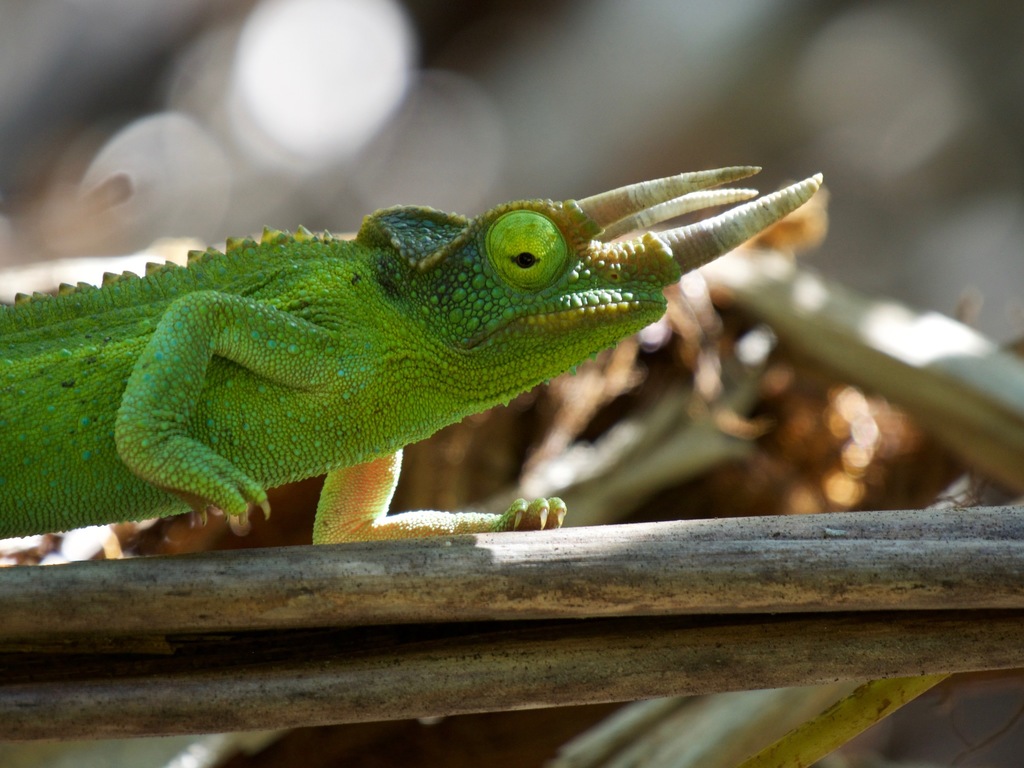
(c) Nils, some rights reserved (CC BY) · licence
Family: Chamaeleonidae · Class: Reptilia · Order: Squamata
Trioceros jacksonii (Jackson's Chameleon) is a California animal in the Chamaeleonidae family.
Jackson's chameleon is a medium-sized arboreal lizard native to East Africa that has established non-native populations in California. Adults typically measure 12.1 to 12.7 cm (4.75 to 5 inches) in snout-to-vent length, with total length including tail reaching 20 to 25 cm (8 to 10 inches). Males are distinguished by three prominent horns projecting from the head: one from the nose (rostral horn) and two from above the eyes (preocular horns). Females possess a single, smaller rostral horn or lack horns entirely. The species exhibits the characteristic chameleon features of independently moving eyes, a prehensile tail, and zygodactylous feet adapted for grasping branches. Coloration varies from bright green to brown, with the ability to change color based on temperature, mood, and social interactions. In California, Jackson's chameleons have established populations in San Luis Obispo County, particularly around Morro Bay, and in Orange County near Laguna Beach. Additional populations may exist in Los Angeles County on the Palos Verdes Peninsula and in San Diego County, though establishment status in these areas remains uncertain. The species has also been documented in Balboa Park in San Diego. These California populations originated from escaped or released pets, as the species is popular in the reptile trade. Jackson's chameleons inhabit cool, humid environments with dense vegetation. In their native range in Kenya and Tanzania, they occur at elevations above 3,000 meters (9,842 feet) in montane forests. California populations occupy coastal areas with similar cool, moist conditions, particularly areas that experience morning fog. They are strictly arboreal, preferring shrubs, trees, and dense vegetation that provides cover and hunting opportunities. The species requires high humidity and is vulnerable to desiccation in dry environments. These chameleons are insectivorous, feeding primarily on a variety of arthropods including flies, crickets, moths, and other small invertebrates. They are ambush predators, using their projectile tongues to capture prey from distances up to their body length. Jackson's chameleons are ovoviviparous, with females giving birth to 8 to 30 live young after a gestation period of 5 to 6 months. Breeding typically occurs during the rainy season in their native range, but California populations may have adapted to local seasonal patterns. Males are territorial and display aggressive behaviors including color changes, head bobbing, and horn displays when confronting rivals. Jackson's chameleons are not federally or state listed in California, as they are a non-native species. However, their establishment raises ecological concerns about potential impacts on native arthropod communities and competition with native insectivorous species. The species' dependence on specific microclimatic conditions may limit its spread in California's Mediterranean climate, confining populations to coastal areas with adequate humidity and temperature stability.
Classification
Class: Reptilia · Order: Squamata · Family: Chamaeleonidae
Frequently asked questions
How is Trioceros jacksonii classified?
Trioceros jacksonii belongs to class Reptilia, order Squamata, family Chamaeleonidae.
What family does Trioceros jacksonii belong to?
Trioceros jacksonii is in the Chamaeleonidae family.
What is Trioceros jacksonii?
Jackson's chameleon is a medium-sized arboreal lizard native to East Africa that has established non-native populations in California.
Is Trioceros jacksonii found in California?
Yes. Trioceros jacksonii is recorded in California in The California Species Project's catalogue.
More California species
This species has no close relatives in our California data — here are other species to explore.
Data from The California Species Project — 14,000+ California species with verified data from CNPS, CDFW, USFWS, and more.