Troglodytes aedon
House Wren
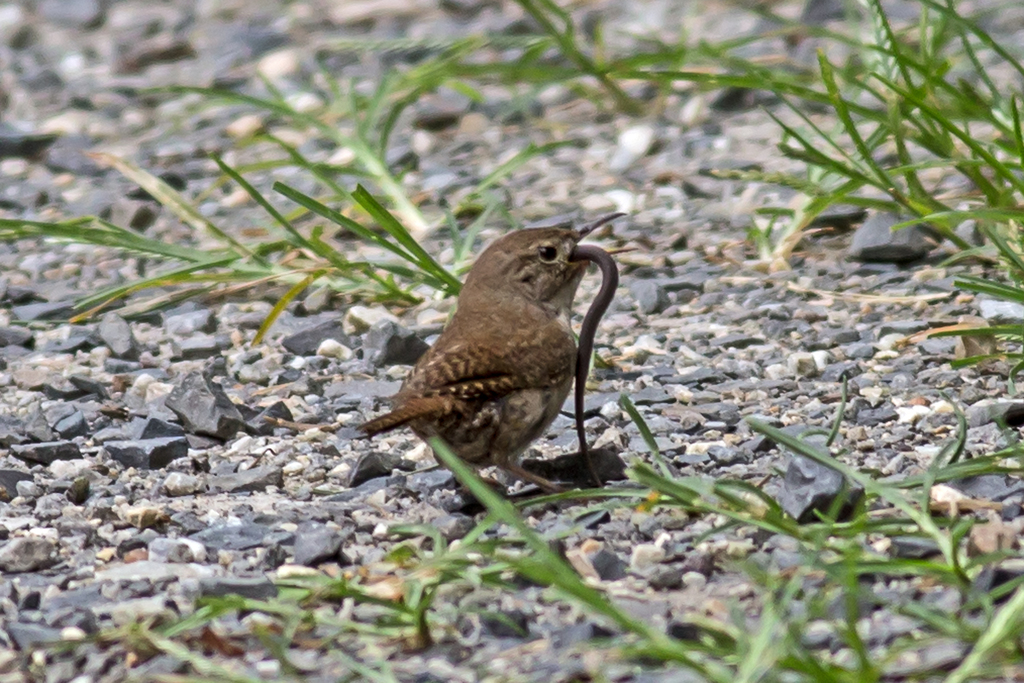
(c) Bill Keim, some rights reserved (CC BY) · licence
Family: Troglodytidae · Class: Aves · Order: Passeriformes
Troglodytes aedon (House Wren) is a California animal in the Troglodytidae family.
The House Wren is a small, compact songbird measuring 11 to 13 cm (4.3 to 5.1 inches) in length with a wingspan of 15 to 17 cm (5.9 to 6.7 inches). Adults weigh 10 to 12 grams. The species displays relatively plain brown plumage with subtle barring on the wings and tail. The upperparts are grayish-brown to reddish-brown, while the underparts are pale gray-brown with faint barring on the flanks. The bill is thin, slightly curved, and well-adapted for capturing insects. Both sexes appear similar, though males may be slightly larger. A distinguishing feature is the frequently held erect tail position and the bird's characteristic energetic movements. House Wrens breed across much of North America, from southern Canada through Central America. In California, they occur as breeding residents in mountainous regions and foothills, primarily in the Sierra Nevada, Cascade Range, and northern Coast Ranges. The species is found from Siskiyou and Modoc counties south through the Sierra Nevada to Kern County, with scattered populations in coastal ranges from Marin County north. During winter, most California populations migrate to lower elevations or southern regions, though some individuals remain in milder coastal areas. This species inhabits a variety of woodland and edge habitats, typically preferring open or semi-open areas with scattered trees and shrubs. House Wrens occupy elevations from near sea level to approximately 2,400 meters (7,900 feet) in California's mountains. They utilize riparian woodlands, oak woodlands, mixed coniferous forests, parks, and residential areas with mature trees. The species requires suitable cavity-nesting sites, including natural tree holes, old woodpecker cavities, and artificial nest boxes. House Wrens are primarily insectivorous, consuming beetles, caterpillars, moths, flies, ants, and spiders. They forage actively by gleaning insects from bark, leaves, and branches, often moving quickly through dense vegetation. Males establish territories in spring and construct multiple stick nests in cavities to attract females. Breeding occurs from April through July, with females laying 4 to 8 white eggs with fine reddish-brown spots. Incubation lasts 12 to 14 days, and nestlings fledge after 12 to 18 days. The species commonly produces two broods per season in suitable habitat. House Wrens are not federally or state-listed and maintain stable populations across most of their range. According to the North American Breeding Bird Survey, continental populations have remained relatively stable over recent decades. In California, populations appear secure in suitable mountain and foothill habitats. Primary conservation concerns include habitat loss from urban development and forest management practices that reduce cavity availability. Climate change may affect distribution patterns by altering suitable breeding habitat at higher elevations. Nest box programs have successfully supported local populations in some areas where natural cavities are limited.
Classification
Class: Aves · Order: Passeriformes · Family: Troglodytidae
Frequently asked questions
How is Troglodytes aedon classified?
Troglodytes aedon belongs to class Aves, order Passeriformes, family Troglodytidae.
What family does Troglodytes aedon belong to?
Troglodytes aedon is in the Troglodytidae family.
What is Troglodytes aedon?
The House Wren is a small, compact songbird measuring 11 to 13 cm (4.3 to 5.1 inches) in length with a wingspan of 15 to 17 cm (5.9 to 6.7 inches).
Is Troglodytes aedon found in California?
Yes. Troglodytes aedon is recorded in California in The California Species Project's catalogue.
Related species
Other California species in the same genus, family, or bioregion.
Data from The California Species Project — 14,000+ California species with verified data from CNPS, CDFW, USFWS, and more.