Troglodytes hiemalis
Winter Wren
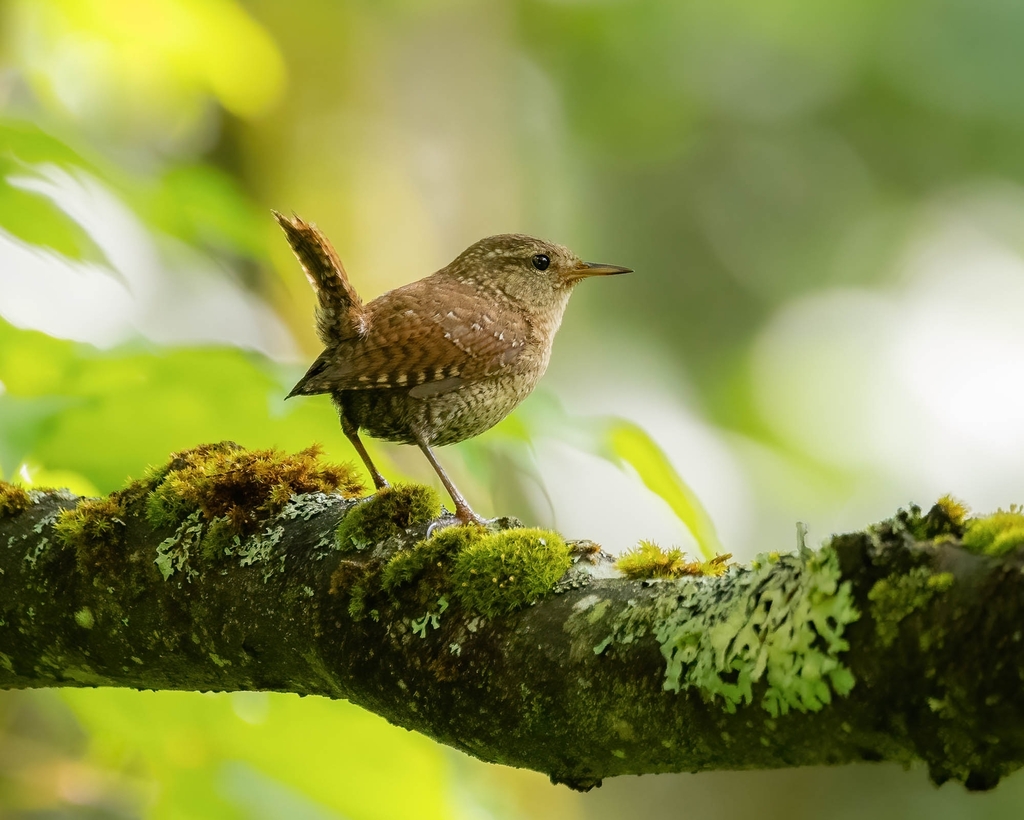
(c) Derek Spencer, some rights reserved (CC BY) · licence
Family: Troglodytidae · Class: Aves · Order: Passeriformes
Troglodytes hiemalis (Winter Wren) is a California animal in the Troglodytidae family.
The Winter Wren is a diminutive songbird measuring 8 to 10 centimeters (3.1 to 3.9 inches) in length with a wingspan of 13 to 17 centimeters (5.1 to 6.7 inches). Adults weigh between 8 to 12 grams (0.28 to 0.42 ounces), making them one of North America's smallest wrens. The plumage is predominantly dark brown with intricate barring of black and lighter brown across the wings, tail, and flanks. The underparts are slightly paler brown with subtle buff coloring on the throat and breast. A faint pale eyebrow stripe extends above the dark eye, and the short tail is typically held erect. The bill is thin, slightly curved, and dark-colored, adapted for gleaning insects from bark crevices. The Winter Wren breeds across the boreal forests of Alaska and Canada, extending south through the mountainous regions of the western United States, including the Pacific Northwest, northern Rocky Mountains, and the Appalachian Mountains. In California, breeding populations occur primarily in the coastal ranges from Humboldt County south to Monterey County, with scattered populations in the Sierra Nevada at elevations above 1,500 meters (4,900 feet). During winter, the species expands its range southward, reaching central California and occasionally the southern portions of the state. This species inhabits dense coniferous and mixed forests with extensive understory vegetation, fallen logs, and thick brush. In California, Winter Wrens typically occupy old-growth and mature second-growth forests dominated by Douglas fir, coast redwood, and mixed evergreen species. They show strong preference for areas with abundant coarse woody debris, including fallen trees, root tangles, and dense shrub layers. Breeding territories are established in moist, shaded ravines and creek bottoms where humidity remains high throughout the nesting season. Winter Wrens are primarily insectivorous, foraging by gleaning arthropods from bark surfaces, fallen logs, and leaf litter. Their diet consists of beetles, caterpillars, flies, spiders, and other small invertebrates. Males establish territories in early spring and produce complex, cascading songs that can last 8 to 10 seconds and contain over 100 notes. The species is polygynous, with males potentially mating with multiple females. Females construct dome-shaped nests in cavities among tree roots, fallen logs, or dense vegetation, typically 0.3 to 3 meters (1 to 10 feet) above ground. Clutches contain 4 to 7 white eggs with reddish-brown speckles, and incubation lasts 12 to 16 days. The Winter Wren is not federally or state-listed and maintains stable populations across most of its range. However, the species faces potential threats from habitat loss due to intensive logging practices that remove old-growth characteristics essential for nesting and foraging. Climate change may also impact high-elevation populations by altering forest composition and reducing suitable habitat. Conservation efforts focus on maintaining mature forest structure and preserving coarse woody debris in managed forests.
Classification
Class: Aves · Order: Passeriformes · Family: Troglodytidae
Frequently asked questions
How is Troglodytes hiemalis classified?
Troglodytes hiemalis belongs to class Aves, order Passeriformes, family Troglodytidae.
What family does Troglodytes hiemalis belong to?
Troglodytes hiemalis is in the Troglodytidae family.
What is Troglodytes hiemalis?
The Winter Wren is a diminutive songbird measuring 8 to 10 centimeters (3.1 to 3.9 inches) in length with a wingspan of 13 to 17 centimeters (5.1 to 6.7 inches).
Is Troglodytes hiemalis found in California?
Yes. Troglodytes hiemalis is recorded in California in The California Species Project's catalogue.
Related species
Other California species in the same genus, family, or bioregion.
Data from The California Species Project — 14,000+ California species with verified data from CNPS, CDFW, USFWS, and more.