Troglodytes pacificus
Pacific Wren
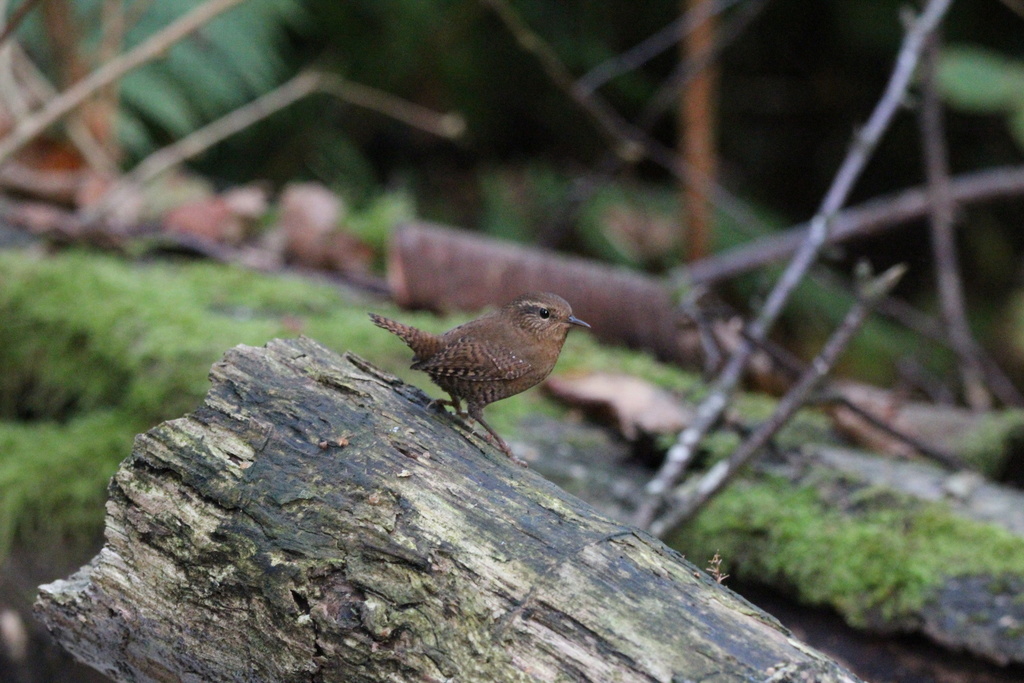
(c) Justin Flint, some rights reserved (CC BY) · licence
Family: Troglodytidae · Class: Aves · Order: Passeriformes
Troglodytes pacificus (Pacific Wren) is a California animal in the Troglodytidae family.
The Pacific Wren is a small, compact songbird measuring 9 to 11 cm (3.5 to 4.3 inches) in length with a wingspan of 13 to 17 cm (5.1 to 6.7 inches). Adults weigh 8 to 12 grams. The species displays rich brown plumage with subtle barring on the wings, tail, and flanks. The underparts are lighter brown to buff-colored, while the back and crown show darker brown tones. A faint pale eyebrow stripe extends above the eye. The tail is typically held upright, a characteristic behavior of wrens. The bill is thin, slightly curved, and dark brown, adapted for gleaning insects from bark crevices. Historically considered a subspecies of the Winter Wren, the Pacific Wren was recognized as a distinct species in 2010 following genetic and vocal analyses. The species ranges along the Pacific Coast from British Columbia south to central California. In California, Pacific Wrens inhabit the coastal mountains from Del Norte and Humboldt counties south through the Santa Cruz Mountains to Monterey County. They also occur in the Sierra Nevada foothills and some populations are found in the Transverse and Peninsular ranges of southern California. Pacific Wrens occupy dense, humid coniferous and mixed forests, particularly those dominated by Douglas fir, coast redwood, and tanoak. They prefer areas with abundant fallen logs, dense understory vegetation, and stream corridors. The species is typically found from sea level to elevations of 2,100 meters (6,900 feet), though they are most common below 1,500 meters (4,900 feet). Optimal habitat includes old-growth and mature second-growth forests with substantial woody debris and thick ground cover. The species is insectivorous, foraging primarily for beetles, moths, caterpillars, spiders, and other small arthropods. Pacific Wrens exhibit secretive behavior, moving through dense undergrowth and fallen logs while searching for prey in bark crevices and leaf litter. Males establish territories in spring and produce complex, melodious songs lasting 8 to 10 seconds with rapid trills and warbles. Breeding occurs from April through July, with females constructing dome-shaped nests in cavities among tree roots, fallen logs, or dense vegetation. Clutch size ranges from 4 to 7 eggs, which are incubated for 14 to 16 days. Young fledge after 15 to 17 days but remain dependent on parents for an additional two weeks. The Pacific Wren is not federally or state-listed and maintains stable populations throughout most of its range as of December 2025. However, the species faces localized threats from habitat loss due to logging, urban development, and wildfire. Climate change may affect suitable habitat distribution, particularly at lower elevations. Forest management practices that retain large woody debris, dense understory, and old-growth characteristics benefit Pacific Wren populations. The species serves as an indicator of healthy forest ecosystems and responds positively to habitat restoration efforts that maintain structural complexity in forested environments.
Classification
Class: Aves · Order: Passeriformes · Family: Troglodytidae
Frequently asked questions
How is Troglodytes pacificus classified?
Troglodytes pacificus belongs to class Aves, order Passeriformes, family Troglodytidae.
What family does Troglodytes pacificus belong to?
Troglodytes pacificus is in the Troglodytidae family.
What is Troglodytes pacificus?
The Pacific Wren is a small, compact songbird measuring 9 to 11 cm (3.5 to 4.3 inches) in length with a wingspan of 13 to 17 cm (5.1 to 6.7 inches).
Is Troglodytes pacificus found in California?
Yes. Troglodytes pacificus is recorded in California in The California Species Project's catalogue.
Related species
Other California species in the same genus, family, or bioregion.
Data from The California Species Project — 14,000+ California species with verified data from CNPS, CDFW, USFWS, and more.