Turdus migratorius
American Robin
(c) Mila Turov, some rights reserved (CC BY) · licence
Family: Turdidae · Class: Aves · Order: Passeriformes
Turdus migratorius (American Robin) is a California animal in the Turdidae family.
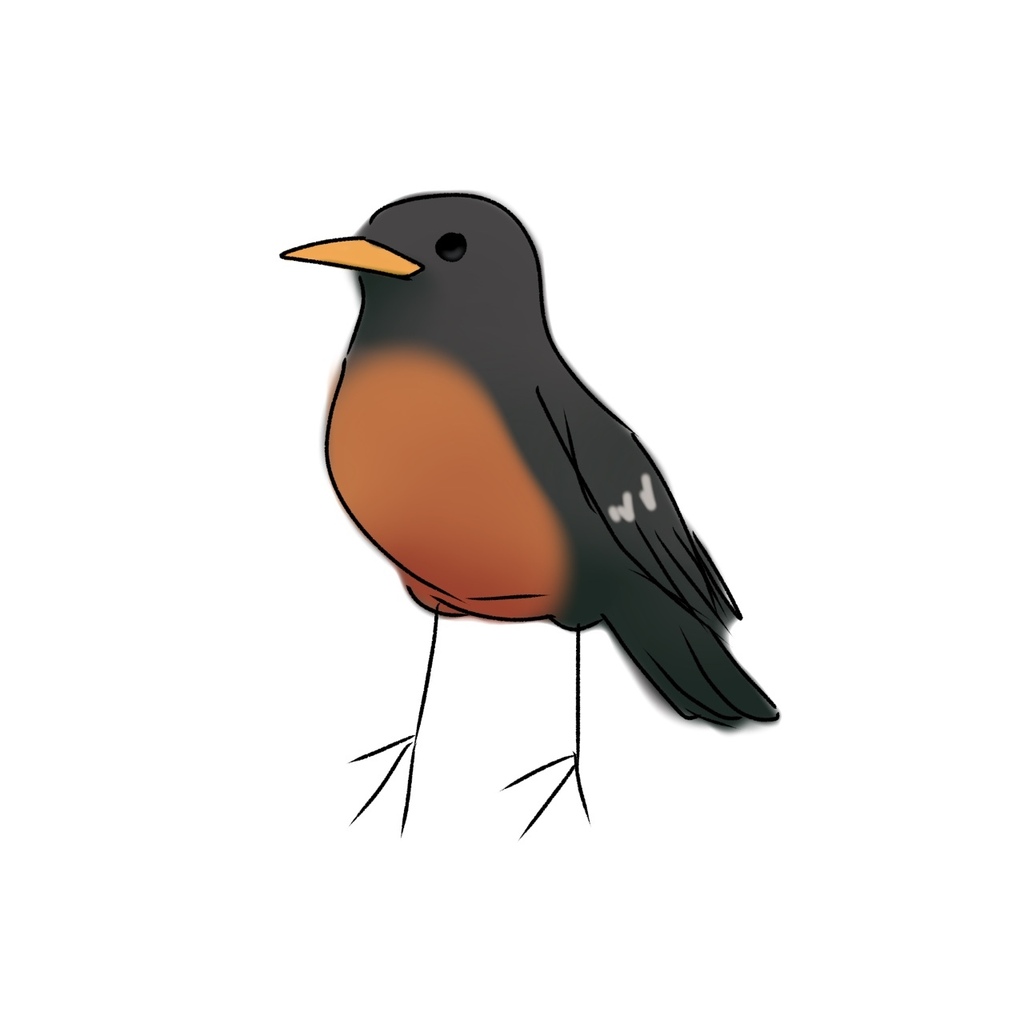
The American Robin is a medium-sized thrush measuring 20 to 28 cm (8 to 11 inches) in length with a wingspan of 31 to 41 cm (12 to 16 inches). Adult males display a dark gray to black head and back, with a distinctive brick-red to orange-red breast and belly. The lower belly and undertail coverts are white. Females exhibit similar coloration but with duller, lighter tones throughout. Both sexes have a yellow bill with a dark tip, white eye rings, and dark legs. Juveniles show heavily spotted breasts and lack the solid red coloration of adults. American Robins have one of the largest breeding ranges of any North American bird, extending from Alaska and northern Canada south to central Mexico. In California, they occur year-round as both residents and migrants throughout most of the state, from sea level to approximately 3,660 meters (12,000 feet) elevation. Populations are found in all California counties, with highest densities in areas with suitable habitat including urban parks, suburban neighborhoods, and mixed woodland environments. The species occupies diverse habitats including deciduous and mixed forests, woodland edges, parks, golf courses, suburban lawns, and agricultural areas. American Robins require areas with short grass or bare ground for foraging, combined with trees or shrubs for nesting and roosting. They adapt readily to human-modified landscapes and are among the most urbanized bird species in North America. During winter, they often form large flocks in areas with abundant fruit trees. American Robins are primarily ground-foraging omnivores, feeding on earthworms, insects, larvae, and various fruits and berries. They employ a distinctive hunting behavior, running across lawns and pausing to cock their heads while listening for prey movement underground. Breeding occurs from April through July in California, with females constructing cup-shaped nests of grass, twigs, and mud in tree branches or human structures 1.5 to 4.6 meters (5 to 15 feet) above ground. Females lay 3 to 5 pale blue eggs, incubating them for 12 to 14 days. Young fledge after 13 to 16 days but continue to receive parental care for several weeks. Most pairs produce two to three broods annually. The American Robin maintains stable populations across most of its range and is not federally or state listed. According to the North American Breeding Bird Survey, continental populations have remained relatively stable since 1966, with some regional variations. The species benefits from suburban development that creates ideal habitat conditions of short grass areas adjacent to trees. Primary threats include window strikes, domestic cat predation, and pesticide exposure, particularly during the breeding season. Climate change may affect northern populations through altered precipitation patterns and temperature regimes, but the species' adaptability and broad habitat tolerance suggest continued population stability.
Classification
Class: Aves · Order: Passeriformes · Family: Turdidae
Frequently asked questions
How is Turdus migratorius classified?
Turdus migratorius belongs to class Aves, order Passeriformes, family Turdidae.
What family does Turdus migratorius belong to?
Turdus migratorius is in the Turdidae family.
What is Turdus migratorius?
The American Robin is a medium-sized thrush measuring 20 to 28 cm (8 to 11 inches) in length with a wingspan of 31 to 41 cm (12 to 16 inches).
Is Turdus migratorius found in California?
Yes. Turdus migratorius is recorded in California in The California Species Project's catalogue.
Related species
Other California species in the same genus, family, or bioregion.
Data from The California Species Project — 14,000+ California species with verified data from CNPS, CDFW, USFWS, and more.