Turdus obscurus
Eyebrowed Thrush
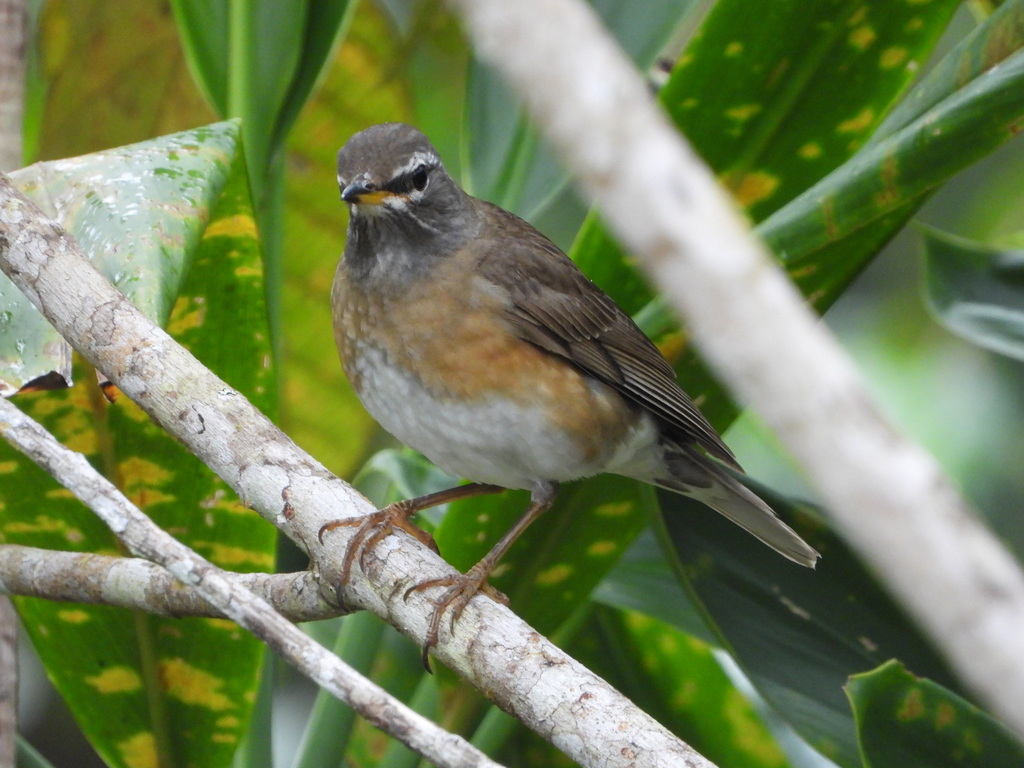
no rights reserved · CC0
Family: Turdidae · Class: Aves · Order: Passeriformes
Turdus obscurus (Eyebrowed Thrush) is a California animal in the Turdidae family.
The Eyebrowed Thrush is a medium-sized songbird measuring 22 to 24 centimeters (8.7 to 9.4 inches) in length with a wingspan of 34 to 38 centimeters (13.4 to 15.0 inches). Adults weigh between 55 to 85 grams (1.9 to 3.0 ounces). The species exhibits sexual dimorphism in plumage. Males display a distinctive slate-gray head and upperparts with a prominent white eyebrow stripe that extends from above the eye to the nape. The throat and upper breast are pale orange-buff, transitioning to white on the lower breast and belly with dark spotting on the sides. Females are generally browner overall with less distinct markings, showing a brownish-gray head and back with a less prominent buff eyebrow stripe. Both sexes have a dark bill, orange-yellow legs, and a dark eye. The Eyebrowed Thrush breeds across the boreal forests of Siberia, from the Ural Mountains east to Kamchatka and south to northeastern China, Mongolia, and the Russian Far East. During winter, the species migrates to Southeast Asia, including southern China, Myanmar, Thailand, Laos, Vietnam, and occasionally the Philippines. In North America, the Eyebrowed Thrush is considered a rare vagrant, with most records occurring in Alaska, particularly the Aleutian Islands and Bering Sea islands. California records are extremely rare, with fewer than five documented occurrences, primarily along the coast during fall migration periods. Breeding habitat consists of dense coniferous and mixed forests, particularly those dominated by spruce, fir, and birch trees. The species prefers forest edges, clearings with scattered trees, and areas with dense understory vegetation. During migration and winter, Eyebrowed Thrushes utilize a broader range of habitats including deciduous woodlands, parks, gardens, and scrubland. In California, vagrant individuals have been found in coastal scrub, riparian areas, and urban parks with mature trees. Eyebrowed Thrushes are primarily insectivorous during the breeding season, feeding on beetles, caterpillars, flies, and other invertebrates gleaned from foliage and the ground. During fall and winter, the diet shifts to include berries and fruits, particularly those of elderberry, rowan, and various shrubs. Breeding occurs from May to July, with pairs constructing cup-shaped nests in tree forks or dense shrubs 2 to 6 meters (6.6 to 19.7 feet) above ground. Females lay 3 to 6 pale blue eggs with brown spotting, which are incubated for 13 to 14 days. Both parents feed the nestlings, which fledge after 13 to 15 days. The Eyebrowed Thrush is not federally listed in the United States and has no special conservation status in California due to its vagrant status. The species is classified as Least Concern by the International Union for Conservation of Nature, with stable populations throughout its native range. Climate change and habitat loss in breeding areas represent potential long-term threats, but current population trends remain stable across most of the species' range.
Classification
Class: Aves · Order: Passeriformes · Family: Turdidae
Frequently asked questions
How is Turdus obscurus classified?
Turdus obscurus belongs to class Aves, order Passeriformes, family Turdidae.
What family does Turdus obscurus belong to?
Turdus obscurus is in the Turdidae family.
What is Turdus obscurus?
The Eyebrowed Thrush is a medium-sized songbird measuring 22 to 24 centimeters (8.7 to 9.4 inches) in length with a wingspan of 34 to 38 centimeters (13.4 to 15.0 inches).
Is Turdus obscurus found in California?
Yes. Turdus obscurus is recorded in California in The California Species Project's catalogue.
Related species
Other California species in the same genus, family, or bioregion.
Data from The California Species Project — 14,000+ California species with verified data from CNPS, CDFW, USFWS, and more.