Turdus rufopalliatus
Rufous-backed Robin
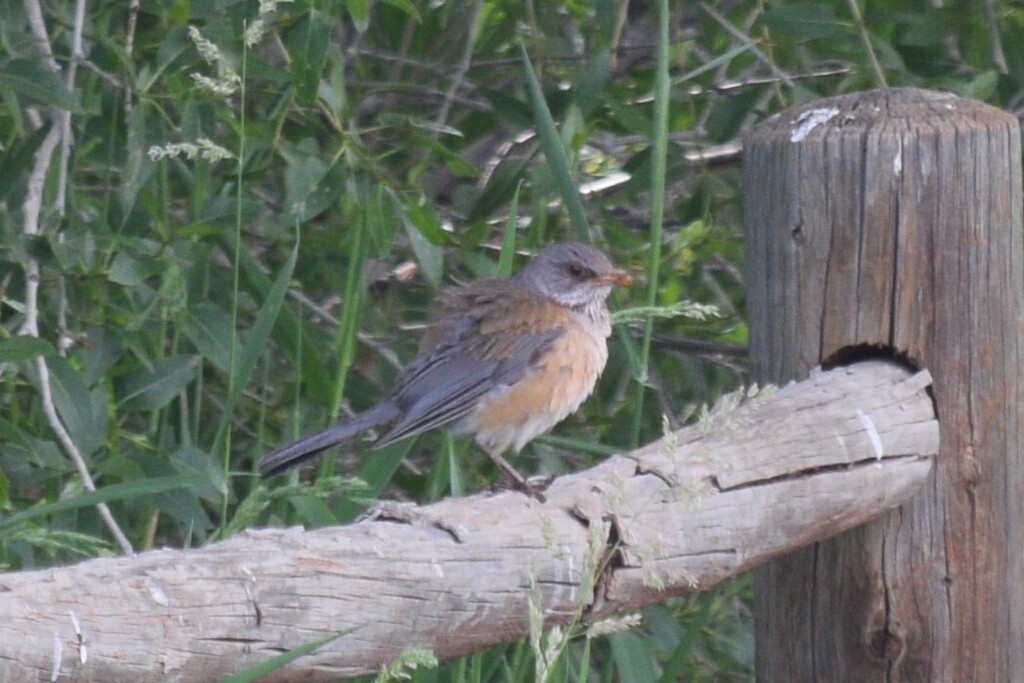
(c) William Harmon, some rights reserved (CC BY) · licence
Family: Turdidae · Class: Aves · Order: Passeriformes
Turdus rufopalliatus (Rufous-backed Robin) is a California animal in the Turdidae family.
The Rufous-backed Robin is a medium-sized thrush measuring 21 to 24 centimeters (8.3 to 9.4 inches) in length with a wingspan of approximately 35 to 38 centimeters (13.8 to 15.0 inches). Adult males display distinctive plumage with a bright rufous back and rump, contrasting sharply with a blackish head, throat, and upper breast. The lower breast and belly are white to pale gray, often with dark spotting on the upper breast. Females are similar but generally duller, with brownish rather than blackish head coloration. Both sexes have a yellow-orange bill with a dark tip and yellow to orange legs. Juveniles show heavy spotting on the back and underparts, similar to other juvenile thrushes. The species is primarily resident in western Mexico, ranging from Sonora and Chihuahua south through Jalisco and into parts of central Mexico. In the United States, Rufous-backed Robin occurs as a vagrant or winter visitor, with most records concentrated in Arizona, particularly in the Sonoran Desert regions near the Mexican border. California records are extremely rare, with only a handful of documented occurrences over several decades, primarily in the southern counties during fall and winter months. These California sightings typically represent birds that have wandered north from their normal range in northwestern Mexico. Rufous-backed Robins inhabit arid and semi-arid regions, favoring thornscrub, desert washes, riparian woodlands, and oak-pine forests at elevations from sea level to approximately 2,500 meters (8,200 feet). In their core Mexican range, they occupy diverse habitats including tropical deciduous forests, pine-oak woodlands, and cultivated areas with scattered trees. During vagrant appearances in California, birds are typically found in desert oases, parks with large trees, or riparian areas that provide suitable foraging opportunities. The species exhibits typical thrush foraging behavior, feeding primarily on fruits, berries, and invertebrates. They forage both on the ground, turning over leaf litter to locate insects and worms, and in trees where they consume various fruits including figs, elderberries, and cactus fruits. Breeding occurs from April through August in their native range, with females constructing cup-shaped nests of twigs, grass, and mud placed in tree forks or dense shrubs. Clutches typically contain 2 to 4 pale blue eggs with brown spotting. The species is known for its melodious song, similar to that of American Robin but with distinct phrases and variations. Rufous-backed Robin is not federally or state listed in California, reflecting its status as an occasional vagrant rather than a breeding resident. In Mexico, populations appear stable across most of their range, though habitat conversion and urbanization pose localized threats. The species adapts well to modified landscapes, including agricultural areas and suburban environments with appropriate vegetation. Climate change may potentially affect the frequency of vagrant occurrences in California, though the species' vagrant status makes population monitoring challenging in the state.
Classification
Class: Aves · Order: Passeriformes · Family: Turdidae
Frequently asked questions
How is Turdus rufopalliatus classified?
Turdus rufopalliatus belongs to class Aves, order Passeriformes, family Turdidae.
What family does Turdus rufopalliatus belong to?
Turdus rufopalliatus is in the Turdidae family.
What is Turdus rufopalliatus?
The Rufous-backed Robin is a medium-sized thrush measuring 21 to 24 centimeters (8.3 to 9.4 inches) in length with a wingspan of approximately 35 to 38 centimeters (13.8 to 15.0 inches).
Is Turdus rufopalliatus found in California?
Yes. Turdus rufopalliatus is recorded in California in The California Species Project's catalogue.
Related species
Other California species in the same genus, family, or bioregion.
Data from The California Species Project — 14,000+ California species with verified data from CNPS, CDFW, USFWS, and more.