Tursiops truncatus
Common Bottlenose Dolphin
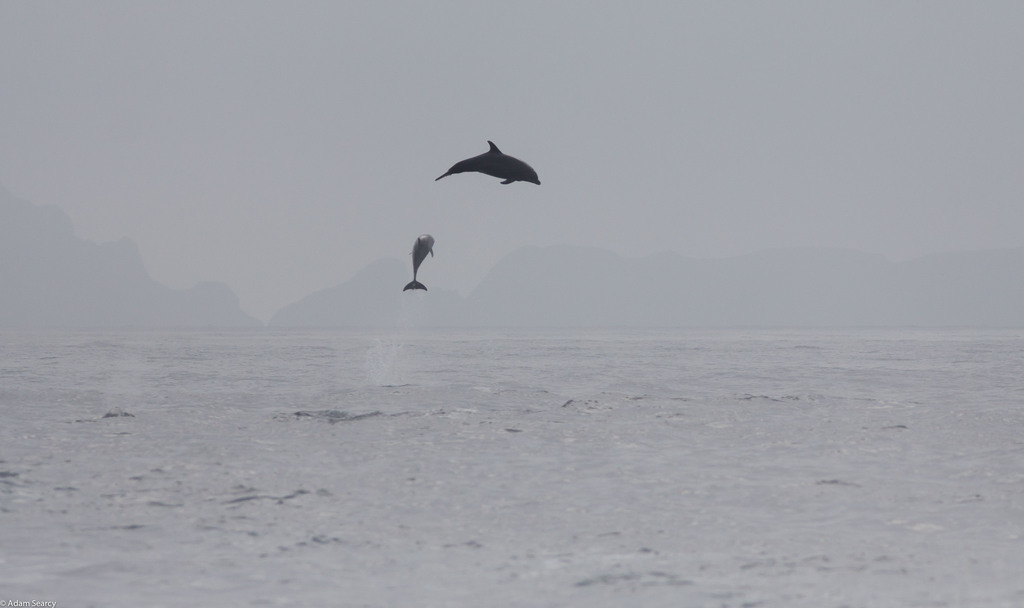
(c) Adam J. Searcy, some rights reserved (CC BY) · licence
Family: Delphinidae · Class: Mammalia · Order: Artiodactyla
Tursiops truncatus (Common Bottlenose Dolphin) is a California animal in the Delphinidae family.
The common bottlenose dolphin is a robust marine mammal measuring 2.0 to 4.0 meters (6.6 to 13.1 feet) in length and weighing 150 to 650 kilograms (330 to 1,430 pounds). Adults display a characteristic dark gray dorsal coloration that gradually fades to light gray or white on the ventral surface. The species is distinguished by its pronounced beak-like rostrum, typically measuring 7.0 to 8.0 centimeters (2.8 to 3.1 inches) in length, and a prominent melon that houses the echolocation organ. The dorsal fin is tall, curved, and positioned at the midpoint of the body. Sexual dimorphism is evident, with males averaging 20 percent larger than females. Bottlenose dolphins inhabit coastal and offshore waters throughout California's continental shelf and slope regions. The species occurs from the Mexican border north to Humboldt County, with year-round populations documented in Southern California waters including the Channel Islands, Monterey Bay, and San Francisco Bay. According to NOAA Fisheries, California waters support portions of multiple distinct population segments, including the California coastal stock and offshore populations that extend into international waters. The species occupies diverse marine habitats from nearshore waters less than 10 meters deep to offshore environments exceeding 2,000 meters in depth. Coastal populations prefer areas with sandy bottoms, kelp forests, and rocky reefs, while offshore ecotypes inhabit pelagic waters over the continental slope. Water temperature preferences range from 10 to 32 degrees Celsius, though California populations typically encounter temperatures between 12 and 22 degrees Celsius. Bottlenose dolphins are highly social animals that form pods ranging from 2 to 30 individuals, though temporary aggregations may exceed 1,000 animals. The species exhibits a fission-fusion social structure, with pod composition changing frequently. Reproduction is seasonal in California waters, with calving peaks occurring from spring through early fall. Females reach sexual maturity at 5 to 13 years and produce single calves after a 12-month gestation period. Calving intervals average 3 to 6 years. The species demonstrates sophisticated foraging behaviors, including cooperative hunting, fish whacking, and strand feeding. Diet consists primarily of fish, squid, and crustaceans, with prey selection varying by habitat and season. Bottlenose dolphins are not federally listed under the Endangered Species Act, though specific populations face conservation concerns. The California coastal stock is considered stable with an estimated 346,000 individuals as of the most recent NOAA assessment. Primary threats include entanglement in fishing gear, vessel strikes, pollution including plastic debris and chemical contaminants, noise pollution from shipping and sonar, and habitat degradation from coastal development. Climate change affects prey distribution and ocean temperature patterns. The Marine Mammal Protection Act provides federal protection, prohibiting harassment, hunting, capture, or killing of marine mammals in U.S. waters.
Classification
Class: Mammalia · Order: Artiodactyla · Family: Delphinidae
Frequently asked questions
How is Tursiops truncatus classified?
Tursiops truncatus belongs to class Mammalia, order Artiodactyla, family Delphinidae.
What family does Tursiops truncatus belong to?
Tursiops truncatus is in the Delphinidae family.
What is Tursiops truncatus?
The common bottlenose dolphin is a robust marine mammal measuring 2.0 to 4.0 meters (6.6 to 13.1 feet) in length and weighing 150 to 650 kilograms (330 to 1,430 pounds).
Is Tursiops truncatus found in California?
Yes. Tursiops truncatus is recorded in California in The California Species Project's catalogue.
Related species
Other California species in the same genus, family, or bioregion.
Data from The California Species Project — 14,000+ California species with verified data from CNPS, CDFW, USFWS, and more.