Tylobolus uncigerus
Black Round Millipede
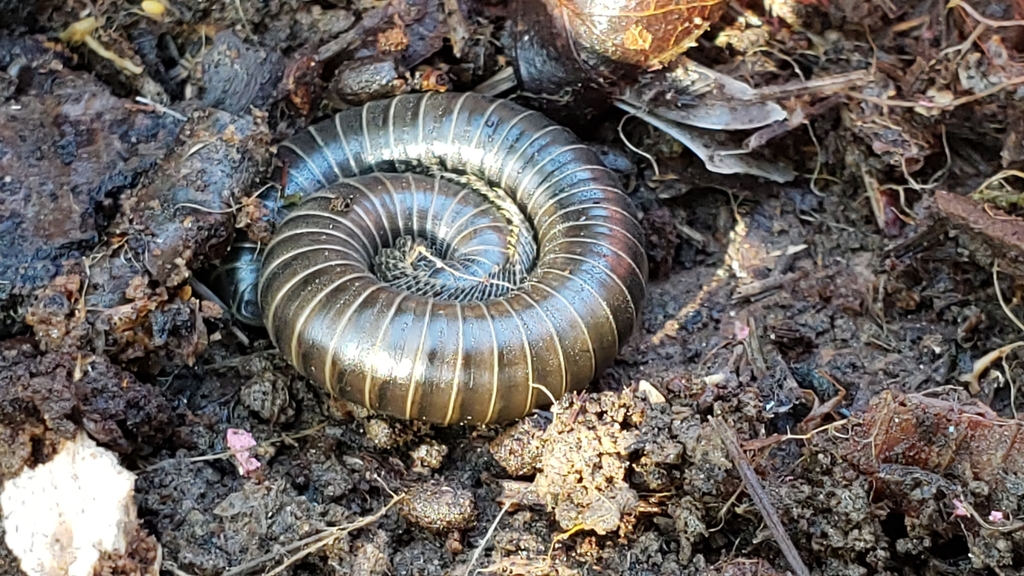
(c) Gavin Slater, some rights reserved (CC BY) · licence
Family: Spirobolidae · Class: Diplopoda · Order: Spirobolida
Tylobolus uncigerus (Black Round Millipede) is a California animal in the Spirobolidae family.
Tylobolus uncigerus is a millipede species belonging to the family Spirobolidae within the order Spirobolida. As a member of the class Diplopoda, this arthropod possesses the characteristic double pair of legs per body segment that distinguishes millipedes from other myriapods. The species is classified within the subfamily Tylobolinae and is one of seven species currently recognized within the genus Tylobolus. The physical characteristics of T. uncigerus follow the typical spirobolid body plan, with an elongated, cylindrical form composed of numerous segments. Like other members of its family, this species likely exhibits a dark coloration and can coil defensively when threatened, a behavior common among spirobolid millipedes. The body segments are ring-like, each bearing two pairs of legs except for the first few segments. According to the U.S. Fish and Wildlife Service, T. uncigerus occurs in both Mexico and the United States. Within the United States, the species' range includes various locations, though specific distributional details within individual states remain poorly documented in the scientific literature. The binational distribution suggests this millipede inhabits regions along the U.S.-Mexico border or has a broader range extending into both countries. Habitat preferences for T. uncigerus have not been extensively documented in available scientific literature. Like other spirobolid millipedes, the species likely inhabits soil and leaf litter environments where it can find suitable organic matter for feeding. Most millipedes in this family prefer areas with adequate moisture and organic debris, including forest floors, grasslands, and areas with decomposing plant material. As a detritivore, T. uncigerus likely feeds on decaying organic matter, including dead leaves, wood fragments, and other plant debris. Millipedes play important ecological roles as decomposers, helping to break down organic matter and recycle nutrients in soil ecosystems. The species probably exhibits typical millipede reproductive behavior, with individuals reaching sexual maturity after several molts and females laying eggs in soil or organic matter. The conservation status of T. uncigerus is currently listed as "Not Listed" by the U.S. Fish and Wildlife Service, indicating it does not receive federal protection under the Endangered Species Act. The Pacific Region (Region 1) serves as the lead region for this species wherever it is found. No specific conservation concerns, population trends, or threats have been documented for this species in readily available scientific literature. The limited scientific documentation available for T. uncigerus reflects a common challenge in millipede taxonomy and ecology, where many species remain understudied despite their ecological importance. Additional research is needed to better understand the species' detailed morphology, habitat requirements, distribution patterns, and ecological role within its native ecosystems.
Classification
Class: Diplopoda · Order: Spirobolida · Family: Spirobolidae
Frequently asked questions
How is Tylobolus uncigerus classified?
Tylobolus uncigerus belongs to class Diplopoda, order Spirobolida, family Spirobolidae.
What family does Tylobolus uncigerus belong to?
Tylobolus uncigerus is in the Spirobolidae family.
What is Tylobolus uncigerus?
Tylobolus uncigerus is a millipede species belonging to the family Spirobolidae within the order Spirobolida.
Is Tylobolus uncigerus found in California?
Yes. Tylobolus uncigerus is recorded in California in The California Species Project's catalogue.
More California species
This species has no close relatives in our California data — here are other species to explore.
Data from The California Species Project — 14,000+ California species with verified data from CNPS, CDFW, USFWS, and more.