Tympanuchus phasianellus columbianus
Columbian Sharp-tailed Grouse
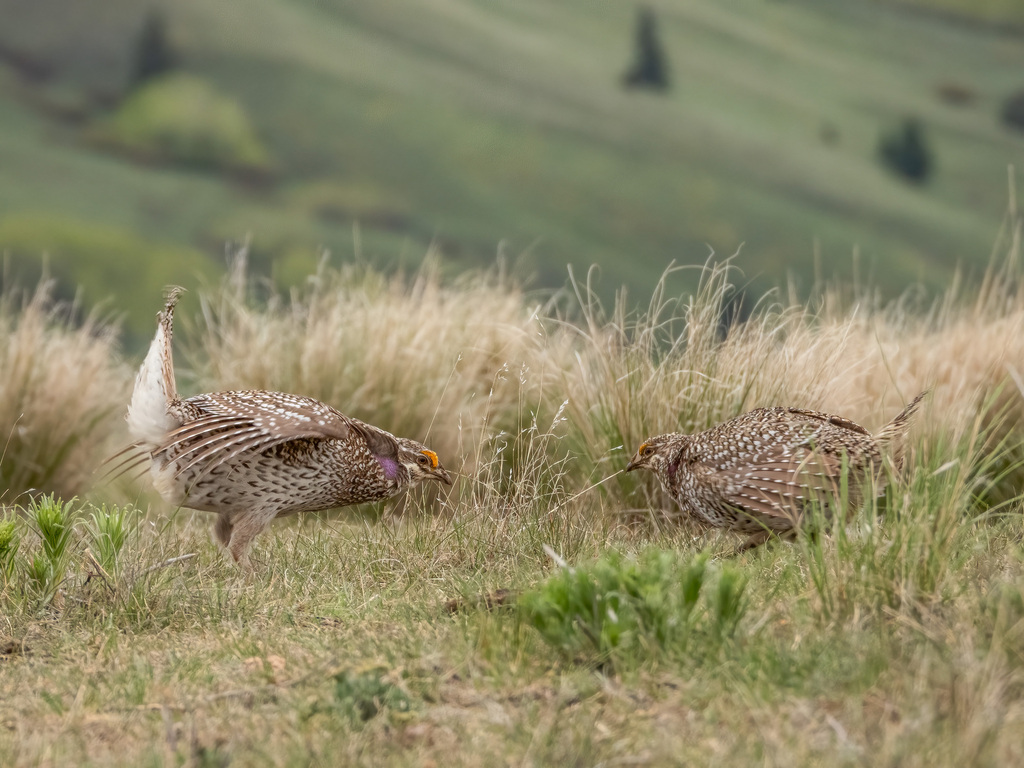
(c) Jason Alexander, some rights reserved (CC BY) · licence
Family: Phasianidae · Class: Aves · Order: Galliformes
Conservation status: G5T3 SX
Tympanuchus phasianellus columbianus (Columbian Sharp-tailed Grouse) is a California animal in the Phasianidae family.
The Columbian sharp-tailed grouse is a medium-sized prairie grouse subspecies measuring approximately 40-50 cm (16-20 inches) in length and weighing 680-1,200 grams (1.5-2.6 pounds). Adults display mottled brown, white, and buff plumage with darker barring that provides effective camouflage in grassland habitats. The tail is distinctive, appearing square when spread with prominent white outer feathers that flash conspicuously during flight. Males develop yellowish air sacs and elongated neck feathers during breeding season, which they display prominently during courtship rituals. Historically, this subspecies ranged across the intermountain western United States, including California, Colorado, Idaho, Montana, Nevada, Oregon, Utah, and Washington. However, the current distribution represents a dramatic range contraction. The subspecies was extirpated from Nevada by 1952, California by 1960, and Oregon by 1970, and has been nearly extirpated from Montana (NatureServe Explorer). Today, viable populations persist primarily in Idaho, Washington, and small portions of Colorado, occupying less than 10% of their former range. Columbian sharp-tailed grouse inhabit shrub-steppe ecosystems, semi-desert grasslands, and areas dominated by big sagebrush (Artemisia tridentata) communities. They require large expanses of relatively undisturbed native vegetation for successful breeding and foraging. These birds utilize a mosaic of habitats including grasslands for feeding, shrublands for cover, and open areas for lekking displays. Elevation ranges typically span from valley floors to moderate elevations in the intermountain region. This subspecies exhibits complex social behaviors centered around communal breeding displays called leks. Males gather at traditional dancing grounds from March through May, performing elaborate courtship displays that include foot-stamping, tail-rattling, and producing distinctive cooing calls using their inflated neck sacs. Females visit leks to select mates, then nest solitarily in grass cover. Clutches typically contain 10-14 eggs, with incubation lasting approximately 23 days. Chicks are precocial, leaving the nest within hours of hatching. The diet consists primarily of seeds, leaves, and flowers of native plants, with insects providing important protein for growing chicks. The Columbian sharp-tailed grouse carries a NatureServe global rank of G5T3, indicating the subspecies is vulnerable to extirpation. Primary threats include habitat conversion to agriculture, which has eliminated approximately 75% of shrub-steppe habitat in portions of their range over the past century. Urban development, energy infrastructure, and invasive plant species further fragment remaining habitat. Conservation efforts focus on protecting and restoring large blocks of native shrub-steppe habitat through programs like the Conservation Reserve Program and habitat conservation plans. The subspecies is considered a Federal Species of Concern in some states and receives various state-level protections throughout its remaining range. Recovery depends on maintaining connectivity between remaining populations and restoring degraded habitats to support sustainable population levels.
Classification
Class: Aves · Order: Galliformes · Family: Phasianidae
Conservation status
G5T3 SX
Frequently asked questions
How is Tympanuchus phasianellus columbianus classified?
Tympanuchus phasianellus columbianus belongs to class Aves, order Galliformes, family Phasianidae.
What family does Tympanuchus phasianellus columbianus belong to?
Tympanuchus phasianellus columbianus is in the Phasianidae family.
Is Tympanuchus phasianellus columbianus protected or of conservation concern?
Tympanuchus phasianellus columbianus carries the following status: G5T3 SX.
What is Tympanuchus phasianellus columbianus?
The Columbian sharp-tailed grouse is a medium-sized prairie grouse subspecies measuring approximately 40-50 cm (16-20 inches) in length and weighing 680-1,200 grams (1.5-2.6 pounds).
Is Tympanuchus phasianellus columbianus found in California?
Yes. Tympanuchus phasianellus columbianus is recorded in California in The California Species Project's catalogue.
Related species
Other California species in the same genus, family, or bioregion.
Data from The California Species Project — 14,000+ California species with verified data from CNPS, CDFW, USFWS, and more.