Tyrannus crassirostris
Thick-billed Kingbird
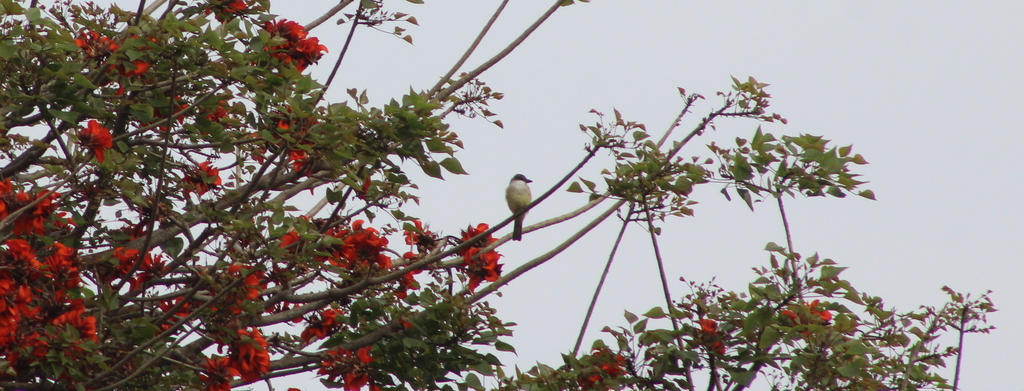
(c) Archer Silverman, some rights reserved (CC BY) · licence
Family: Tyrannidae · Class: Aves · Order: Passeriformes
Tyrannus crassirostris (Thick-billed Kingbird) is a California animal in the Tyrannidae family.
The Thick-billed Kingbird is a large, robust flycatcher measuring 22 to 24 cm (8.7 to 9.4 inches) in length with a wingspan of approximately 38 to 41 cm (15 to 16 inches). Adults weigh between 47 to 65 grams. The species displays a prominent thick, heavy black bill that distinguishes it from other kingbird species. The head and back are brownish-gray, while the throat and breast are white to pale gray. The belly shows a distinct yellow wash, and the wings appear dark brown to black with white edging on the flight feathers. The tail is dark with white outer edges, and adults show a concealed orange-red crown patch that becomes visible during aggressive displays or courtship. The Thick-billed Kingbird has a limited range in the extreme southwestern United States, primarily occurring in Arizona and southwestern New Mexico. In California, the species is considered a vagrant, with rare documented sightings in the southeastern desert regions near the Colorado River and in Imperial County. The core breeding range extends through northwestern Mexico, including Sonora and Sinaloa. Historical records suggest the species may have been more regular in southeastern California during the early 20th century, but current occurrence remains sporadic and unpredictable. This kingbird inhabits riparian woodlands, desert washes, and areas with scattered large trees, particularly cottonwoods and willows. The species shows preference for elevations from sea level to approximately 1,200 meters (3,900 feet). In its core range, Thick-billed Kingbirds favor areas near permanent or seasonal water sources, including river valleys, stream corridors, and agricultural areas with irrigation. They require tall perches for hunting and large trees for nesting, often selecting sites in the canopy of mature cottonwoods or sycamores. Thick-billed Kingbirds are active aerial insectivores, capturing prey through sallying flights from prominent perches. Their diet consists primarily of large insects including beetles, grasshoppers, cicadas, and flying ants. They also consume berries and small fruits, particularly during migration and winter months. Breeding occurs from May through July, with pairs constructing a cup-shaped nest of twigs, grass, and plant fibers placed in the fork of a large tree branch, typically 6 to 15 meters (20 to 49 feet) above ground. Females lay 2 to 4 pale pink or buff eggs with brown spotting. The species is migratory, departing breeding grounds by September and returning in April. The Thick-billed Kingbird is not federally listed and lacks formal conservation status in California due to its vagrant occurrence. However, habitat loss throughout its core range, particularly riparian woodland destruction and water diversions, poses ongoing threats. Climate change may affect the species' limited southwestern distribution by altering precipitation patterns and water availability in desert riparian systems. In California, the species remains a sought-after vagrant among birders, with most recent sightings occurring during fall migration periods.
Classification
Class: Aves · Order: Passeriformes · Family: Tyrannidae
Frequently asked questions
How is Tyrannus crassirostris classified?
Tyrannus crassirostris belongs to class Aves, order Passeriformes, family Tyrannidae.
What family does Tyrannus crassirostris belong to?
Tyrannus crassirostris is in the Tyrannidae family.
What is Tyrannus crassirostris?
The Thick-billed Kingbird is a large, robust flycatcher measuring 22 to 24 cm (8.7 to 9.4 inches) in length with a wingspan of approximately 38 to 41 cm (15 to 16 inches).
Is Tyrannus crassirostris found in California?
Yes. Tyrannus crassirostris is recorded in California in The California Species Project's catalogue.
Related species
Other California species in the same genus, family, or bioregion.
Data from The California Species Project — 14,000+ California species with verified data from CNPS, CDFW, USFWS, and more.