Tyrannus forficatus
Scissor-tailed Flycatcher
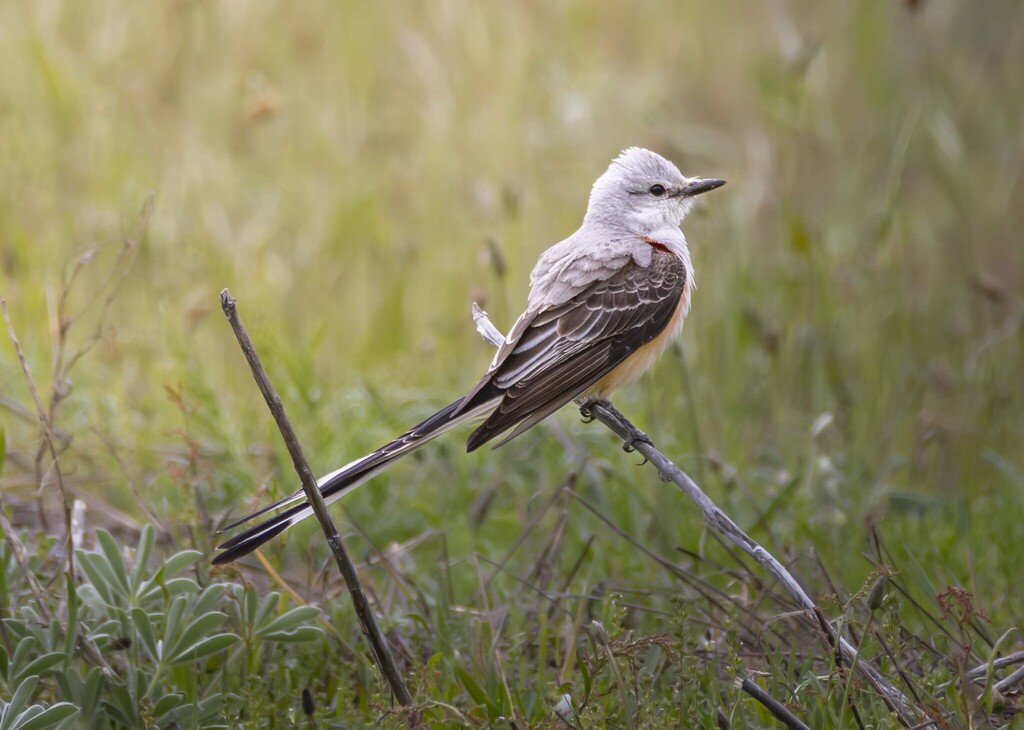
(c) Brooke J., some rights reserved (CC BY) · licence
Family: Tyrannidae · Class: Aves · Order: Passeriformes
Tyrannus forficatus (Scissor-tailed Flycatcher) is a California animal in the Tyrannidae family.
The Scissor-tailed Flycatcher is a medium-sized passerine bird measuring 20 to 38 centimeters (8 to 15 inches) in total length, with the dramatic tail accounting for much of this measurement. Adults weigh 32 to 53 grams (1.1 to 1.9 ounces). Males display pale gray heads and backs, white underparts with salmon-pink sides and underwing coverings, and black wings with white edges. The species' most distinctive feature is its deeply forked tail with extremely long outer feathers that can exceed the body length. Females are similar but have shorter tails and less vibrant coloration. Juveniles show brownish plumage with much shorter tails. The Scissor-tailed Flycatcher breeds primarily in the south-central United States, with its core range extending from Texas north through Oklahoma and Kansas into southern Nebraska. The species occurs as a vagrant and occasional breeder in California, with records concentrated in the Central Valley and desert regions. Most California observations occur during spring and fall migration periods, typically from April through May and August through October. The species has been documented in scattered counties including Kern, Imperial, Riverside, and San Bernardino. During the breeding season, Scissor-tailed Flycatchers inhabit open country with scattered trees, including grasslands, agricultural areas, golf courses, and suburban areas with adequate perching sites. They prefer areas with a mosaic of open ground for foraging and trees or tall structures for nesting and roosting. In California, vagrants are typically found in similar open habitats, particularly areas with power lines, fence posts, and isolated trees that provide suitable perches. Scissor-tailed Flycatchers are aerial insectivores that hunt from prominent perches, making sallying flights to capture flying insects including beetles, flies, moths, grasshoppers, and flying ants. They also occasionally consume small fruits and berries. The species exhibits elaborate aerial courtship displays, with males performing complex aerial courtship flights that showcase their elongated tails. Nesting occurs from April through July, with females constructing cup-shaped nests in tree forks or on horizontal branches 3 to 9 meters (10 to 30 feet) above ground. Clutches typically contain 3 to 6 eggs, with an incubation period of 14 to 17 days. Young fledge after 15 to 16 days but remain dependent on parents for several additional weeks. The Scissor-tailed Flycatcher is not federally or state listed and maintains stable populations across its primary range. According to the North American Breeding Bird Survey, populations have remained relatively stable since 1970, with some evidence of range expansion northward and westward. Climate change may facilitate continued range expansion as suitable habitat becomes available in previously marginal areas. The species' occurrence in California remains irregular and primarily involves transient individuals, though occasional breeding attempts have been documented in the southeastern desert regions.
Classification
Class: Aves · Order: Passeriformes · Family: Tyrannidae
Frequently asked questions
How is Tyrannus forficatus classified?
Tyrannus forficatus belongs to class Aves, order Passeriformes, family Tyrannidae.
What family does Tyrannus forficatus belong to?
Tyrannus forficatus is in the Tyrannidae family.
What is Tyrannus forficatus?
The Scissor-tailed Flycatcher is a medium-sized passerine bird measuring 20 to 38 centimeters (8 to 15 inches) in total length, with the dramatic tail accounting for much of this measurement.
Is Tyrannus forficatus found in California?
Yes. Tyrannus forficatus is recorded in California in The California Species Project's catalogue.
Related species
Other California species in the same genus, family, or bioregion.
Data from The California Species Project — 14,000+ California species with verified data from CNPS, CDFW, USFWS, and more.