Tyrannus savana
Fork-tailed Flycatcher
no rights reserved · CC0
Family: Tyrannidae · Class: Aves · Order: Passeriformes
Tyrannus savana (Fork-tailed Flycatcher) is a California animal in the Tyrannidae family.
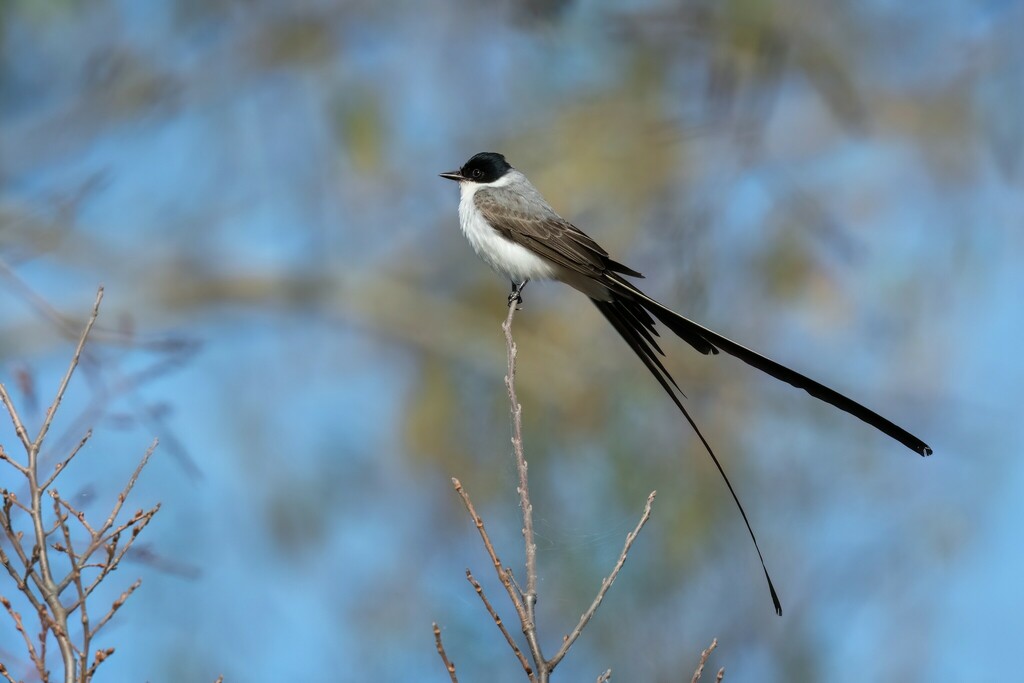
The Fork-tailed Flycatcher is a large, distinctive tyrant flycatcher measuring 37-41 cm (14.5-16 inches) in total length, with males significantly larger than females due to their extremely long, deeply forked tail streamers. Adult males possess black caps extending from the forehead to the nape, contrasting sharply with white underparts and gray backs. The tail comprises two elongated outer rectrices that can extend up to 25 cm (10 inches) beyond the body, creating the species' characteristic silhouette. Females and juveniles display shorter tails and more subdued coloration, with brownish caps and less pronounced tail forking. This Neotropical species breeds primarily in open grasslands, savannas, and agricultural areas from southern Mexico through South America to northern Argentina. The Fork-tailed Flycatcher undertakes one of the longest migrations among tyrant flycatchers, with northern populations traveling to wintering grounds in South America. In North America, the species occurs as a rare vagrant, with documented records scattered across the United States, including California. Most North American observations involve individuals that have strayed from regular migration routes, typically appearing during fall migration from August through November. Fork-tailed Flycatchers inhabit open country with scattered trees, fence posts, or other elevated perches. They favor grasslands, agricultural fields, pastures, and prairie edges where insect prey is abundant. The species typically forages at heights of 2-15 meters above ground, requiring both open hunting areas and suitable perching sites. During migration, individuals may appear in atypical habitats including urban parks, coastal scrub, and desert oases. These aerial insectivores employ sit-and-wait hunting tactics, sallying from exposed perches to capture flying insects including beetles, flies, moths, and flying ants. Their long tail streamers aid in aerial maneuverability during pursuit flights. Breeding occurs from March through August in their primary range, with pairs constructing cup-shaped nests of twigs and grass in tree forks 3-8 meters above ground. Females typically lay 2-4 creamy white eggs marked with brown spots. Males perform elaborate courtship displays featuring acrobatic flights that showcase their elongated tail feathers. The Fork-tailed Flycatcher is not federally listed and maintains stable populations throughout most of its range, classified as Least Concern by the International Union for Conservation of Nature. However, habitat conversion of native grasslands to intensive agriculture poses localized threats in some regions. In California, the species remains an extremely rare vagrant with fewer than 20 documented records since 1900, according to eBird and various ornithological sources. Most California sightings occur along the coast during fall migration, with records from Monterey, San Luis Obispo, and Los Angeles counties. Climate change may potentially alter migration patterns and vagrancy frequency, though long-term impacts remain unclear.
Classification
Class: Aves · Order: Passeriformes · Family: Tyrannidae
Frequently asked questions
How is Tyrannus savana classified?
Tyrannus savana belongs to class Aves, order Passeriformes, family Tyrannidae.
What family does Tyrannus savana belong to?
Tyrannus savana is in the Tyrannidae family.
What is Tyrannus savana?
The Fork-tailed Flycatcher is a large, distinctive tyrant flycatcher measuring 37-41 cm (14.5-16 inches) in total length, with males significantly larger than females due to their extremely long, deeply forked tail streamers.
Is Tyrannus savana found in California?
Yes. Tyrannus savana is recorded in California in The California Species Project's catalogue.
Related species
Other California species in the same genus, family, or bioregion.
Data from The California Species Project — 14,000+ California species with verified data from CNPS, CDFW, USFWS, and more.