Tyrannus vociferans
Cassin's Kingbird
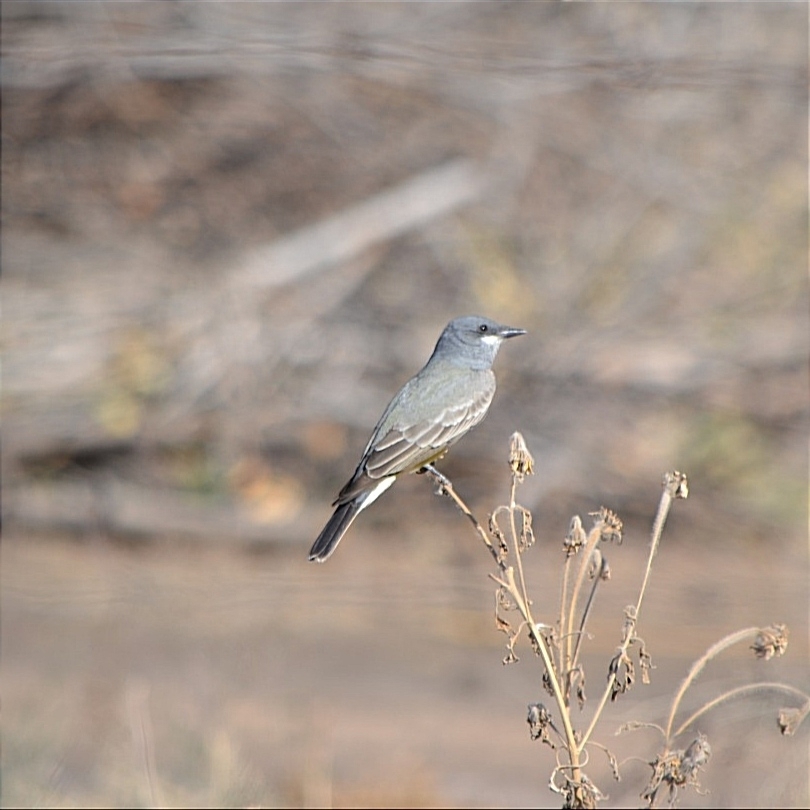
(c) Mauricio Calderón, some rights reserved (CC BY) · licence
Family: Tyrannidae · Class: Aves · Order: Passeriformes
Tyrannus vociferans (Cassin's Kingbird) is a California animal in the Tyrannidae family.
Cassin's Kingbird is a medium-sized flycatcher measuring 20 to 24 cm (8 to 9.5 inches) in length with a wingspan of 39 to 41 cm (15 to 16 inches). Adults weigh 42 to 56 grams. The upperparts are dark olive-gray, while the underparts are pale yellow. The head displays a distinctive dark gray cap with a concealed orange-red crown patch visible when the bird is excited or displaying. A white throat contrasts with the darker head coloration. The tail is dark with white outer edges, most visible during flight. The bill is black and relatively broad at the base, typical of aerial insectivores. Cassin's Kingbird breeds throughout much of California, from sea level to approximately 2,400 meters (8,000 feet) elevation. The species ranges from Humboldt and Shasta counties south through the Central Valley, coastal ranges, and Sierra Nevada foothills to the Mexican border. During winter, most California populations migrate south to Mexico and Central America, though some individuals may remain in southern California coastal areas and the Colorado River valley. The species inhabits open woodlands, riparian corridors, oak savannas, and semi-arid scrublands. Cassin's Kingbirds show strong preference for areas with scattered tall trees for nesting and perching, combined with open spaces for foraging. They commonly occur in agricultural areas with remnant trees, suburban parks, and desert oases. The species adapts well to human-modified landscapes provided suitable nest sites remain available. Cassin's Kingbirds are aerial insectivores that hunt from exposed perches, making short flights to capture flying insects before returning to the same or nearby perch. Their diet consists primarily of flying ants, wasps, bees, beetles, flies, and moths. During late summer and fall, they supplement their diet with berries and small fruits. The species is highly territorial during breeding season, with pairs defending areas of 2 to 5 hectares. Males perform courtship displays involving steep climbs followed by tumbling flights while calling loudly. Breeding occurs from April through July. Females construct cup-shaped nests 4 to 15 meters high in tree forks or on horizontal branches, using twigs, plant fibers, and feathers. Clutch size ranges from 2 to 4 eggs, with an average of 3. Incubation lasts 12 to 14 days, performed exclusively by the female. Both parents feed nestlings, which fledge after 14 to 17 days. The species typically produces one brood per year. Cassin's Kingbird is not federally or state listed and maintains stable populations across most of its California range. The species benefits from fire suppression that maintains open woodland structure, though it faces localized declines from habitat conversion and intensive agricultural practices. Climate change may affect the timing of insect emergence relative to breeding cycles. Urban development poses threats in some areas, but the species shows adaptability to suburban environments with appropriate habitat management.
Classification
Class: Aves · Order: Passeriformes · Family: Tyrannidae
Frequently asked questions
How is Tyrannus vociferans classified?
Tyrannus vociferans belongs to class Aves, order Passeriformes, family Tyrannidae.
What family does Tyrannus vociferans belong to?
Tyrannus vociferans is in the Tyrannidae family.
What is Tyrannus vociferans?
Cassin's Kingbird is a medium-sized flycatcher measuring 20 to 24 cm (8 to 9.5 inches) in length with a wingspan of 39 to 41 cm (15 to 16 inches).
Is Tyrannus vociferans found in California?
Yes. Tyrannus vociferans is recorded in California in The California Species Project's catalogue.
Related species
Other California species in the same genus, family, or bioregion.
Data from The California Species Project — 14,000+ California species with verified data from CNPS, CDFW, USFWS, and more.