Tyria jacobaeae
Cinnabar Moth
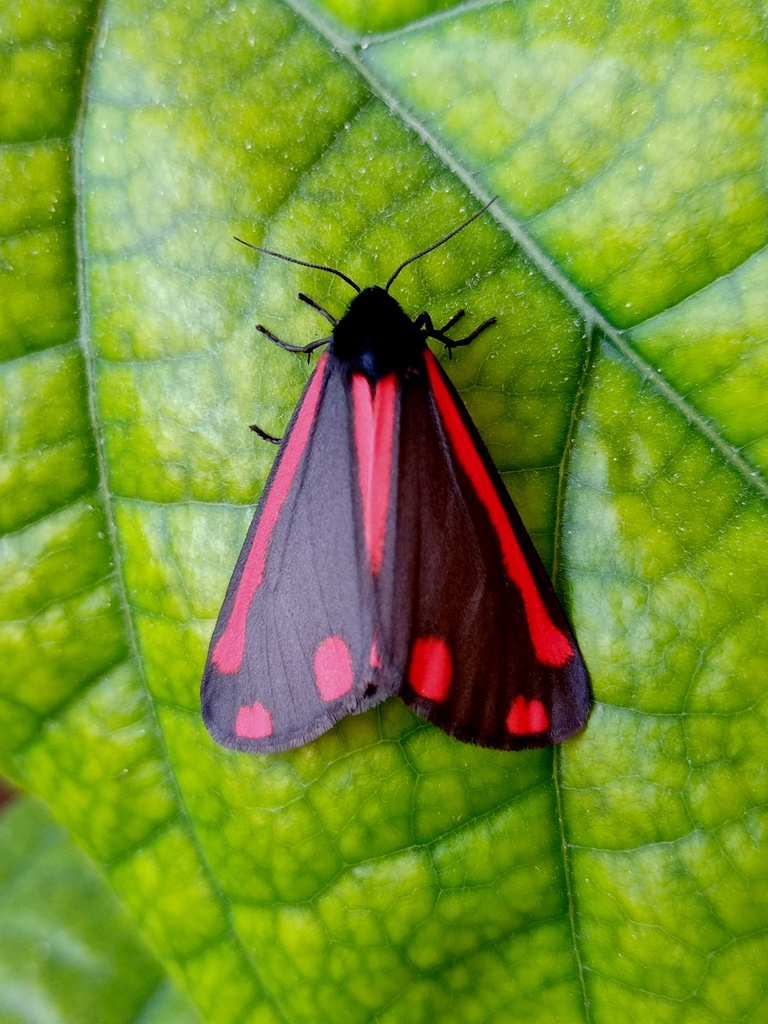
(c) mnauky, some rights reserved (CC BY) · licence
Family: Erebidae · Class: Insecta · Order: Lepidoptera
Tyria jacobaeae (Cinnabar Moth) is a California animal in the Erebidae family.
The Cinnabar Moth (Tyria jacobaeae) is a distinctive day-flying moth in the family Erebidae, originally native to Europe but introduced to North America as a biological control agent. Adults measure 15-20 mm (0.6-0.8 inches) in length with a wingspan of 32-42 mm (1.3-1.7 inches). The forewings are dark gray to black with two bright red stripes and red spots along the margins. The hindwings are entirely red with narrow black borders. This striking coloration serves as aposematic warning to predators of the moth's toxicity. The body is black with a red collar behind the head. Native to Europe, the Cinnabar Moth was deliberately introduced to North America beginning in 1959 as part of biological control programs targeting tansy ragwort. In California, established populations occur along the coastal regions from Mendocino County south to Monterey County, with additional populations in the Central Valley. The species has also established in Oregon, Washington, and parts of the northeastern United States. Populations typically occur below 1,500 meters (4,900 feet) elevation. Cinnabar Moths inhabit areas where their host plant, tansy ragwort (Senecio jacobaea), is present. This includes coastal grasslands, disturbed areas, roadsides, pastures, and agricultural margins. The species prefers open habitats with moderate moisture and is most common in Mediterranean climates similar to its European origin. Adults are active during daylight hours, unlike most moths, and can be observed flying slowly among vegetation from May through August. The species exhibits a specialized relationship with tansy ragwort, which serves as the sole host plant for larval development. Adult females lay clusters of 30-60 eggs on the underside of ragwort leaves in late spring and early summer. The distinctive black and yellow striped larvae, measuring up to 30 mm (1.2 inches) when mature, feed exclusively on ragwort foliage, flowers, and stems. Larvae sequester pyrrolizidine alkaloids from their host plant, making both caterpillars and adults toxic to vertebrate predators. The species completes one generation per year in most areas, with larvae pupating in the soil during late summer and emerging as adults the following spring. Winter is spent in the pupal stage. As an introduced species, the Cinnabar Moth is not listed under federal or state conservation legislation. The moth was intentionally released as a classical biological control agent and continues to fulfill this role in managing tansy ragwort populations. In some areas, the moth has proven highly effective, reducing ragwort densities by 90% or more according to biological control studies. However, population levels fluctuate with host plant availability and weather conditions. The species faces no significant conservation threats and maintains stable populations throughout its introduced range. Climate change may potentially expand suitable habitat northward, though the moth's distribution remains primarily limited by host plant occurrence.
Classification
Class: Insecta · Order: Lepidoptera · Family: Erebidae
Frequently asked questions
How is Tyria jacobaeae classified?
Tyria jacobaeae belongs to class Insecta, order Lepidoptera, family Erebidae.
What family does Tyria jacobaeae belong to?
Tyria jacobaeae is in the Erebidae family.
What is Tyria jacobaeae?
The Cinnabar Moth (Tyria jacobaeae) is a distinctive day-flying moth in the family Erebidae, originally native to Europe but introduced to North America as a biological control agent.
Is Tyria jacobaeae found in California?
Yes. Tyria jacobaeae is recorded in California in The California Species Project's catalogue.
Related species
Other California species in the same genus, family, or bioregion.
Data from The California Species Project — 14,000+ California species with verified data from CNPS, CDFW, USFWS, and more.