Tyto alba
Barn Owl
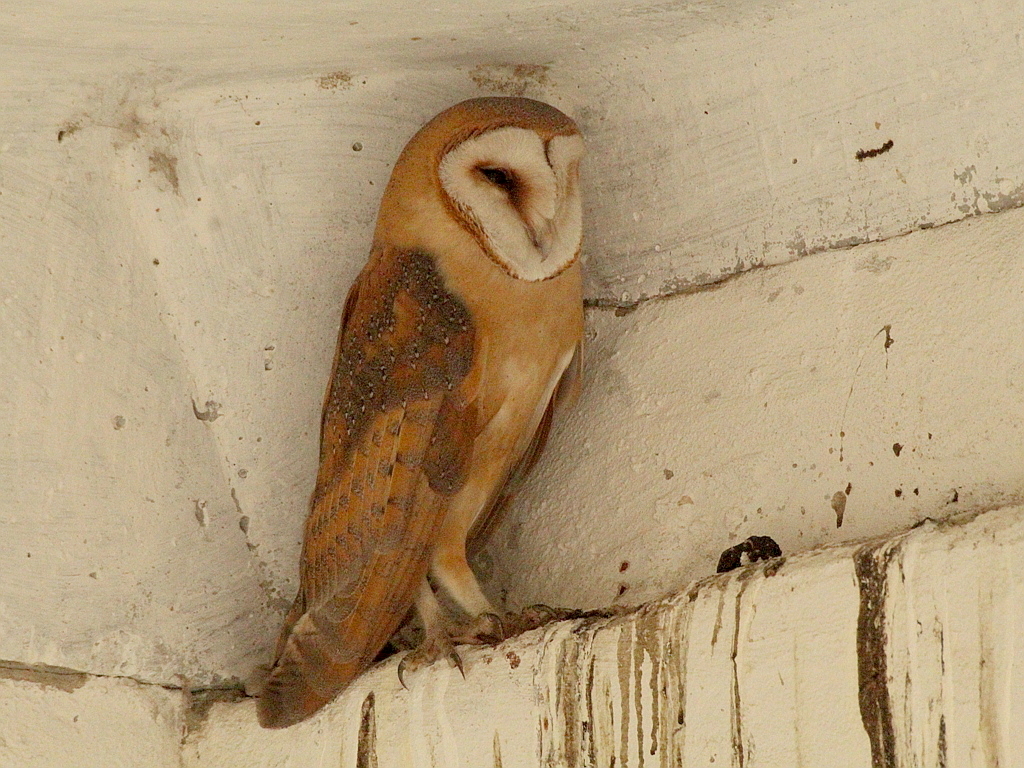
(c) Andrew Bazdyrev, some rights reserved (CC BY) · licence
Family: Tytonidae · Class: Aves · Order: Strigiformes
Tyto alba (Barn Owl) is a California animal in the Tytonidae family.
The Barn Owl is a medium-sized raptor with distinctive pale plumage and a heart-shaped facial disc. Adults measure 32 to 40 cm (12.6 to 15.7 inches) in length with a wingspan of 80 to 95 cm (31.5 to 37.4 inches). Males typically weigh 310 to 460 grams, while females are larger at 430 to 680 grams. The upperparts are golden-buff to tawny brown with fine gray vermiculation and small white spots. The underparts range from pure white to buff, often with small dark spots. The facial disc is white to pale buff, bordered by a narrow dark line. The eyes are dark brown to black, and the bill is pale yellow to white. Barn Owls occur throughout California except in high mountain areas and dense forests. The species has a nearly cosmopolitan distribution, found on all continents except Antarctica. In California, they inhabit areas from sea level to approximately 2,400 meters (7,900 feet) elevation, though they are most common below 1,200 meters (3,900 feet). Populations are resident year-round, though some seasonal movement occurs in response to prey availability. The species occupies diverse open and semi-open habitats including agricultural areas, grasslands, prairies, deserts, wetland edges, and suburban environments. Barn Owls require suitable nesting sites such as tree cavities, cliff crevices, abandoned buildings, nest boxes, or other structures that provide shelter and protection. They typically hunt over open areas with low vegetation where small mammals are accessible. Barn Owls are primarily nocturnal hunters, using exceptional hearing to locate prey in complete darkness. Their asymmetrically positioned ears allow precise triangulation of sounds. The diet consists almost exclusively of small mammals, particularly rodents such as voles, mice, rats, and shrews. A single owl may consume over 1,000 rodents per year. Breeding typically occurs from February through October in California, with peak activity from April through August. Females lay 3 to 11 white eggs, with clutch size varying based on prey abundance. Incubation lasts 29 to 34 days, and young fledge at 50 to 70 days old. Pairs may produce multiple broods per year when conditions are favorable. Barn Owls have no special conservation status in California and are considered stable statewide. However, local populations may be affected by habitat loss from agricultural intensification and urban development. The species benefits from nest box programs and agricultural practices that maintain suitable hunting habitat and nesting opportunities. Rodenticide use poses a significant threat, as owls may be poisoned through consumption of contaminated prey. Climate change may affect prey availability and breeding success in some regions, though the species' adaptability and broad habitat tolerance provide resilience against environmental changes.
Classification
Class: Aves · Order: Strigiformes · Family: Tytonidae
Frequently asked questions
How is Tyto alba classified?
Tyto alba belongs to class Aves, order Strigiformes, family Tytonidae.
What family does Tyto alba belong to?
Tyto alba is in the Tytonidae family.
What is Tyto alba?
The Barn Owl is a medium-sized raptor with distinctive pale plumage and a heart-shaped facial disc.
Is Tyto alba found in California?
Yes. Tyto alba is recorded in California in The California Species Project's catalogue.
Related species
Other California species in the same genus, family, or bioregion.
Data from The California Species Project — 14,000+ California species with verified data from CNPS, CDFW, USFWS, and more.