Tyto furcata
American Barn Owl
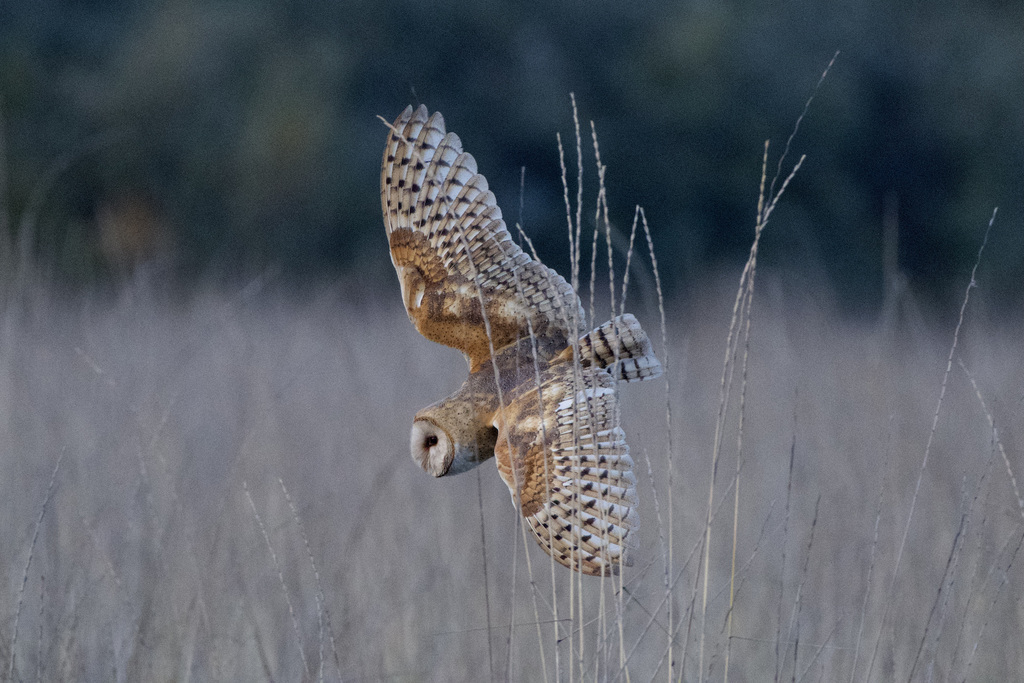
no rights reserved · CC0
Family: Tytonidae · Class: Aves · Order: Strigiformes
Tyto furcata (American Barn Owl) is a California animal in the Tytonidae family.
The American Barn Owl is a medium-sized owl measuring 32-40 cm (12.6-15.7 inches) in length with a wingspan of 80-95 cm (31.5-37.4 inches). The species displays distinctive facial features including a heart-shaped white facial disc bordered by brown, and dark eyes set within the disc. The upperparts are golden-brown with gray mottling and white spotting, while the underparts range from white to buff with variable dark spotting. Sexual dimorphism is evident, with females typically larger and more heavily spotted than males. In California, the American Barn Owl occurs throughout the state in lowlands and lightly forested foothills, being fairly common in the lower Colorado River valley and Central Valley regions (Birds of the World). The species has adapted to both natural and human-modified landscapes across elevational gradients from sea level to approximately 4,000 meters in suitable habitat. The species inhabits open grasslands, agricultural areas, woodland edges, and suburban environments where suitable foraging and nesting sites are available. Barn owls require a combination of open hunting areas for prey capture and cavity sites for nesting and roosting. They utilize both natural cavities in trees, cliffs, and caves, as well as human-made structures including barn lofts, church steeples, haystacks, and nest boxes (Birds of the World). The availability of suitable foraging habitat can be limited by lack of appropriate nesting sites. American Barn Owls are strictly nocturnal hunters with exceptional adaptations for low-light conditions. The species has evolved highly specialized hearing capabilities and excellent low-light vision, with sound-location accuracy among the most precise of any animal tested (Birds of the World). Their diet consists primarily of small mammals, particularly rodents such as voles, mice, and rats. Hunting occurs over open areas using a slow, methodical flight pattern approximately 1-4 meters above ground. Breeding behavior includes the formation of monogamous pairs, though polygyny may occur when prey is abundant. Females lay 3-11 white eggs in clutches, with incubation lasting approximately 30-34 days. The species can produce multiple broods per year when conditions are favorable, with breeding activity often correlated with prey abundance cycles. The American Barn Owl is considered a migratory nongame bird of management concern by the Office of Migratory Bird Management (NatureServe). While not federally listed, populations face pressures from habitat conversion, particularly the loss of grassland and agricultural areas suitable for foraging. The species benefits from nest box programs and conservation of mixed agricultural landscapes that provide both hunting areas and nesting opportunities. Climate change and intensification of agricultural practices present ongoing challenges to population stability.
Classification
Class: Aves · Order: Strigiformes · Family: Tytonidae
Frequently asked questions
How is Tyto furcata classified?
Tyto furcata belongs to class Aves, order Strigiformes, family Tytonidae.
What family does Tyto furcata belong to?
Tyto furcata is in the Tytonidae family.
What is Tyto furcata?
The American Barn Owl is a medium-sized owl measuring 32-40 cm (12.6-15.7 inches) in length with a wingspan of 80-95 cm (31.5-37.4 inches).
Is Tyto furcata found in California?
Yes. Tyto furcata is recorded in California in The California Species Project's catalogue.
Related species
Other California species in the same genus, family, or bioregion.
Data from The California Species Project — 14,000+ California species with verified data from CNPS, CDFW, USFWS, and more.