Udea rubigalis
Celery Leaftier Moth
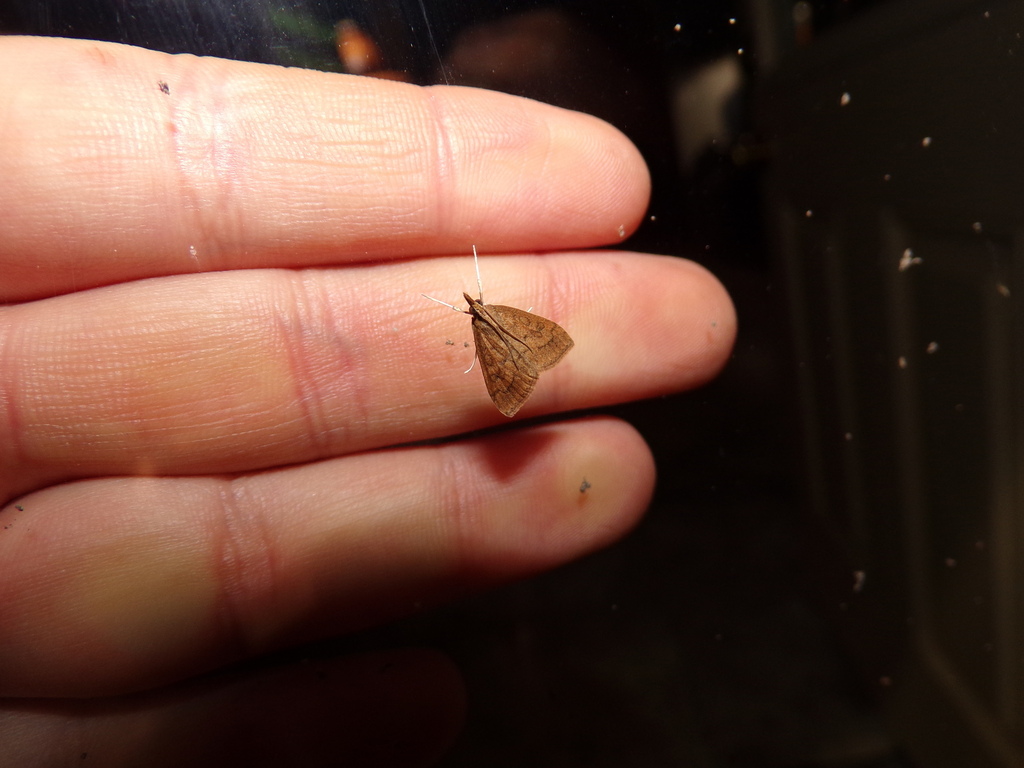
(c) Texas Bird Family, some rights reserved (CC BY) · licence
Family: Crambidae · Class: Insecta · Order: Lepidoptera
Udea rubigalis (Celery Leaftier Moth) is a California animal in the Crambidae family.
The Celery Leaftier Moth (Udea rubigalis) is a small pyralid moth in the family Crambidae. Adults have a wingspan of approximately 18-22 mm (0.7-0.9 inches). The forewings are pale yellowish-brown to tan with darker brown markings, including a characteristic zigzag pattern across the wing and distinct postmedial and antemedial lines. The hindwings are lighter, typically whitish to pale yellow with a faint brownish border. The thorax matches the forewing coloration, while the abdomen is pale yellow to cream-colored. This species has a broad distribution across North America, ranging from southern Canada through the United States to northern Mexico. In California, Udea rubigalis occurs throughout much of the state, from coastal areas to inland valleys and foothills. The species has been documented in agricultural regions where suitable host plants are cultivated, as well as in natural areas where wild members of the Apiaceae family grow. The Celery Leaftier Moth inhabits diverse environments including agricultural fields, gardens, riparian areas, and disturbed habitats. Adults are commonly found in areas supporting umbellifer plants, particularly where celery, parsley, dill, fennel, and related crops are grown. The species adapts to elevations from sea level to approximately 1,500 meters (4,900 feet), though it is most abundant in lowland agricultural zones and coastal plains. Larvae are the economically significant life stage, feeding on plants in the carrot family (Apiaceae). Primary host plants include cultivated celery (Apium graveolens), parsley (Petroselinum crispum), dill (Anethum graveolens), and fennel (Foeniculum vulgare). Caterpillars create characteristic feeding damage by folding or tying leaves together with silk webbing, feeding within these protective shelters. This behavior gives the species its common name. The larvae are pale green to yellowish-green with darker head capsules and measure 15-20 mm (0.6-0.8 inches) when fully grown. Adults are nocturnal and attracted to artificial lights. The species is multivoltine in warmer climates, producing multiple generations per year. In California's mild climate, breeding may occur continuously with overlapping generations. Udea rubigalis is not listed under state or federal endangered species legislation and maintains stable populations across its range. As an agricultural pest species, it faces regular management through integrated pest control programs in commercial farming operations. The moth benefits from widespread cultivation of host plants and appears well-adapted to human-modified landscapes. Climate change may potentially expand its range northward and extend breeding seasons in cooler regions. Population monitoring occurs primarily through agricultural pest surveys rather than conservation assessments, as the species' pest status ensures regular documentation of its presence and abundance in farming areas.
Classification
Class: Insecta · Order: Lepidoptera · Family: Crambidae
Frequently asked questions
How is Udea rubigalis classified?
Udea rubigalis belongs to class Insecta, order Lepidoptera, family Crambidae.
What family does Udea rubigalis belong to?
Udea rubigalis is in the Crambidae family.
What is Udea rubigalis?
The Celery Leaftier Moth (Udea rubigalis) is a small pyralid moth in the family Crambidae.
Is Udea rubigalis found in California?
Yes. Udea rubigalis is recorded in California in The California Species Project's catalogue.
Related species
Other California species in the same genus, family, or bioregion.
Data from The California Species Project — 14,000+ California species with verified data from CNPS, CDFW, USFWS, and more.