Udea washingtonalis
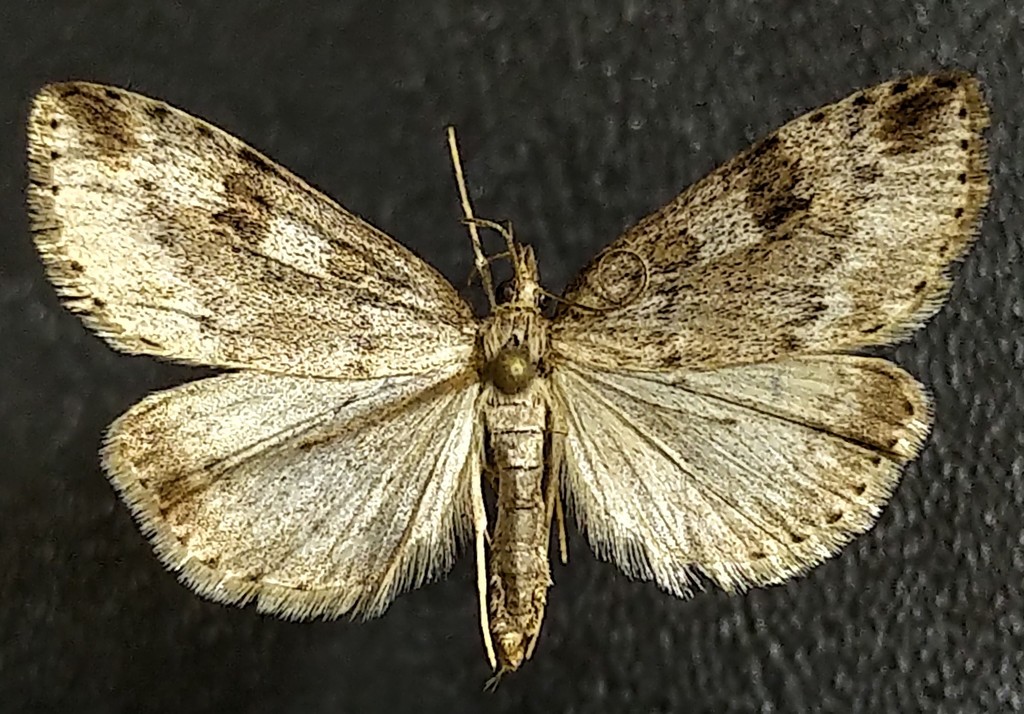
(c) Doug Macaulay, some rights reserved (CC BY) · licence
Family: Crambidae · Class: Insecta · Order: Lepidoptera
Udea washingtonalis is a California animal in the Crambidae family.
Udea washingtonalis is a small moth in the family Crambidae, subfamily Spilomelinae. Adults have a wingspan of 19 to 28 mm, varying by subspecies (BugGuide.Net). The forewings are white with a distinctive dark brown band extending from the middle of the costa halfway to the inner margin. The anteromedial and postmedial lines are broken or indistinct, and black spots occur along the outer margin and distal half of the costa. The median area shows pale yellowish shading, while the hindwings are white with a diffuse yellowish terminal band (BugGuide.Net). This species demonstrates considerable geographic variation across four recognized subspecies: U. w. washingtonalis (the nominate form), U. w. hollandi, U. w. nomensis, and U. w. pribilofensis (BugGuide.Net). The species was originally described by Grote in 1882 and is catalogued as Hodges number 5081 in the standard North American moth classification system. Udea washingtonalis has a broad distribution across northern North America, extending from the Pacific Northwest through boreal regions. The species occurs in various habitats including forest edges, meadows, and disturbed areas where its host plants are present. Different subspecies occupy distinct geographic ranges, with some adapted to specific regional conditions including arctic and subarctic environments. Adults are typically active during summer months, when they can be attracted to artificial lights. Like other members of the genus Udea, this species likely has a univoltine life cycle in most of its range, though specific details of its biology remain poorly documented. The larvae are presumed to feed on various herbaceous plants, following the general feeding patterns observed in related Udea species, though specific host plant relationships for U. washingtonalis have not been thoroughly studied. The moth belongs to the tribe Udeini within the diverse subfamily Spilomelinae, which includes numerous grass moths and related species. This taxonomic placement reflects evolutionary relationships with other small crambid moths that share similar morphological and ecological characteristics. No formal conservation assessment has been conducted for Udea washingtonalis, and it does not appear on federal or state endangered species lists. The species' conservation status remains largely unassessed due to limited research on population trends and distribution patterns. However, its broad geographic range and presence across multiple habitat types suggest it may be relatively stable compared to more specialized moth species. Like many lepidopteran species, populations may face localized pressures from habitat modification and climate change effects on northern ecosystems, but comprehensive monitoring data are lacking. Additional research is needed to better understand the species' ecology, population dynamics, and conservation needs across its range.
Classification
Class: Insecta · Order: Lepidoptera · Family: Crambidae
Frequently asked questions
How is Udea washingtonalis classified?
Udea washingtonalis belongs to class Insecta, order Lepidoptera, family Crambidae.
What family does Udea washingtonalis belong to?
Udea washingtonalis is in the Crambidae family.
What is Udea washingtonalis?
Udea washingtonalis is a small moth in the family Crambidae, subfamily Spilomelinae.
Is Udea washingtonalis found in California?
Yes. Udea washingtonalis is recorded in California in The California Species Project's catalogue.
Related species
Other California species in the same genus, family, or bioregion.
Data from The California Species Project — 14,000+ California species with verified data from CNPS, CDFW, USFWS, and more.